
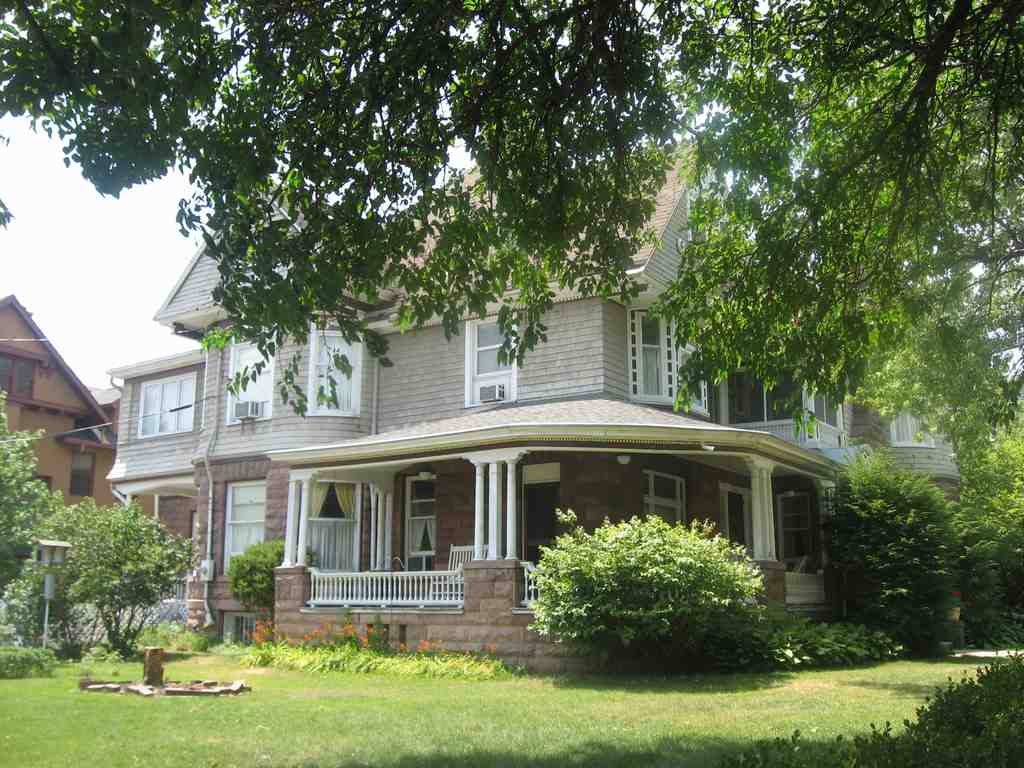
On your right, look for a tall Queen Anne house with a sandstone ground floor, wood-shingled upper walls, and a round corner tower capped by a pointed conical roof.
This is the Morey-Lampert House, one of the earliest large mansions in South Bend, and still one of its most memorable. Queen Anne architecture delights in variety rather than neat symmetry, so the house gives you textures, angles, a porch that wraps around, and that tower rising at the corner like a small flourish of theatre. A fuller view on your screen pulls the whole composition together.
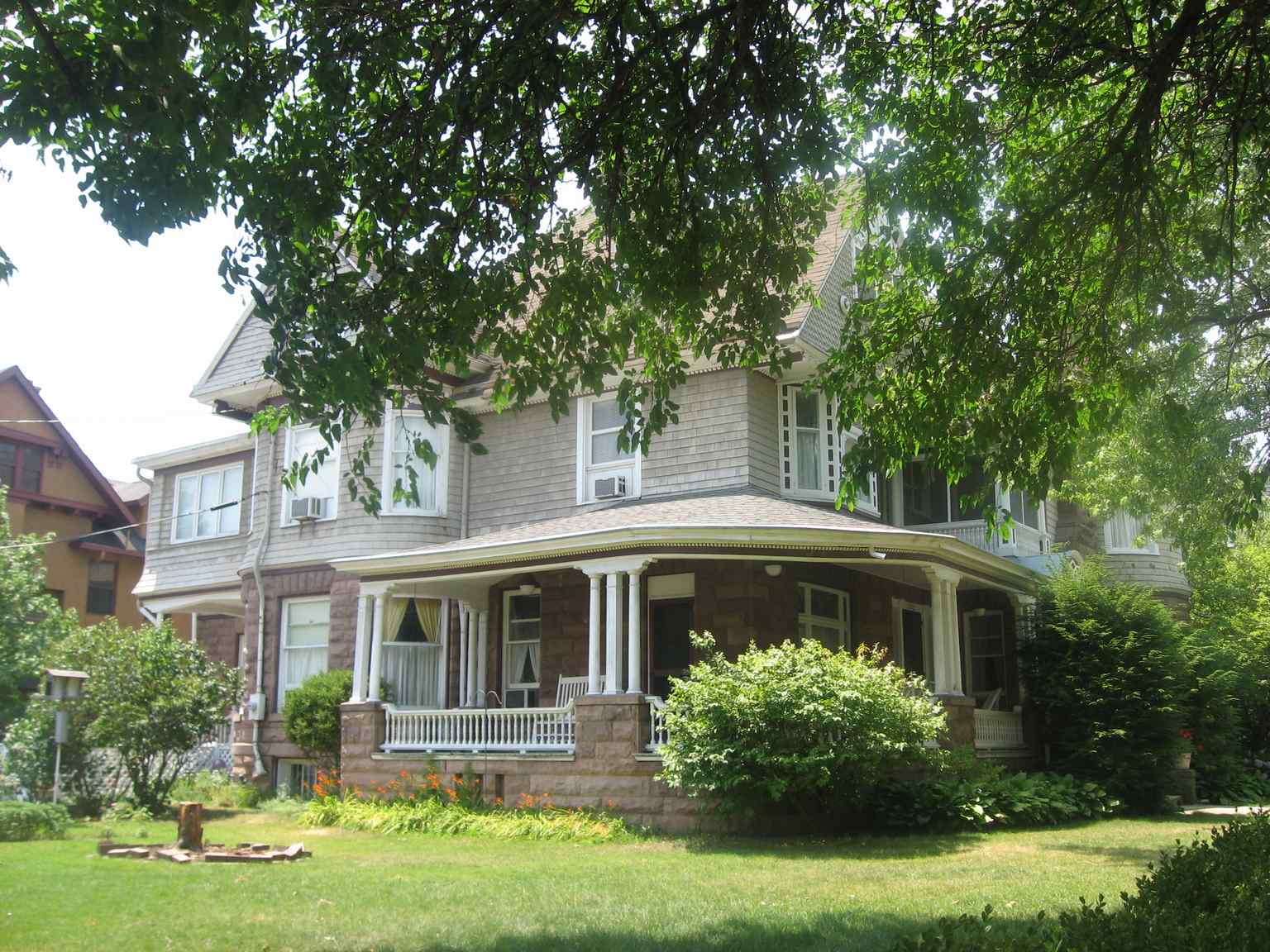
Doctor George P Morey and his wife, Frances Helen Rose Morey, chose this very plot with care. Frances descended from the Rose family, who had held the land since eighteen fifty-one, so when Morey raised this lavish home here between eighteen ninety-four and eighteen ninety-six, he was doing more than building a mansion. He was honoring his wife's family story.
There is, however, a sadness bound tightly into the house. Frances Helen Rose Morey died on the thirtieth of July, eighteen ninety-six, after living here only a few months. Their daughter Frances Claire also died young. So this splendid residence, completed at immense expense, became a place touched by grief almost as soon as the family settled in.
Doctor Morey himself had lived a full and public life. Born in western New York in eighteen forty-four, he served as a private in the Union Army during the Civil War and later remained active in Grand Army of the Republic gatherings here in South Bend. He also had a practical eye for investment: behind this mansion, on what is now Franklin Place, he developed the Morey House, an apartment building he rented to local doctors and lawyers.
In nineteen oh eight, he gave this house to his daughter Helene Rose Morey and her new husband, William Keyes Lamport, as a wedding present. Lamport became the first managing editor of the South Bend Tribune, then helped found a major advertising firm whose campaigns eventually reached national audiences, including work for Evinrude Outboard Motors. That firm also supported local culture, helping the South Bend Museum of Art acquire works such as Mildred Fischer's Paris Shutters in nineteen fifty-three.
The house later served as offices and then as a bed and breakfast called the Inn of West Washington, allowing guests to experience its rich interior and carved sandstone porch. One treasure remains inside: a stained glass window that won a medal at the Chicago World's Fair in eighteen ninety-three. Doctor Morey paid two thousand eight hundred dollars for it, roughly seventy-four thousand dollars in two thousand fifteen terms, and placed it on the west wall to catch the light.
Its grandeur survives, but what lingers most is the family devotion that shaped it.
When you're ready, continue on to the South Bend Remedy Company Building.





