
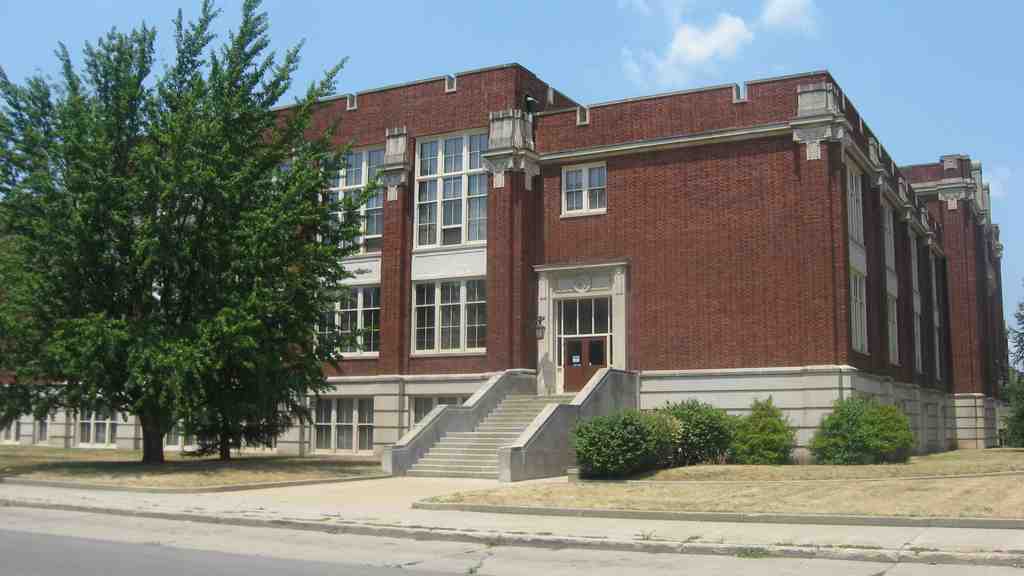
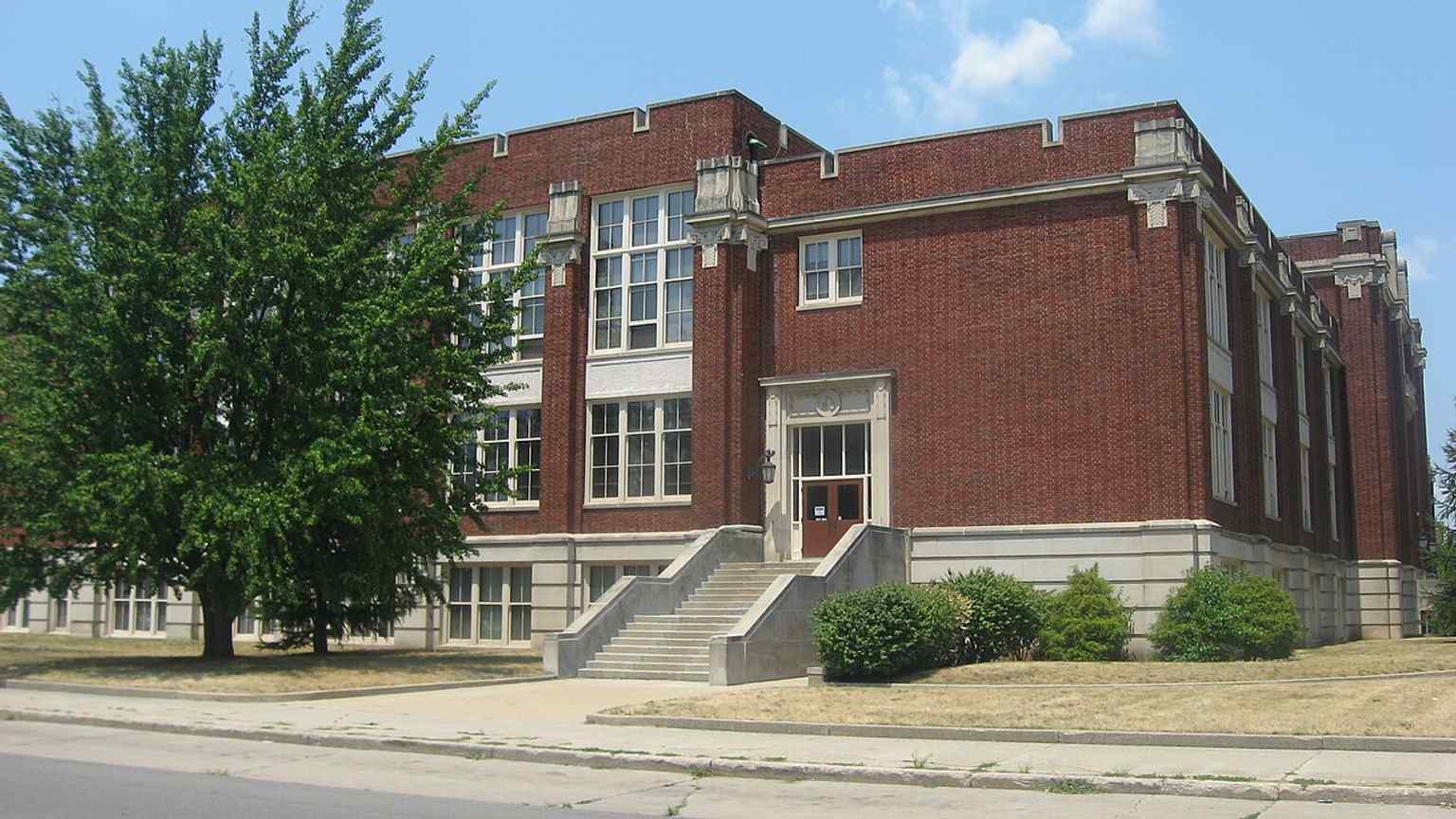
On your right, look for a broad red-brick school building rising two to three stories above a raised foundation, with pale limestone trim and the solid, formal mass of an early twentieth-century civic landmark.
This is Central High School and Boys Vocational School, though the story begins much earlier. South Bend’s first official high school building opened in eighteen seventy-two, and its first graduating class numbered only four students: Charles Henry Bartlett, William Mason Green, Ida Ellsworth, and Lillie Spain. From that modest beginning, Central served as the city’s only high school until nineteen thirteen.
The building in front of you took shape between nineteen eleven and nineteen thirteen. A former vocational building followed behind it around nineteen eighteen, and the school absorbed that structure into the main complex in nineteen twenty-eight. In the app, you can pick out the nineteen eleven Berteling Building, the red-brick core that gave the campus its lasting identity.
By the early nineteen fifties, nearly two thousand students filled these halls. Central earned a reputation for academics, athletics, and something rarer in that era: a more integrated school culture. Graduate Melvin Holmes, class of nineteen fifty-eight, later said that here, “color was secondary.” That is a small sentence with a great deal inside it.
The school also gave girls real athletic opportunity long before Title Nine, the federal law that later required equal access in education and sport. The Girls’ Athletic Association started in nineteen oh-five. Students earned points in field hockey, table tennis, swimming, and volleyball for pins, sweaters, or rings. Water ballet joined the program in nineteen forty-seven, and the girls’ volleyball team did not lose a single match from nineteen forty-eight to nineteen fifty-five.
Then there was John Wooden, long before U-C-L-A made him famous. He coached basketball and baseball here for nine years, ran a tight ship, and when annoyed, reportedly burst out with “My goodness gracious,” which is about as polite as a storm cloud can be. When a few baseball players stopped for ice cream and arrived late, he made the whole team run the bases ten times. Another day, two boys puffed out their cheeks in the spring team photo to mimic tobacco chaws; Wooden gave them a firm scolding, then carried on.
Central closed as a high school in nineteen seventy, later served middle school and adult education, and entered the National Register of Historic Places in nineteen eighty-five. In nineteen ninety-five, developers converted the two hundred and nineteen thousand-square-foot complex into one hundred and six apartments, preserving chalkboards, gym floor lines, and even pool depth markings. The twelve point three million dollar project won multiple preservation awards, which seems only fair for a building that refused to forget what it had been.
If you are curious about the present-day complex, its office keeps weekday hours from nine in the morning to six in the evening and closes on Saturdays and Sundays.
Central’s real achievement was not simply teaching students, but teaching a growing city what it could become. When you are ready, continue on toward the Cathedral of St. James.





