
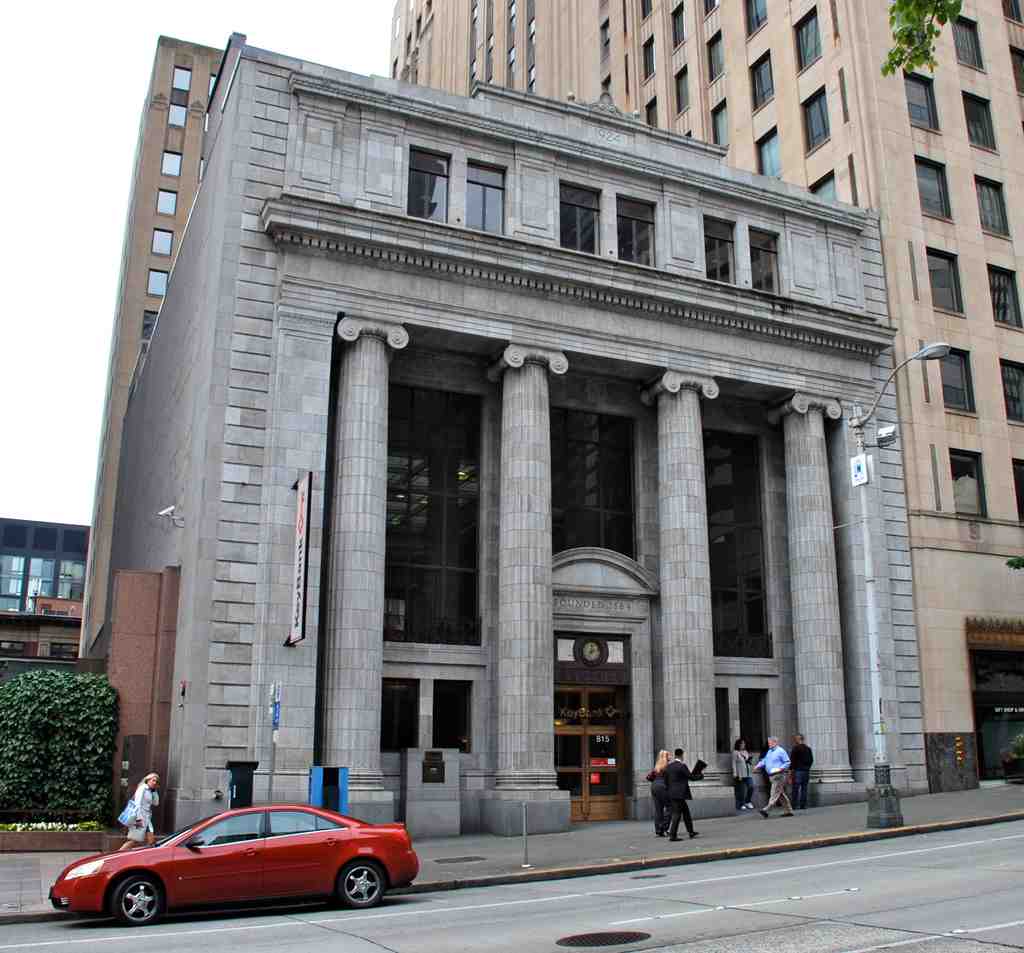
To spot the Bank of California Building, look for a grand, gray stone-clad structure at 815 2nd Avenue, right next to the towering Exchange Building, with four massive Roman-style columns guarding its front and a set of tall windows that seem to invite you into the past.
Alright, take a deep breath, smell that mix of city air and a hint of old marble-because you’re standing in front of one of Seattle’s most stately survivors, the Bank of California Building. Let’s wind the clock back a hundred years: it’s the roaring 1920s, jazz is hot, “talkies” are taking over the movie theaters, and here in Seattle, bankers are dreaming big. The Bank of California, already a west coast banking powerhouse after gobbling up a few rivals, had just decided their tiny old office at 2nd and Columbia wasn’t cutting it anymore. They wanted something bold, something to show off their money-and honestly, who doesn’t want to flex a little in the 1920s?
So, in classic bank style, they bought up the Epler Block just up the street from their old spot, where a four-story building had stood since the ashes cooled after Seattle’s infamous Great Fire. The plan? Tear it down, make something new, something that would scream ‘trust,’ ‘security,’ and-importantly-‘we have a lot of really nice marble inside.’
Fast-forward a bit-by early 1924, after months of noisy demolition, the building’s concrete frame rose quickly. Imagine the city full of horse-drawn wagons, the clang of hammers, the smell of wet cement, and everyone wondering just how grand these bankers were going to go. By August, the doors opened and Seattle saw what “strict Italian Renaissance style” really looked like: a 60-foot facade dressed up in smooth, gray terra cotta, those four showy Ionic columns (let’s be honest-columns this big would make even an ancient Roman emperor jealous), and a beautifully arched pediment that proudly displayed the building’s birthdate.
Don’t just stare at the outside-imagine stepping through those front doors back in 1924. You’d be greeted by a dazzling sunlit bank chamber stretching up 40 feet high, with a semi-octagonal ceiling painted in warm, Mediterranean colors. Bronze torch lights cast a golden glow on polished walnut woodwork, marble counters, and-true story-huge clocks made with fancy imported stone from France. Even the air inside would’ve felt rich (though not in the dollar-bill sense). There were offices on the balconies above, and downstairs, employees had luxurious recreation rooms and vaults stashed away from prying eyes. If you were really lucky (and probably in the right suit), you might’ve gotten invited to the exclusive club room upstairs.
Now, not everything went as planned-you know how construction costs always “slip a little”? Their $200,000 plan ballooned by an extra $50,000, making this place even more precious in bank ledger terms. And here’s a twist that’s a bit funny: at one point, they dreamed up an ultra-modern idea-putting a customer parking garage in the basement. Nobody’s quite sure whether that made the final cut, but hey, it would’ve been the height of luxury for 1920s Seattle drivers.
Time marched on, and by the 1970s, the bank had grown so much they built an even bigger, shinier Union Bank of California Center nearby. Here comes the irony: while their new skyscraper now sells cough drops and energy drinks as a Bartell Drugs, it’s this sturdy, classic 1924 building that’s still operating as a bank today, now under the Key Bank name. Well, that’s what you call good bones! It survived mergers, lawsuits (yes, rival banks were not happy when the Bank of California tried to keep both locations open), and more than a few name changes.
So, as you stand here on the sidewalk, picture the swirling energy of the twenties. Imagine dapper customers striding through those big doors, the echo of their footsteps bouncing off marble floors, the shine of all that bronze and stone. This building has seen Seattle through booms, busts, and everything in between, and it still stands as proud today as it did when couples jitterbugged downtown and bankers dreamed of world domination-one loan at a time. Now, ready to march over to the next Seattle treasure? I promise, fewer columns-maybe more totem poles!




