
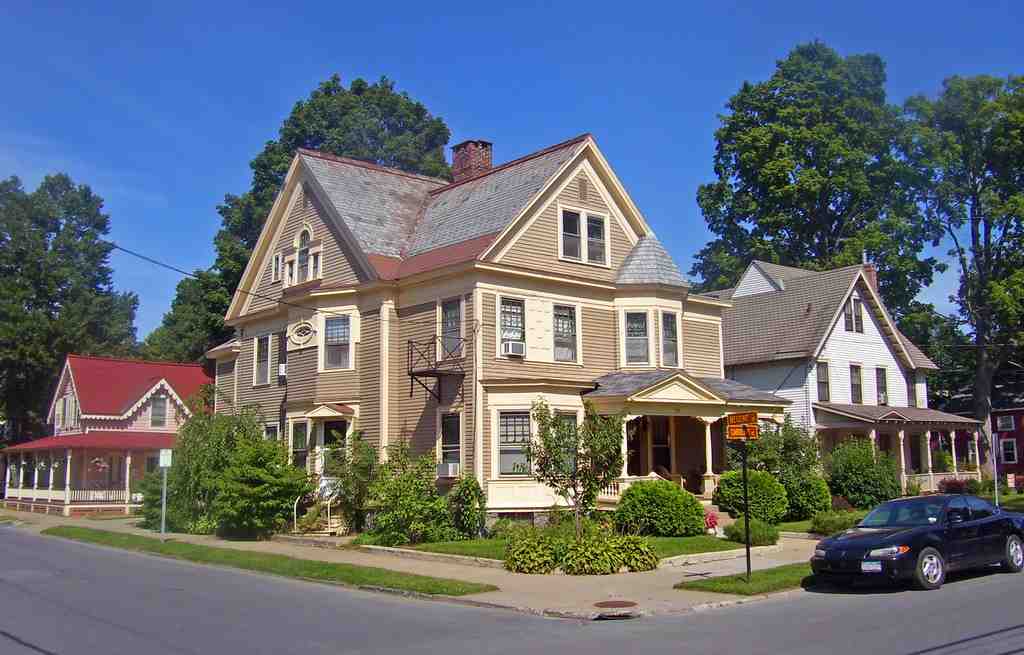
To spot the East Side Historic District, just look for grand old houses with steep gabled roofs, fancy woodwork, and cozy front porches lining both sides of the tree-shaded street ahead of you-right at the intersection of Regent and Caroline Streets.
Welcome to Saratoga Springs’ East Side Historic District-don’t worry, you don’t have to be a millionaire to take a stroll here, but in the 1800s, a thick wallet definitely helped! Imagine yourself here around 1890. The street is alive with elegant horse-drawn carriages trotting past, the clip-clop echoing against beautiful buildings wrapped in crisp white or brick-red clapboard. Ladies in long, swishing skirts and gentlemen with tall hats stroll by, their eyes scanning the grand houses-home to the owners of the city’s most fashionable stores and spas.
Back in those days, Saratoga Springs was one of America’s hottest resort towns-a place where the word “vacation” meant mingling with the country’s glitterati. The wealthiest families of the era flocked here each summer. Of course, if you couldn’t snag a mansion on North Broadway, the East Side was the next best thing. These homes bloom in all sorts of popular 19th and 20th-century styles: Queen Anne, Gothic Revival, and sturdy Bungalows. Picture the ornate R. Newton Brezee House at 119 Caroline Street-the architect’s own pride and joy-with its layered angles and sun-catching windows. Even local architects like Brezee wanted their piece of the East Side story.
The neighborhood is like a living museum, with over 370 historic buildings, and only a handful of more modern oddballs sneaking in. Some might say the vibe here is “old money with a twist of historic drama.” If you follow the winding lines and alleys, you’ll notice the district stretches irregularly, like a patchwork quilt, nearly touching the Saratoga Race Course and wrapping around the edges of Congress Park. Locals will joke that the boundaries are so twisty, you might need breadcrumbs just to get back to where you started! Almost every house has a tale, but the streets themselves, with their narrow lanes and hidden alleyways in a nearly perfect grid, whisper stories all day long.
Speaking of stories, let’s jump to 1902 and meet someone who shook things up: Lucy Skidmore Scribner, who founded the Young Women’s Industrial Club. That tongue-twister soon became the Skidmore School of the Arts and by 1922, Skidmore College. Imagine rooms buzzing with creative energy-future artists and teachers hurrying through the leafy, sunlit campus. The Regent Street Theatre, with its shingled facade, was the first building ever made just for the college, way back in 1903. By 1931, the campus spanned a whopping 34 acres of the East Side, bustling with 82 buildings. When Skidmore moved north in 1976, the echoes of student laughter and theater applause lingered in the old classrooms.
The neighborhood isn’t just about grand houses-it’s also home to institutions that add a dash of local flavor: the old armory on Lake Avenue, the neighborhood church, a fire station, and an elementary school. These buildings, mixed in with homes, create a place where every corner is steeped in history.
Today, you can thank Saratoga Springs’ trusty Design Review Commission for keeping the charm intact. That’s right, any plans for signs or paint jobs here are carefully reviewed. The same way a strict grandmother keeps a family portrait just right, Saratoga’s seven-member commission preserves every porch column and window frame with pride.
So as you stand here, take a deep breath and imagine the East Side’s roll call: the shouts of children playing on the sidewalk, the distant neigh from the racetrack, and the soft hum of breezes through century-old trees. Not bad for a neighborhood that started as Saratoga’s answer to “keeping up with the Joneses”-and ended up as one of New York’s most amazing time machines. Ready to step back into the golden age of Saratoga?


