
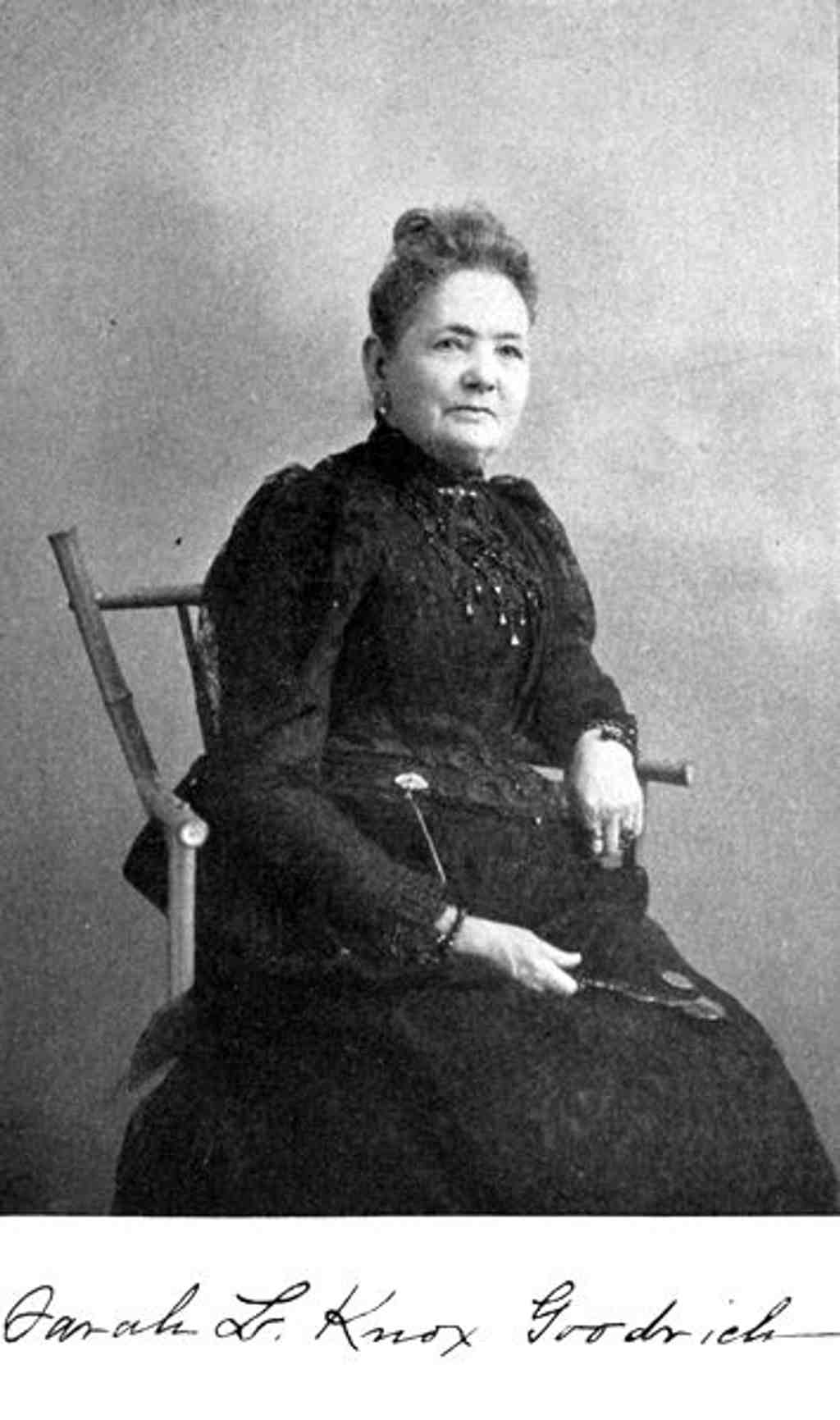
To spot the Sarah Knox-Goodrich landmark, look for a stately woman sitting confidently in a chair, dressed in a long dark Victorian gown, often depicted with a no-nonsense gaze-she’ll be looking right at you, almost as if she’s sizing up your resolve for justice!
Alright, let’s rewind the clock to a time when San Jose’s streets were a little dustier, the carriages were a little rattle-ier, and women weren’t allowed to vote-unless, of course, they were as determined as Sarah Knox-Goodrich. Imagine the bustling whirr of horses' hooves and merchants calling out their wares, while a young Sarah, born all the way back in 1825 Virginia, grows up knowing what it means to carve your own destiny. Her life brought her from Virginia to Missouri, then over the wild trails to California during the chaos of the Gold Rush.
With her first husband, William Knox, Sarah arrived in San Jose, a city not yet sparkling with today’s tech but glimmering with ambition. William, a businessman turned state senator, and Sarah, a force of nature, paired up for a good old-fashioned power couple-at least, as much as a woman could be a “power” anything at the time. Knox famously helped draft Senate Bill 252, granting married women rights over their own property, but behind the scenes it was Sarah, with that iron will, who made sure justice didn’t just linger in the air like California dust.
Sarah’s journey was never quiet, and she sure didn’t let widowhood slow her down. After William’s sudden death, she married Levi Goodrich, San Jose’s own “starchitect.” Levi designed grand courthouses, but Sarah built something of her own-a movement. She took Levi’s sandstone from his quarry and, in 1889, erected the Knox-Goodrich Building. Just imagine huge blocks being hoisted, stone masons chipping away beneath the sun, carving out massive Romanesque arches and intricate capitals. High up, the intertwined letters ‘G’ and ‘K’ and the proud date-1889-still watch over Fountain Alley.
But her real legacy was out on the streets, in the ruckus of parades and protests. Picture July 4, 1876: while most carriages in San Jose jostled for the best view of the fireworks, Sarah’s was loaded with banners-“We are the disfranchised Class,” “We are Taxed without being Represented.” As the parade organizers planned to tuck her and her fellow suffragists at the end, right next to the African-Americans but ahead of the Chinese immigrants, Sarah turned that discomfort into a teachable moment about women’s lack of rights, and the city made her lead the parade instead. Now, that’s a traffic jam worth joining!
Inside the stately Knox-Goodrich Building, everyday life bustled-shops on the bottom, bustling tenants upstairs debating the issues of the day. All the while, Sarah, who often wrote for the Woman’s Journal and the San Jose Mercury, kept the presses rolling with ideas about fairness and opportunity.
She lobbied and petitioned lawmakers, even nominating herself for the California Assembly in 1877. She was ahead of her time-bold enough to say, in writing, “Remove my political disabilities!” Her efforts made women eligible to run for educational offices years before they could actually cast a ballot.
And when legendary suffragist Susan B. Anthony rolled into town, who do you think hosted her and then marched beside her to Sacramento? You guessed it-Sarah Knox-Goodrich. She used not only her voice, but her fortune, funding campaigns and sponsoring trailblazing women like Laura de Force Gordon to bring the gospel of equality up and down the coast.
Today, as you stand before this landmark, close your eyes and feel the echoes of those old parades, the chisel against stone, the determined clacking of a typewriter. Sarah may be gone, but her “common sense and abundance of bank stock” still guide the dreams of San Jose. And next time you see a parade, maybe give a little wave to the spirit of Sarah, riding proudly at the front.
Curious about the biography, suffragist activities or the knox-goodrich building? Don't hesitate to reach out in the chat section for additional details.




