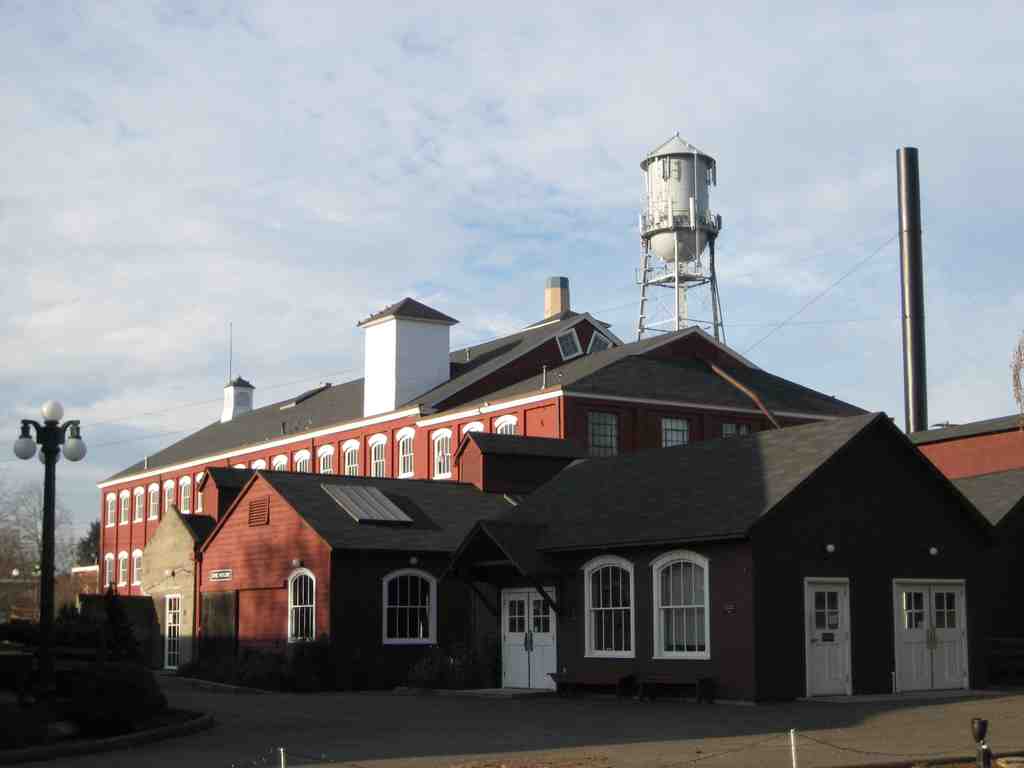
Our protagonist here is Thomas Lister Kay, a man who began his life as a humble weaver in Yorkshire before migrating to Oregon in 1862 and transforming himself into an ambitious mill founder. It turns out knowing how to actually weave is rather useful when you want to build a textile empire. In 1889, Kay opened this mill thanks to a twenty thousand dollar pledge from locals, which equals about six hundred fifty thousand dollars in today's money. But his success was built on the backs of a workforce enduring an absolutely brutal grind. Fifty laborers, including men, women, and children as young as eleven, trudged through grueling sixty-hour work weeks. They survived ten-hour shifts, six days a week, surrounded by deafening, heavy machinery and thick, choking wool dust. But exhaustion was not the only hazard, because wooden mills of this era lived under the constant, terrifying threat of fire. In November 1895, the inevitable happened, and the original structure caught a spark, burning completely to the ground. It was the sort of devastating, total loss that would send most rational business owners into early retirement. Instead, the local community rallied once more, raising another twenty-five thousand dollars, roughly nine hundred thousand dollars today, to ensure the mill was rebuilt. Kay had learned his lesson. He hired architect W.D. Pugh to design a new, fire-resistant brick structure right on top of the ashes. He even installed one of Oregon's very first fire-suppression sprinkler systems, an incredibly forward-thinking bit of engineering for 1896. By that November, this supposedly doomed operation was back to manufacturing the first worsted wool cloth west of the Mississippi River. Worsted wool, in case you are wondering, is a high-quality, tightly spun yarn that makes fabric remarkably smooth and durable. Much like Mr. Kay himself.
Stop 2 of 17
Willamette Heritage Center