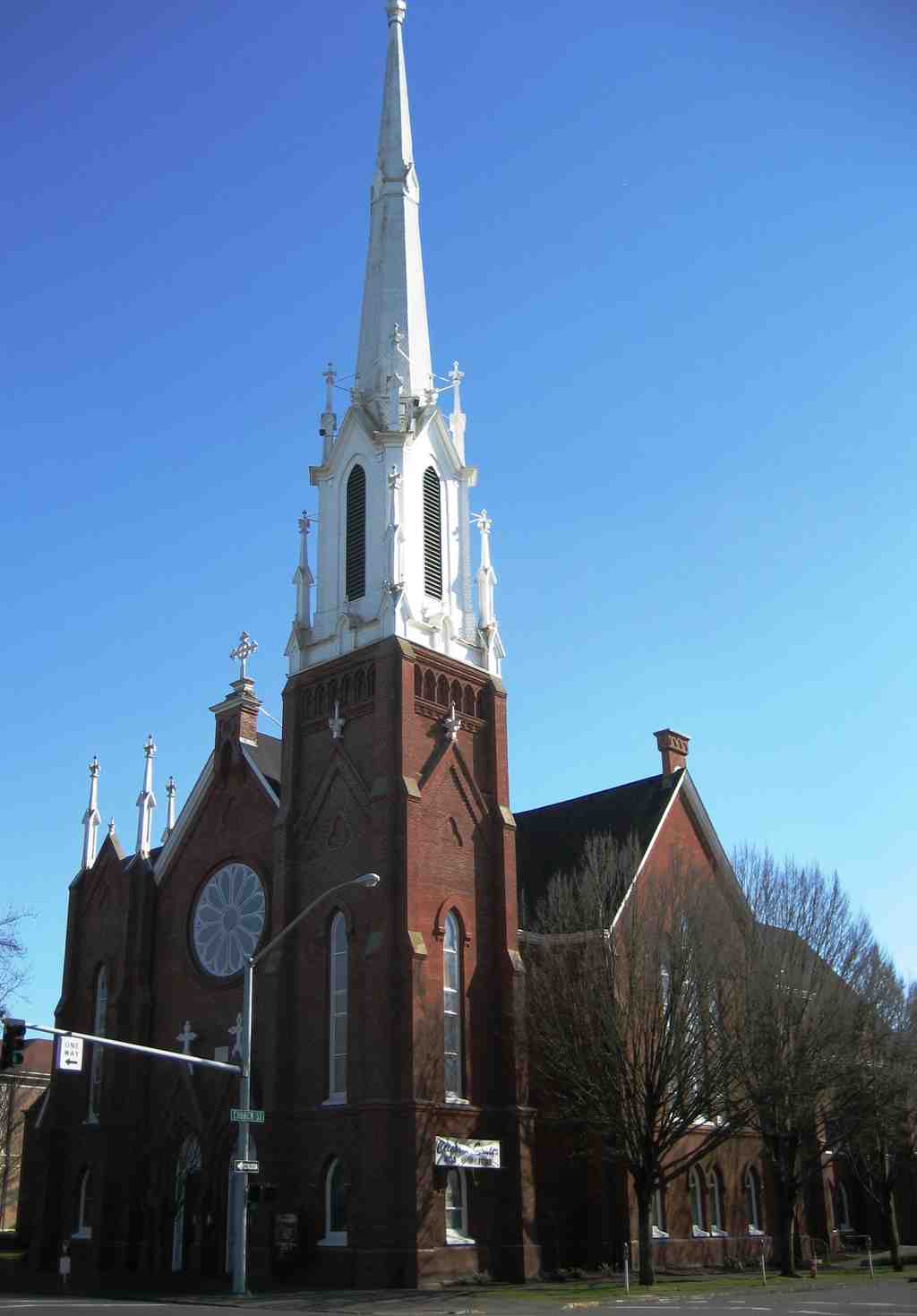
To understand how this imposing sanctuary got here, we have to look back to the early missionaries who arrived by sea on the Lausanne, which we touched on earlier. The founding missionary, Jason Lee, originally set up his mission headquarters right on the banks of the Willamette River. Nature, however, had other plans. Devastating floods repeatedly washed through their settlement, forcing Lee to pack up and seek the safety of higher ground. He relocated operations here to the Chemeketa Plain, effectively planting the seed for the city of Salem out of sheer geographic necessity. By eighteen fifty-three, the growing congregation built their first dedicated structure, a modest wooden frame building on this very corner. But Salem has a habit of refusing to let its buildings rest in peace. When it came time to build the massive brick structure you see today, they did not just tear down the old wooden church. Instead, they hoisted it up and moved it to a nearby lot on Liberty Street. That humble pioneer church went on to have a strange, wandering afterlife, serving a series of entirely secular purposes for decades while the congregation moved on to grander ambitions. And those ambitions were certainly grand. In the eighteen seventies, the church commissioned a celebrated Chicago architect to design a majestic Gothic Revival building. Gothic Revival is an architectural style defined by soaring vertical lines and sharp, pointed arches designed to draw the eye toward heaven. The architect delivered a stunning plan with an estimated price tag of fifty thousand dollars, which is roughly one point five million dollars today. The building committee took one look at that number and refused. They capped the budget at thirty thousand dollars, or about nine hundred thousand today. How did they achieve this massive discount? Through a very literal compromise. They took the architect's exact blueprints and simply reduced the scale of the entire building by one-eighth to save on materials. It is a remarkably blunt engineering solution to a financial problem. Even scaled down, the Panic of eighteen seventy-three nearly derailed them. When the congregation gathered for the formal dedication in eighteen seventy-eight, the grand building was nowhere near finished. The massive arched windows were just boarded over with cheap wood to block the wind, and the iconic spire had not even been built yet. This habit of extreme patience extended to their music, too. In nineteen fifty-three, they installed a massive pipe organ but could not afford all the parts. It was installed with what organ builders call prepared stops, which are essentially empty slots on the control console reserved for pipes that have not been purchased yet. For forty-seven years, the organ played with a mathematically incomplete voice until the missing pipes were finally bought in the year two thousand. If you want to look inside, the building is open on weekdays until four, though they close at twelve thirty on Fridays and are entirely closed on weekends.
Stop 14 of 17
Salem First United Methodist Church