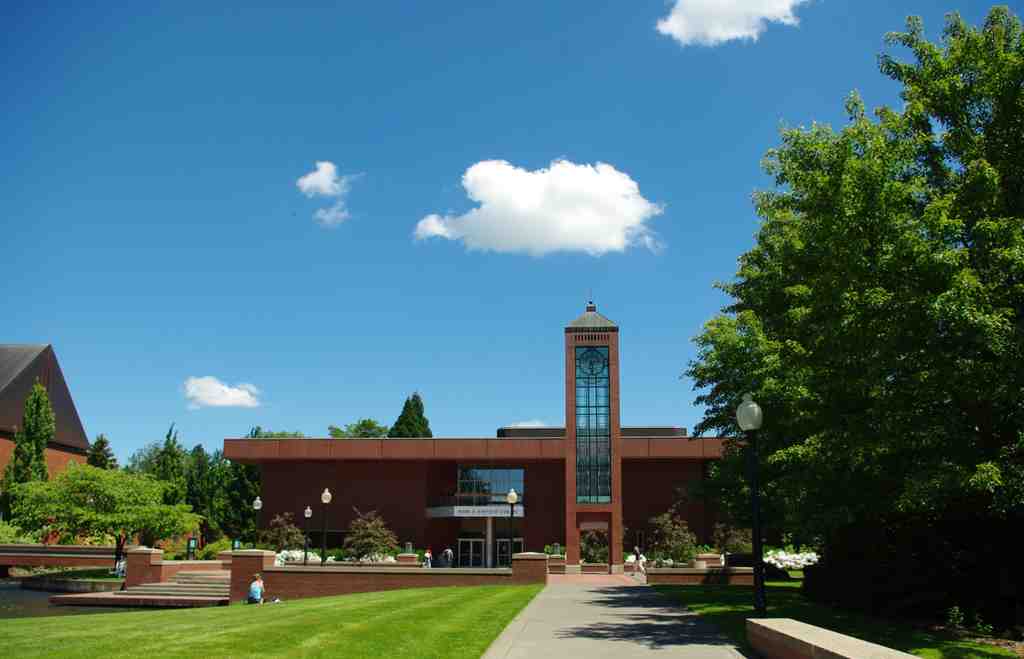
You see, getting this institution's book collection into a permanent, fireproof home was a test of endurance that took over a century. Willamette's original library was established in 1844, just two years after the school was founded. In those early years, it was housed on the third floor of Waller Hall. By 1909, the school had painstakingly amassed a collection of six thousand books valued at thirty five hundred dollars, which translates to roughly one hundred and fifteen thousand dollars today. It was a modest but hard won academic treasure. Then came the evening of December seventeenth, 1919. The threat of fire, a destructive force that repeatedly displaced Salem's institutions, struck the university again, this time targeting its precious books. A massive blaze completely gutted Waller Hall. This was actually the second major fire to strike the five story building, completely destroying its inside along with its distinctive Mansard roof. If you are not familiar with the term, a Mansard roof is a style of architecture featuring four sides with two slopes each, the lower slope being much steeper than the upper. The building's square tower collapsed entirely. The flames consumed the space where the university's books were kept, leaving the library homeless. But the story of this campus is defined by a refusal to stay in the ashes. Fortunately, the strong outer brick walls of Waller Hall, which were made from clay dug right here on campus decades earlier, somehow remained standing. The university rebuilt the interior, and the library was resiliently resurrected on the second floor just one year later. As the decades passed and the collection expanded past sixteen thousand volumes, the library outgrew its rebuilt space. The books were moved to a dedicated concrete building in 1938. Finally, in 1986, this permanent modern facility was constructed. Today, this two story building houses nearly four hundred thousand volumes. The architecture itself is a testament to transparency and permanence, featuring clear glass facades on the north and south sides. That sixty one foot clock tower you see features strips of bent glass woven together, running down to an eighteen ton concrete base. The library is named in honor of Mark O. Hatfield, a 1943 graduate who later served as Oregon's governor and a United States Senator.
Stop 8 of 17
Mark O. Hatfield Library