
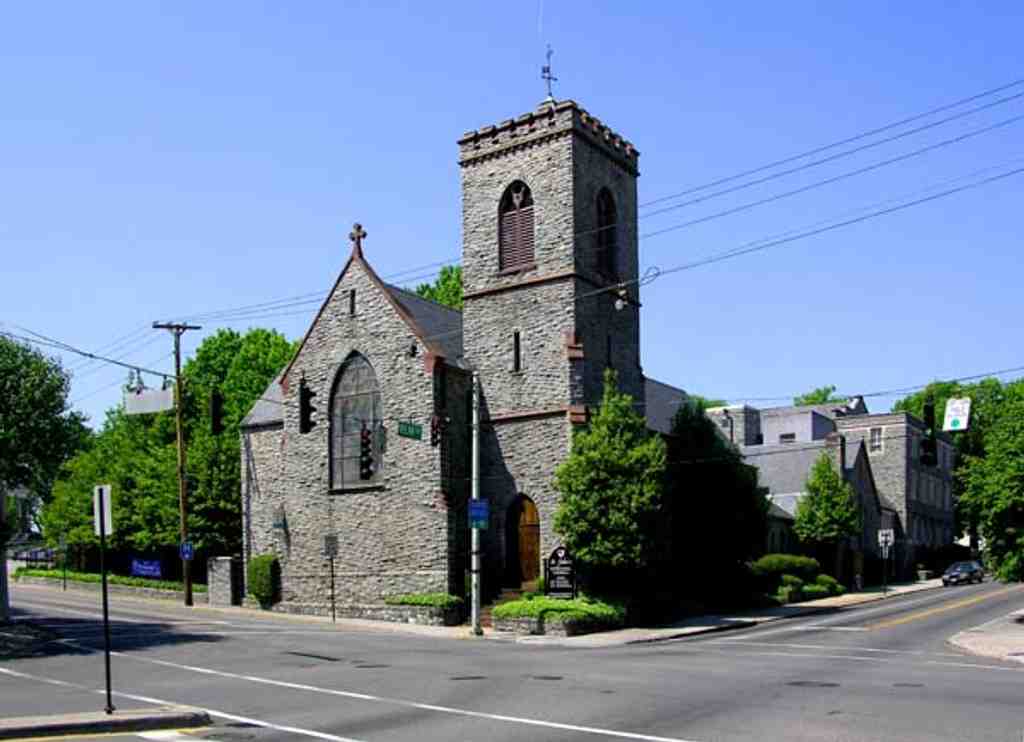
On your left, look for the sturdy blue-gray limestone church with a square corner tower and a steep gabled front wall punctuated by a big pointed Gothic window.
This is St. John’s Episcopal Church, and it has the quiet confidence of a place that’s been through a few name changes, a boomtown growth spurt, and more than one argument over where exactly it ought to stand. The building you’re looking at went up in 1891 to 1892, designed in a late Gothic Revival style by Charles M. Burns, an architect from Philadelphia who knew how to make an Episcopal church look like it means business. The limestone blocks-cool-toned, almost steel-blue in the sun-give it that “built to last” feel, because that’s exactly what it was meant to do.
But the congregation’s story starts earlier… way earlier. Back in the 1830s, a traveling preacher named Nicholas H. Cobbs came through the Roanoke Valley spreading Episcopal worship. Cobbs later became the first Bishop of Alabama, which is a pretty impressive career leap for a guy doing circuit work in the mountains. By 1850, this group had grown into an independent parish. Their first building was in Gainesborough-today’s Gainsboro-then they moved again in 1876 to Big Lick. Yes, Big Lick. Roanoke wore that name for a while like a slightly embarrassing childhood nickname.
Then came the railroads. In 1881, it was announced that Big Lick would become the junction point for the Shenandoah Valley Railroad and the Norfolk and Western… and suddenly this little place had big-city ambitions. By 1884, Roanoke was officially a city, and St. John’s started to swell with new members, many tied to the railroad and the leaders building a boomtown from scratch.
When a prime lot opened up here at Jefferson and Elm in 1891, a parishioner bought it so the church could relocate to the growing residential area just south of downtown. Not everyone loved that plan… and some folks broke off and formed Christ Episcopal Church. Churches grow like families sometimes: with love, changes… and the occasional split at the dinner table.
Architecturally, St. John’s is clever as well as handsome. It’s a clerestory-style church: lower roofs over the aisles, a higher roof over the nave, and a long band of high windows that bring in light and air-without needing heavy exterior buttresses. Inside, there’s a hammerbeam roof and plenty of stained glass, including one window signed by Louis C. Tiffany himself. The bell tower you see on the northeast corner is three stories tall… but fun fact: it didn’t get its bell until 1989. Better late than silent.
This congregation also had real influence. In 1919, when Southwest Virginia created its own Episcopal diocese, St. John’s-then the largest of 82 churches-became the diocesan home base. And in 1925, when the city wanted to widen Jefferson Street in a way that would’ve forced the altar to move, the church helped stop it. If you’re going to build a sanctuary, you generally prefer it stays put.
St. John’s landed on the National Register of Historic Places in 1991-official recognition for a church that’s been riding Roanoke’s changes since the days of Big Lick… and still looks solid doing it.


