
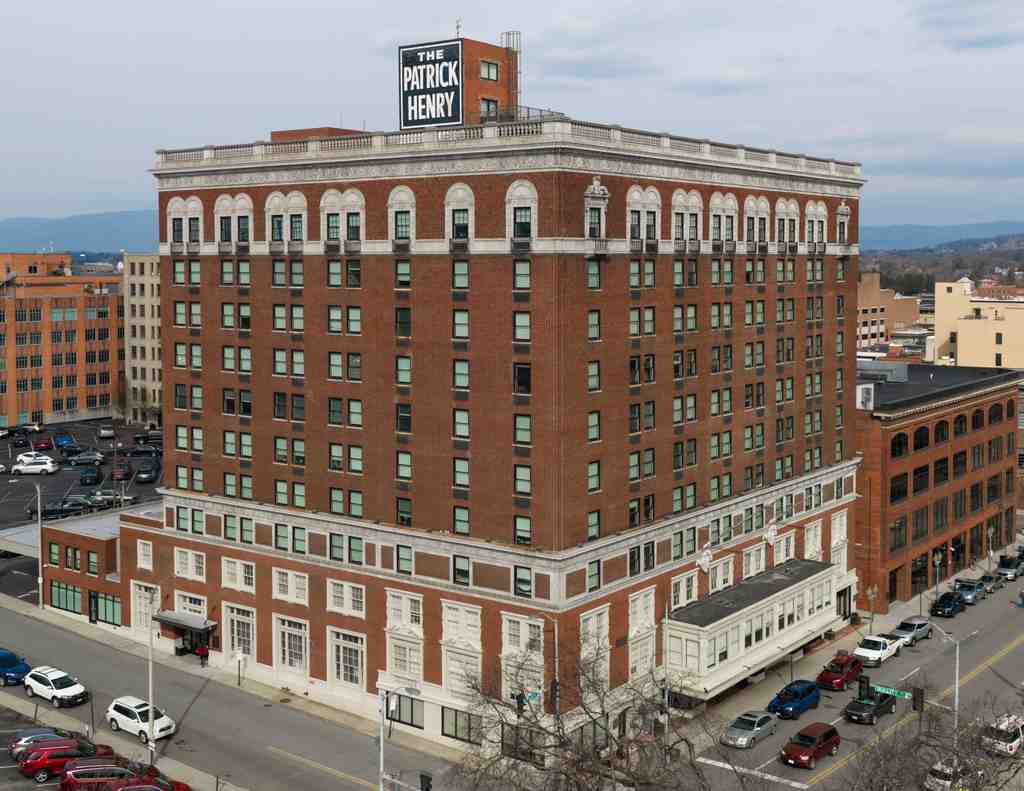
On your right, look for the tall, red-brick hotel building with creamy white trim and a row of arched windows near the top… it’s the kind of place that still looks like it expects your luggage to arrive on a cart.
This is the Patrick Henry Hotel, a big, confident Colonial Revival landmark that opened in 1925, right when Roanoke was riding the post-World War One wave and the Norfolk and Western Railway was helping turn the city into a serious destination. Travelers poured in… and Roanoke needed beds. Lots of beds.
A local business leader named William Wise Boxley set the whole thing in motion, creating a development company and hiring architect William Lee Stoddart… a guy who knew how to design hotels that made guests feel like they’d “made it,” even if they’d just made it off a train. Construction costs crept up, because of course they did, so Boxley had to form a second corporation in 1924 to raise more money and get the job finished. The oldest tradition in American building: “We’re gonna need more capital.”
When it finally opened on November 10, 1925, the Patrick Henry came out swinging: about 300 rooms, and a grand opening party that pulled in over 2,000 people. The name “Patrick Henry” wasn’t picked by some smoky boardroom committee, either… it came from a naming contest won by a young Roanoker, John Payne, who later headed to Hollywood and became a 1940s film star. Not a bad origin story for a hotel sign.
Over the decades, the building lived a lot of lives: run for years by a management company based out of Birmingham, updated in 1938 by local architects, then later sold at auction in 1961 to deal with debts. By the late 1960s, the original 300 rooms were carved into 121 hotel-and-apartment units… a practical makeover with less champagne and more monthly rent.
Then came the rough patch: a 1990 purchase and a $3 million renovation (about $7.3 million today) to rebrand it as a Radisson… followed by foreclosure attempts, failed conversion plans, and finally closure in 2007. It was even condemned for fire code issues… which is a pretty blunt way for a building to get grounded.
But it didn’t stay down. After a 2009 foreclosure for unpaid taxes, it sold for $2 million (around $2.9 million today), and a $20 million renovation (about $29 million today) brought it back in 2011: 134 apartments, plus a restaurant and office and retail space… now simply called “The Patrick Henry.” Dropping “Hotel” is a polite way of saying, “We’ve reinvented ourselves.”
When you’re set, St. John’s Episcopal Church is a 5-minute walk heading south.


