
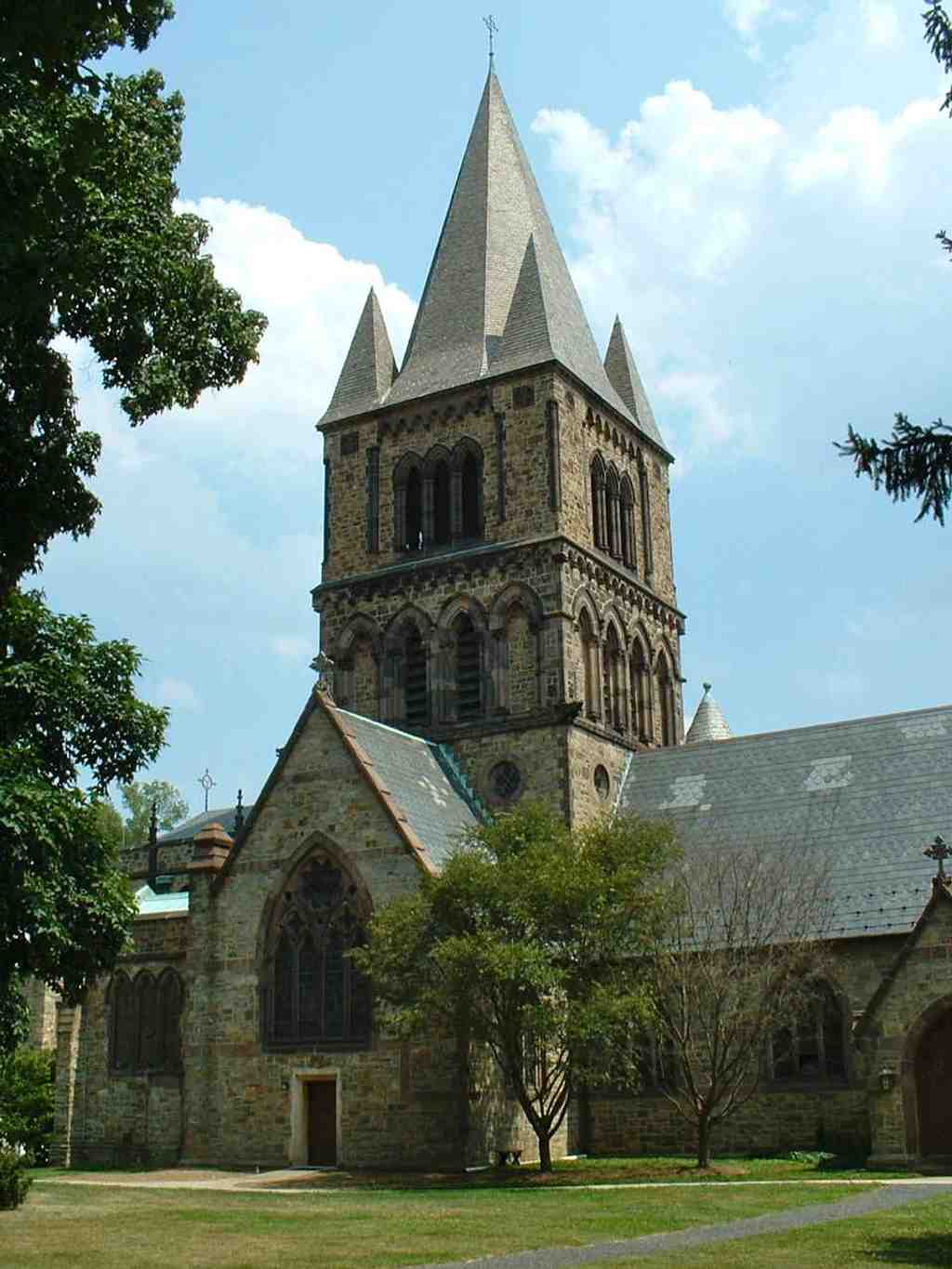
To spot Trinity Church, just look for the impressive, towering stone building with a steep, pointed spire and arched windows rising above the treetops directly ahead of you-it’s hard to miss with its striking Gothic Revival design and commanding presence.
Take a moment to soak in the view, because you’re standing in front of a church with a story so rich, even the bells might ring in excitement! Trinity Church is more than just the largest Episcopal church in New Jersey; it’s practically Princeton’s own time machine, packed with centuries of surprises. Imagine standing on this very spot in 1833, when the idea of an Episcopal church here was almost rebellious. Princeton was mostly a land of Presbyterians, with the famous College of New Jersey (now Princeton University) and the Theological Seminary just down the street. Into this determined crowd came a handful of big dreamers-some with roots in the South-who built a modest Greek Revival hall designed by local star Charles Steadman, who also gave us Miller Chapel and many elegant homes nearby.
Fast forward to 1870, and that simple building gave way to something much grander-what you see before you, clad in Gothic Revival style, rising with confidence. Picture Richard Upjohn and his son at the drawing board, their pencils flying, inspired by medieval Europe. Their creation-and later, celebrated architect Ralph Adams Cram’s additions-turned this place into a stone-and-glass symphony, echoing with carillon bells and awash in sunlight dancing through tall, colored windows. And get this: set above one chancel door is an actual stone relic from the 13th-century St. Oswald’s Church in England, brought all the way from the Stockton family’s distant roots. Trinity has always had one foot here in Princeton, and another somewhere in history.
If you listen closely, you might almost hear the laughter and lessons of children-Trinity built a gothic schoolhouse in 1850, a real innovation at the time. This schoolhouse wasn’t just for Sunday school kids; it also became a classroom for African-American children left out of local schooling, turning the church into a beacon of welcome and progress, one chalky lesson at a time. As the 1800s rolled along, Trinity cast its net wider, founding missions nearby-some which still thrive. And let’s not forget the music! Since 1879, the air has been filled with Anglican choral tradition, from the rousing voices of men and boys to today’s rich harmonies from a full choir of all ages and genders. All those rehearsals under top musicians like James Litton and John Bertalot have left the building humming with song.
Now, drift into the 20th century when Trinity and the town of Princeton both started to stretch their legs and grow. Post-war baby boomers brought so many children, five hundred kids swarmed the Sunday school-imagine the noise and crayon shavings! New halls, kitchens, and meeting rooms sprang up to meet the buzz. But it wasn’t all smooth: in 1963, flames tore through the church, and the community rallied like a scene from an epic film. Out of the ashes, the church was rebuilt along with new efforts to reach everyone in the area, especially through Trinity Counseling Service and, in a twist of church-planting heroics, the creation of All Saints’ Church for the growing eastern neighborhoods. The two parishes even share a cemetery-just in case you were wondering if they ever ran out of things to share.
Leadership here has always had a dramatic flair: rectors who moved on to grander pulpits, a strong-willed dean who ended up at the world’s largest Gothic cathedral, and the parish’s own first woman priest, the Rev. Daphne Hawkes, ordained right under these soaring arches-breaking centuries-old barriers in New Jersey’s Episcopal church. Laypeople, once pew-sitters, started to take on larger roles, shaping the church and its programming, ensuring that everyone has a voice, whether in worship, outreach, or just deciding what’s for coffee hour.
More recently, Trinity faced fresh challenges, including the difficult firing of a long-time music director amid serious charges, followed by a healing transition and the arrival of Dr. Margaret “Meg” Harper in 2023, whose arrival sparked new energy in the beloved music program. Walk by on a Sunday night, and you might just catch the soaring notes of an Evensong echoing through the stone, or the gentle hush of Compline washing through the twilight.
Step back and take it in-Trinity Church has grown from outsider status to being a joyful heart of Princeton, full of music, history, and a few good surprises. And if you ask me, it’s got more character than a church mouse at choir practice!


