
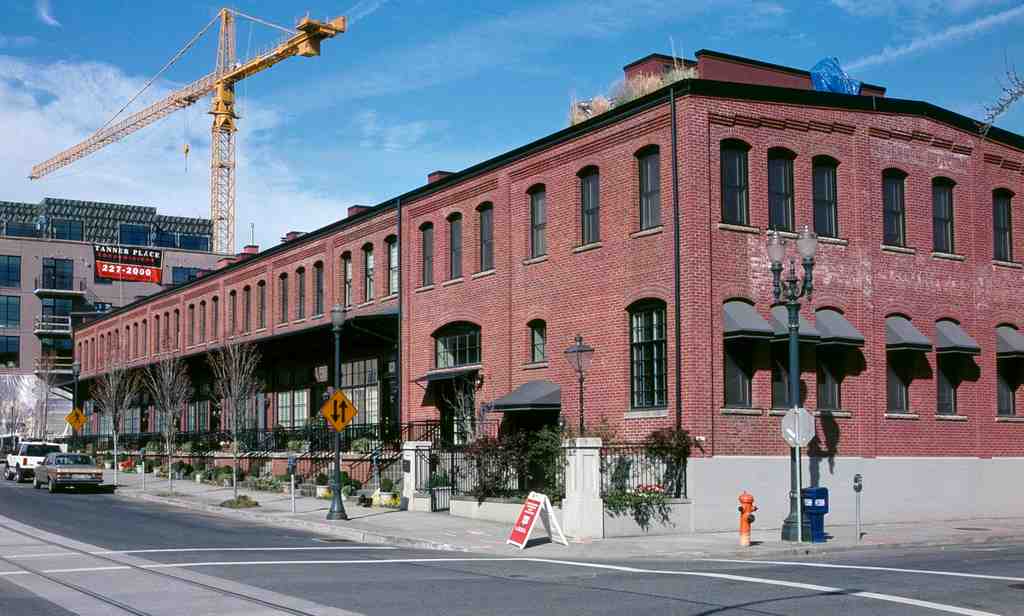
Look ahead and you’ll spot two nearly identical, two-story brick buildings facing each other across NW 11th Avenue, just north of Hoyt Street-those sturdy red-brick giants are the North Bank Depot Buildings, unmistakable with their rows of tall arched windows and distinctive historic charm.
Now, take a moment to imagine yourself standing here in this very spot-but instead of the hum of cars and distant coffee shops, you’d be hit with the thunder of locomotives, the sharp whistle of trains, the heavy clang of freight being lifted, and the chatter of suitcase-carrying travelers excited to journey across the Pacific Northwest. These twin brick buildings sprang to life in 1908 as the proud new “freight houses” of the Spokane, Portland and Seattle Railway-known to locals as the North Bank Road. Back then, this was no sleepy street; it was the pulsing terminal for goods and people bound for Seattle, Spokane, the Columbia Gorge, and even as far as Chicago. The east building, right in front of you, not only handled goods but buzzed as the North Bank Station, welcoming passengers on their way to new adventures.
Picture workers hustling about, wheelbarrows full of packages, conductors calling out destinations-sometimes even doing their best impersonation of a steam train. That’s how the phrase “All aboard!” really got its energy! And believe it or not, these warehouses played a tricky game of musical chairs with Portland’s grand Union Station. The original plan was for SP&S passenger trains to end their journey at Union Station, but due to some classic railroad drama (too many cooks in the train-yard kitchen, you might say), that didn’t quite work out. So, with just weeks before trains were ready to roll, the good folks at SP&S said: “Why not just use our own shiny new freight house as a passenger terminal?”-and so they did, probably saving themselves a lot of paperwork and more than a few headaches.
It wasn’t just SP&S trains that fired up these tracks. The Oregon Electric Railway joined the party in 1912, sending out interurban electric trains from here to towns like Hillsboro, Forest Grove, and even as far as Eugene. Just imagine sleek, whirring electric trains gliding from this spot, passengers peering out wide windows at the growing city as they zipped through neighborhoods and farmland. For a while, this was Portland’s gateway to everywhere, with journeys that ranged from the bustle of Seattle to the lush valleys of Oregon, to glamorous train connections reaching all the way to Chicago.
But, as the roaring twenties wound down and the world rolled into hard times and new technologies, the magic here faded. By 1931, the Oregon Electric pulled its last passenger service from this station, and by 1933 Portlanders were jumping on trains somewhere else. Meanwhile, SP&S started offering more of its long-distance rides from Union Station, but these brick halls and arched doorways managed to stay busy with a steady flow of freight-boxes upon boxes, day after day-up until the 1980s. If these buildings could talk, I’m sure they’d have plenty of travel stories (and maybe a complaint or two about all the heavy lifting).
As the decades passed, the world of freight shifted, locomotives got sleeker, and eventually the railroad yards here quieted down. By the late 1980s, these old buildings sat quiet and watchful as the Pearl District-a place once given over to the clang of industry and the scent of fresh lumber-began to dream of something entirely new: coffee shops, condos, leafy parks, and sunny patios. The city embraced a bold plan, rezoning the old railway lands for a future that would feel less like thunder and steam, and more like home.
Not everything was simple, though. Years of railroading left the land a little battered and bruised, and it took serious dedication to clean up the soil and prepare these buildings for a second life. In 1996, a proud moment: these historic twins were listed on the National Register of Historic Places, forever recognized as keepers of Portland’s railroad legacy. Then, in a twist almost as exciting as any train chase, the North Bank Depot Buildings were lovingly transformed into unique, vibrant living spaces in the late 1990s.
So, as you stand here now-surrounded by leafy trees, art galleries, bustling streets, and perhaps the distant rattle of a streetcar-know that you’re sharing a sidewalk with more than a century of stories. These grand brick buildings have welcomed travelers, moved mountains of freight, survived boom and bust, and now watch over the ever-changing face of Portland’s Pearl District. That’s some serious staying power-right down to the last brick!


