
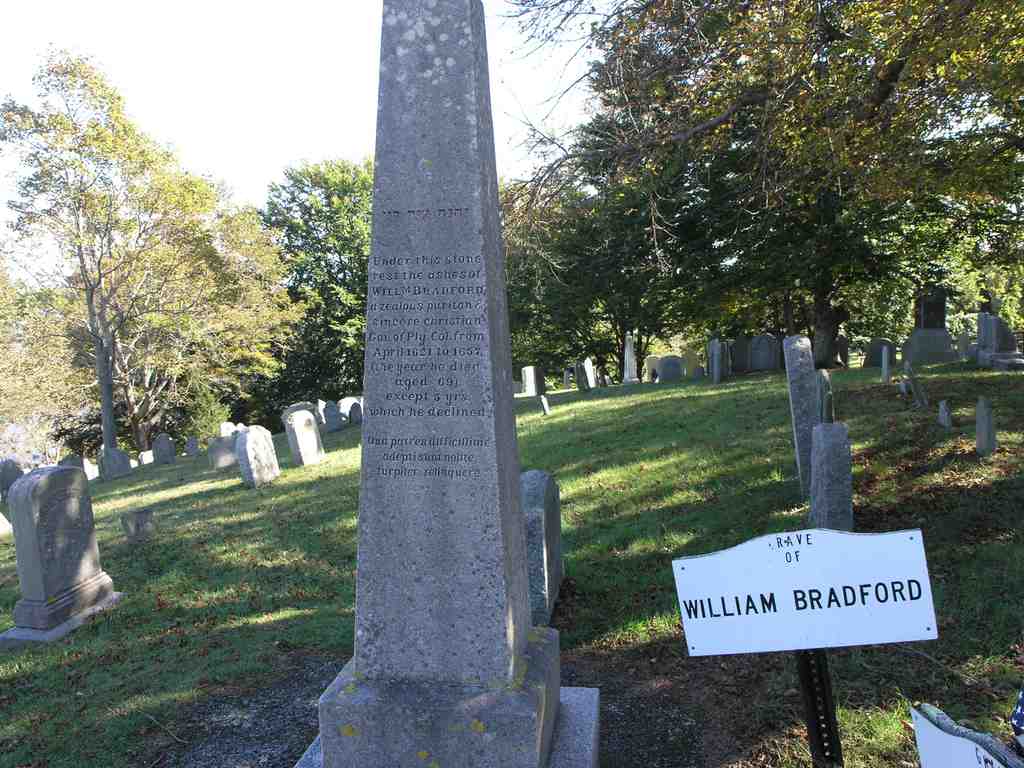
On your right, you will see a tall, pale granite obelisk standing prominently on a grassy slope among older, rounded slate headstones. This is Burial Hill.
Before this hill became a final resting place, it was a place of survival. Rising one hundred sixty-five feet above sea level, it offered the early settlers a sweeping, commanding view over Plymouth Bay and the surrounding landscape. In sixteen twenty-one, they built a fort right up here at the summit. Take a look at your screen to see a reconstruction of that sturdy wooden fort and meeting house, which you can visit today at the nearby Plymouth Plantation.
That original fort was the heart of the community. It functioned not just as a defense, but as a gathering space for the colony and the original meeting house for the First Parish Church, serving that dual purpose until sixteen seventy-seven. But as the colony grew and the need for a fortified hilltop faded, the land transitioned into a burying ground.
Today, there are over two thousand marked graves scattered across these five point one acres, with stones dating from sixteen eighty all the way to nineteen fifty-seven. You are standing among the founders of the Plymouth Colony. Glance at your app for a moment to see the grave of William Bradford. He was a Mayflower passenger and the long-serving governor who documented much of the colony's fragile early history. You will also find Mary Allerton resting here, the very last surviving Mayflower passenger.
There are also several cenotaphs upon this hill. A cenotaph is simply an empty tomb or monument erected in honor of a person whose remains are buried elsewhere. For example, Robert Cushman, the chief organizer of the Mayflower expedition, is memorialized here with a stone, even though his actual resting place is unknown.
This hill holds centuries of quiet memory, keeping watch over the town it helped create. Take a moment to soak this in, and when you are ready, we can walk together to the next stop.




