
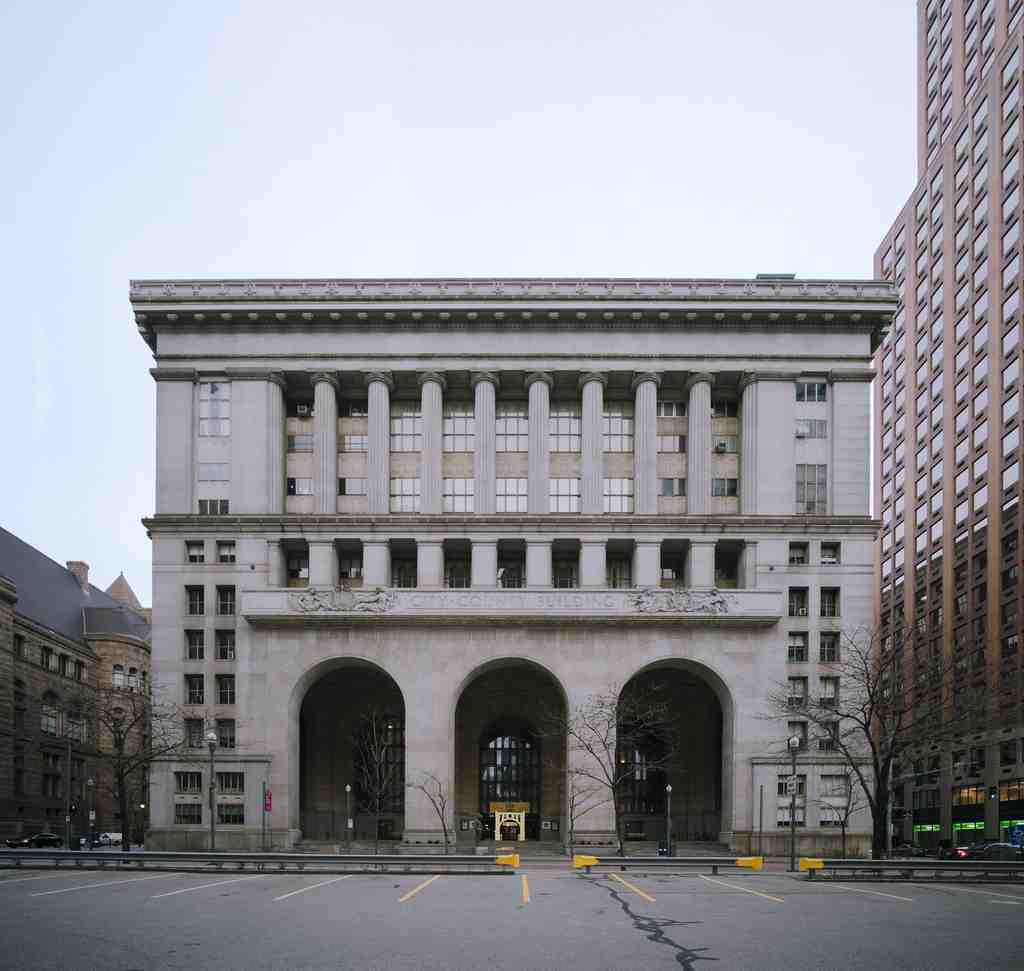
On your left stands the monumental Pittsburgh City-County Building, a massive pale gray stone structure defined by three deep arched entrance bays at the base and a striking row of tall columns lining the upper floors.
This is a spectacular powerhouse of a building. By the early twentieth century, Pittsburgh was growing so fast it was practically bursting at the seams. In nineteen oh seven alone, the city absorbed neighboring Allegheny City, adding a hundred and thirty thousand new residents in an absolute flash. The old city hall simply could not handle the crushing crowds, so city and county officials teamed up to build this masterpiece.
And they wanted it to be entirely homegrown. Mayor Joseph Armstrong was fiercely protective of his city. He demanded that every ounce of material and every single laborer come straight from Allegheny County. Even the design competition was strictly limited to local architects, eventually won by a team led by the brilliant Henry Hornbostel. You can see the grand portico they designed right on your app.
But the project almost derailed before a single shovel hit the dirt. A local contracting firm filed a legal injunction to halt the work, furious over what they claimed was an improper, shady bidding process for the supervising engineer. The legal battle completely paralyzed construction for over a year. The dispute went all the way up to the Pennsylvania Supreme Court and required a special legislative act to finally resolve. When they eventually broke ground in nineteen fifteen, they were so relieved that the pick and shovel used in the ceremony were silver plated and proudly displayed as trophies in the office of the Mayor.
Hornbostel designed the building in the Beaux Arts style, filling the massive, symmetrical structure with rich classical decorations. It was also heavily influenced by the City Beautiful Movement, an urban planning philosophy that believed creating sweeping, orderly civic centers would inspire civic virtue and elevate society. If you want to see how the surrounding streetscape has evolved while this monumental structure stayed completely steadfast, swipe to the before and after view on your screen.
While the outside is intensely rigid, the inside is pure magic. The Grand Lobby is a naturally lit atrium boasting a breathtaking forty seven foot barrel vaulted ceiling. Holding up that magnificent ceiling are custom bronze columns crafted by the legendary Louis Tiffany Studios, featuring intricate carvings of the Native American frontiersman Guyasuta and the historic Fort Pitt Blockhouse at their bases. Even the elevator doors are storytelling masterclasses, covered in bronze reliefs that depict the evolution of Pittsburgh's municipal buildings, aging from childhood to adulthood as the architecture scales up. Hornbostel was so dedicated to his complete vision that he even custom designed the furniture for the Mayor's office and the Supreme Court room... and it is all still being used today.




