
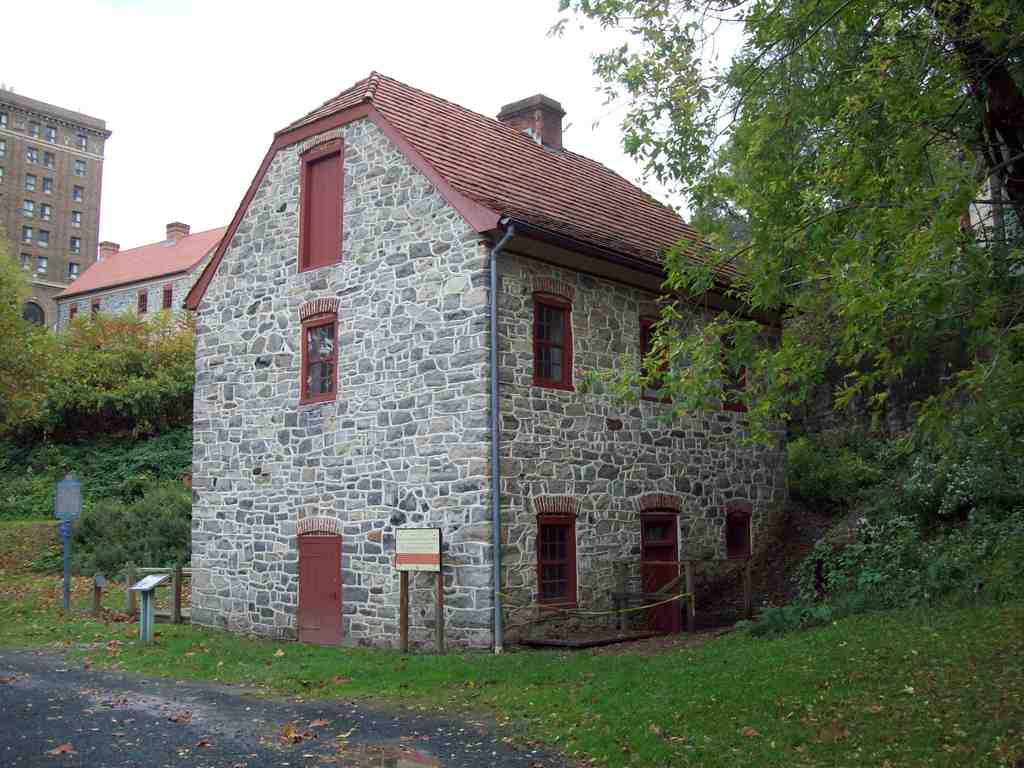
You’re looking for a compact, two-and-a-half-story limestone building with a steep red tile roof and deep red doors and window frames... it sits low by the trees near the creek, like it’s been quietly minding its own business for about 260 years.
This is the Bethlehem Waterworks-also called the Old Waterworks or the 1762 Waterworks-and it has a pretty serious claim to fame: it’s widely believed to be the oldest pump-powered public water supply in what became the United States. Not “old for Bethlehem.” Old, period.
Now, the problem they were trying to solve was simple: most people lived up the hill, but the good spring water was down here near the bottom. Carrying buckets works fine right up until you’re carrying buckets all day, every day, for a whole town. So in 1755, a Danish millwright named Hans Christoph Christensen designed a system to haul water uphill with mechanical muscle instead of human backs. The spring down here pushed out around 800 gallons a minute-plenty for drinking, cooking, bathing, and, importantly, firefighting. Because nothing ruins a nice colonial afternoon like your town catching fire.
The earliest setup was a wooden structure with a cistern and a pump made from lignum vitae, an extremely tough tropical wood. Water got shoved through pipes that started as bored-out hemlock logs-yes, basically long wooden straws-floated down the Lehigh River. If you’re thinking “that sounds like it might leak,” congratulations, you understand early plumbing. The pipes leaked, burst, and generally behaved like pipes that used to be trees.
So Christensen upgraded the whole operation in 1762, building this limestone pumphouse you’re standing by. He was paid thirty shillings for the job-call it roughly a few hundred dollars today, depending on how you convert eighteenth-century wages. Either way, it’s a reminder that “critical infrastructure” has never paid quite what it should.
Inside, the design is clever. The building sits over a holding pit fed from the spring, and a waterwheel-an undershot wheel originally turned by the creek-powered three cast-iron pumps. The energy from that one wheel was said to equal about 100 men. The pumps pushed water nearly 94 feet uphill to a collecting tower near where Central Moravian Church stands today. From there, gravity took over, delivering water into cisterns serving the community’s different choir houses. It’s a beautiful system when it works... and a moody one when pressure builds too high and pipes decide to explode.
As Bethlehem grew, demand grew too-and the Monocacy Creek could only spin so much power. By the early 1800s, the Waterworks and the nearby Oil Mill had to share the same tail race, and the Oil Mill sometimes shut down two days a week so the town could fill its reservoirs. In 1832, water operations moved into the Oil Mill building, which carried the load for 81 more years.
Then came the darker twist: water quality. Epidemics of typhoid and dysentery were traced to the supply, and in January 1913 the state ordered the system shut down for good. Helpful water is great. Helpful water that makes you sick... less great.
This little building has collected honors since: major engineering landmark designations in 1971, and National Historic Landmark status in 1981. It was even restored using original craftsmen’s drawings preserved in the Moravian Archives-again in 2009 after Hurricane Ivan damaged the wheel. Turns out the eighteenth century left better documentation than some modern contractors.
When you’re set, Central Bethlehem Historic District is a 5-minute walk heading south toward Main Street.




