
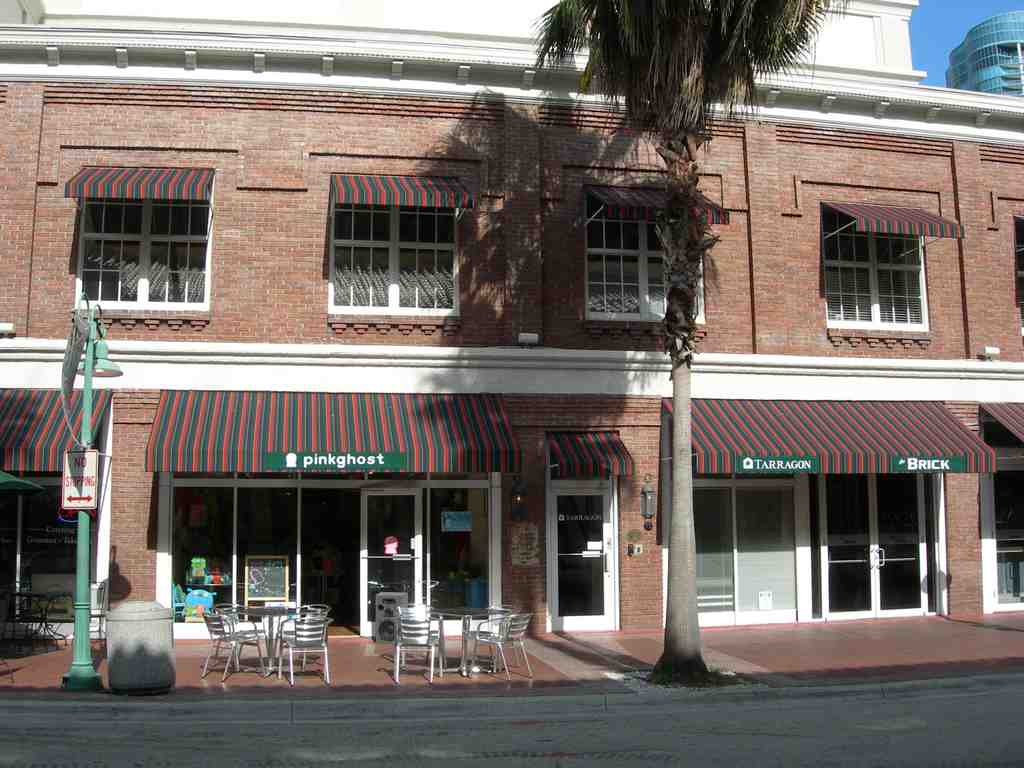
Look to your left for a sturdy two-story red-brick building with striped awnings over wide storefront windows and a simple row of upstairs windows trimmed in brick.
This is the Bryan Building... and in South Florida, a real brick façade is basically a personality trait. Most early buildings around here went with poured concrete or hollow clay tile, but this place doubled down on masonry: brick columns and pilasters dividing five street-level storefronts, big plate-glass windows meant to catch your eye, and upstairs, eight windows framed with a neat brick pattern that nods to a simplified Greek-key look. If you spot the arched doorway on the front, that’s your hint that there’s a second life above the shops-literally, since the main stairs to the upper floor run inside that entrance. And up there? Floors and ceilings made from Dade County pine-hard, local wood that helped buildings survive Florida’s long, humid grind.
The building went up after the 1912 fire that tore through downtown Fort Lauderdale. Fires have a way of “editing” a city’s history, and Thomas Bryan helped write what came next. He was tied to the region’s growth through his father, Nathaniel Bryan, who oversaw construction of Henry Flagler’s Florida East Coast Railway extension from West Palm Beach to Miami-one of those projects that didn’t just connect dots, it created them. Thomas himself was plugged into local business and civic life, and his efforts helped push the creation of Broward County. Back then, this neighborhood was the original commercial heart of Fort Lauderdale-less glossy skyline, more hustle and dust.
Inside these walls, the tenants changed with the times. The Post Office operated here from 1914 to 1925-imagine folks lining up with letters and money orders where retail displays sit now. Around that era, the Fort Lauderdale Bank held space on the ground floor too. Then upstairs became a revolving-door home for travelers and long-term renters: it went by names like the DeSoto, the Lee, the Boriss, and later the Dorsey-famously a men-only place with a cowboy theme. Because nothing says “Florida lodging” like pretending you’re in the Old West.
By the 1960s, downtown business drifted outward with the suburbs, but this building stayed stubbornly intact-one of the least altered survivors of its time. It earned a spot on the National Register of Historic Places in 1997, and got a historically respectful renovation around 1998-part preservation, part the complicated trades cities make to save some history while losing other pieces.
When you’re set, Girls’ Club Foundation is a 4-minute walk heading north.




