
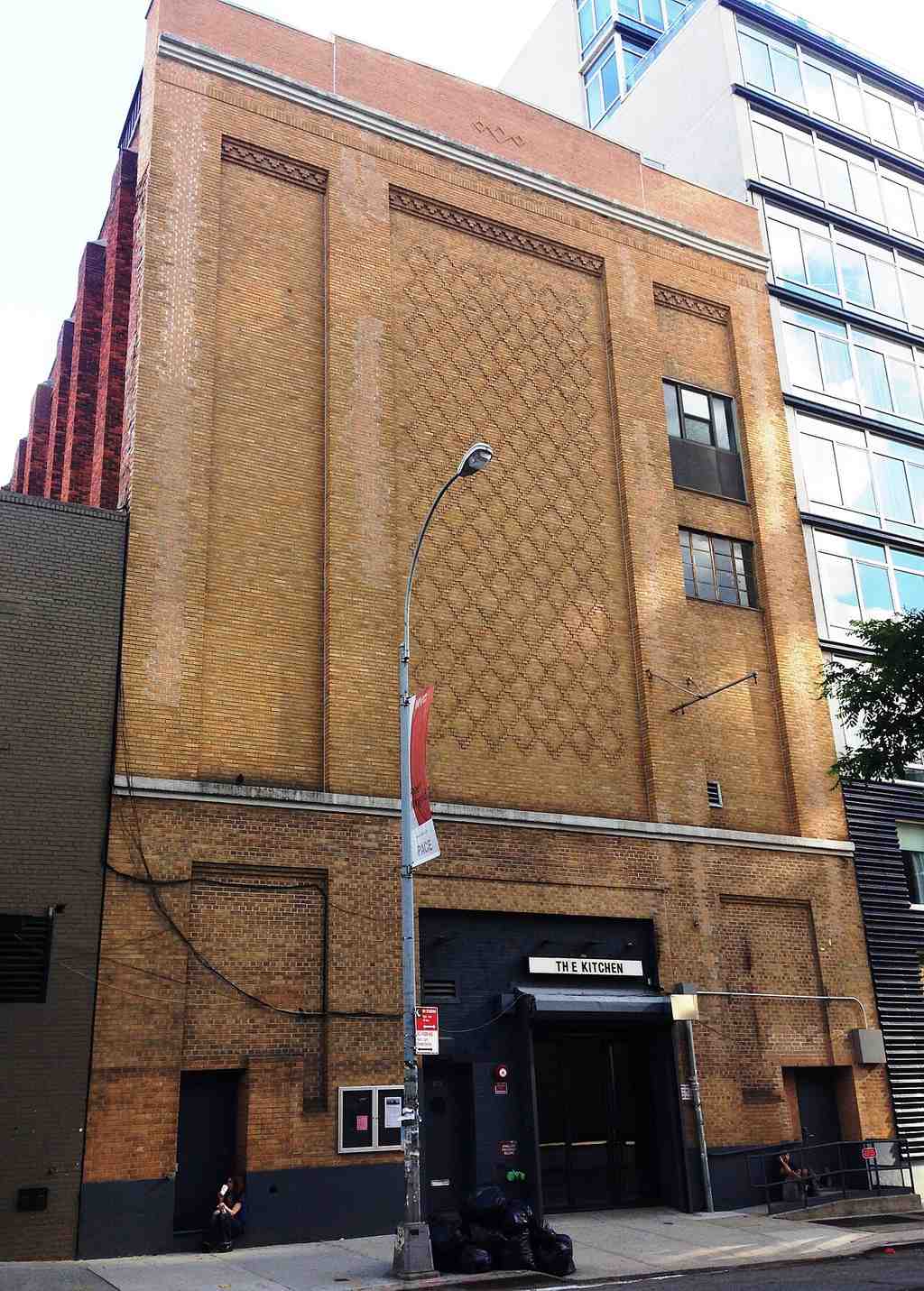
On your left, look for the red-brick industrial facade, the boxy warehouse shape, and the wide dark entry that still reads like a former loading bay.
This is The Kitchen... one of New York’s great laboratories for weird, fearless, rule-breaking art. And I mean that literally: it started in an actual kitchen. In nineteen seventy-one, video artists Steina and Woody Vasulka were desperate for a place to show work in a world that barely took video art seriously, so they rented the kitchen at the Mercer Arts Center in Greenwich Village. That scrappy little room gave the whole institution its name, and suddenly a new kind of creative energy had a home.
At first, The Kitchen focused on video. Then it burst open. Music came in. Performance came in. Dance, film, visual art, literature... all of it. By nineteen seventy-three, it had incorporated as a nonprofit, and not long after, the building that housed the Mercer Arts Center collapsed. That disaster made the next move final, sending The Kitchen to SoHo, to Wooster and Broome, where it grew into one of the city’s premier avant-garde spaces. Avant-garde just means artists pushing past the usual boundaries, trying things before the rest of the world is ready for them.
And wow, did people try things here. The first music director, composer Rhys Chatham, helped shape a downtown scene that got loud, abrasive, and thrilling. The Kitchen became a key home for no wave - a raw, jagged art-and-music movement that rejected polish - with artists like Glenn Branca, Lydia Lunch, and James Chance. Before some names became legend, they were experimenting in rooms like this. Philip Glass worked here. Laurie Anderson did too. Meredith Monk, Brian Eno, Arthur Russell, Cindy Sherman, David Byrne and Talking Heads... the list feels almost unreal.
Some milestones still send chills through art history. In nineteen seventy-five, Steve Reich and Musicians performed a work in progress here that grew into Music for Eighteen Musicians, one of the landmark pieces of modern composition. In nineteen eighty-one, Julius Eastman premiered The Holy Presence of Joan d’Arc here. In nineteen eighty-three, the Beastie Boys played one of their early shows here. And yes... in nineteen ninety-two, Madonna filmed scenes for her EROTICA video here. The Kitchen has always loved a collision of high art, pop culture, noise, risk, and nerve.
This Chelsea building, a former ice house, became The Kitchen’s home in the spring of nineteen eighty-six. Its opening series was called New Ice Nights, a perfect wink to the building’s past. Inside, it has housed a one-hundred-fifty-five-seat black box theater - a flexible performance room with dark walls and minimal fixed scenery - plus gallery space for sound and visual exhibitions. Even the architecture suits the mission: sturdy, industrial, adaptable.
The place has survived real blows too. In two thousand twelve, Hurricane Sandy flooded The Kitchen with four feet of Hudson River water and caused about four hundred fifty thousand dollars in damage. Grants and donors helped it recover. And under leaders including Legacy Russell, who became executive director and chief curator in two thousand twenty-one, it keeps championing emerging artists and experimental work.
This place proves that some of New York’s boldest cultural revolutions started in the most unlikely room of all.
Take one more look, and when you’re ready, we can continue on to Venus.




