
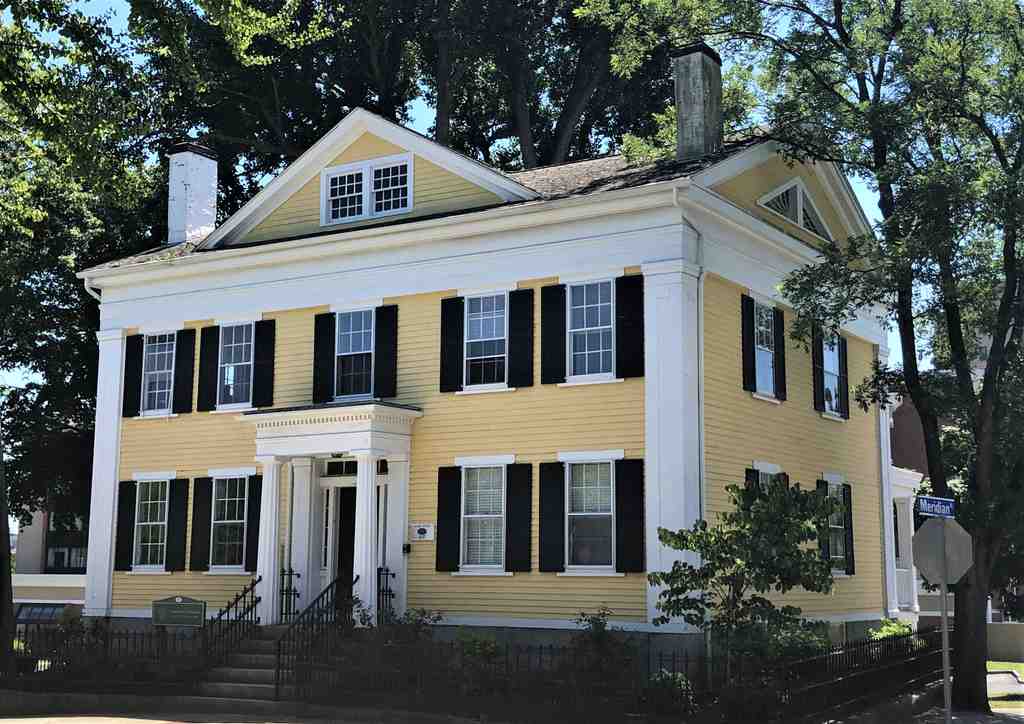
To spot the Acors Barns House, look for a stately white home with a gable roof, broad clapboard exterior, and an entrance framed by classic Greek columns-right at the corner where tall trees peek over an impressive iron fence.
Alright, so here it is: the Acors Barns House. If you’re thinking it looks like the kind of place where a prosperous whaling magnate would count his spoils-or at least keep his ledgers-you’re right on target. This two-and-a-half story Greek Revival beauty went up in 1837, right in the golden age when New London’s fortunes were being fueled by blubber and risk-taking. And trust me, it has all the airs of a leading man in a period drama. Five windows wide, neat as a pin, and with a proper Greek portico-those columns practically shake hands with you as you pass the front walk.
Acors Barns himself was a local upstart who made good. Born the son of a sailor in 1794, he grew up in Westerly and Stonington before moving to New London. By 1827, he was running one of the city’s top whaling firms-so prosperous, in fact, that Acors managed to sidestep the whaling industry’s famous collapse. How? Well, while others clung to their harpoons, he diversified. He invested in railroads just as the west was opening up, and then planted the seeds of the Bank of Commerce here in 1852. For reference, most banks started then with capital of maybe $100,000-around $3.8 million today. The family kept the bank going after Acors’ death, proving dynastic ambition was one thing they didn’t whale on. Sorry, had to slip that in.
The house itself has seen some additions and tweaks over the decades-like that central dormer jutting from the roof and the partly enclosed veranda around back. Depending on your point of view, those changes are either “architectural evolution” or, well, attempts at home improvement that make preservationists wince. The inside, though, is pure architectural drama: envision elaborate hall ceilings, custom woodwork, and marble arched fireplaces where you could almost stage a Greek tragedy. There were dumbwaiters-one of those little lifts, just big enough for your onion soup-running to the kitchen in the cellar. The attic? Five tiny rooms once crammed with servants, a very literal upstairs-downstairs arrangement.
Ownership has been almost as lively as the house itself. It’s been handed down through the Barns family, hosted a legal office, and is now cared for by a local community foundation, who forked over $325,000 in 2013-about $420,000 if you adjust for inflation-for the privilege. That’s the kind of money you only spend for something truly irreplaceable.
People in town will tell you-with just a little pride-that the Acors Barns House is more than just wood and marble. It’s a living artifact. In a city that lost so much character during urban renewal, this place quietly reminds everyone what “New London style” once meant.
Ready for something a little different


