
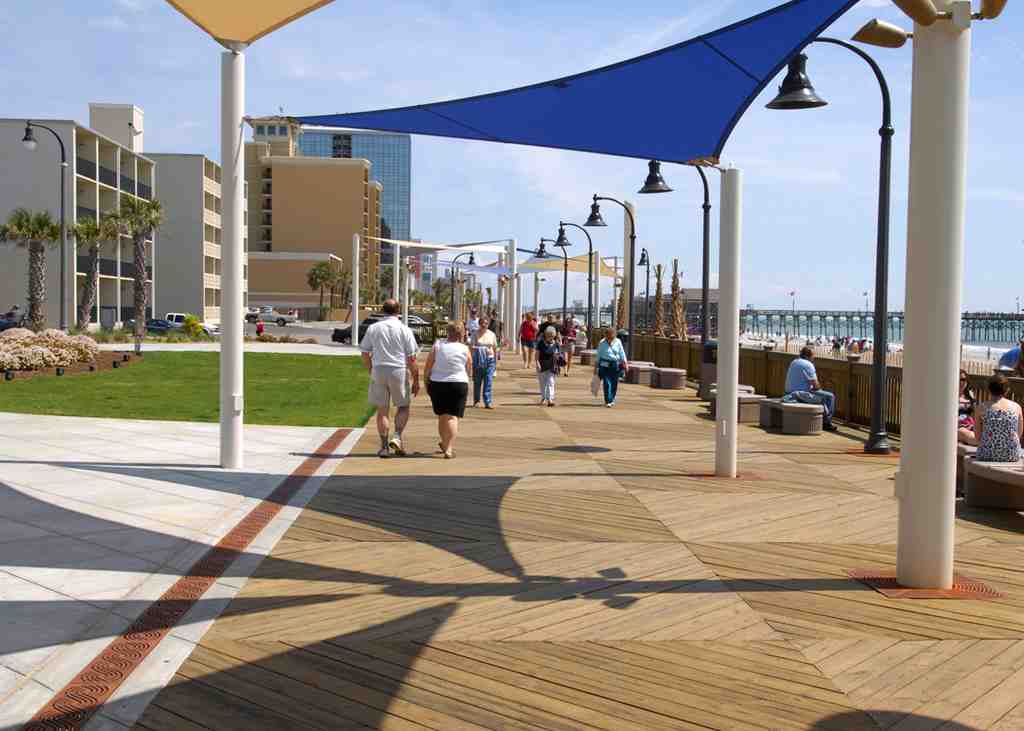
On your left, the Myrtle Beach Boardwalk looks like a long wooden-plank promenade with railings, a broad gently curving path, and the oceanfront piers marking its reach north and south.
For a place so tied to vacation mythology, Myrtle Beach spent a surprisingly long time without much of a boardwalk at all. A beach town without a proper boardwalk is a little like a diner without coffee... technically possible, but nobody trusts it. The first version here linked the Sea Side Inn, Myrtle Beach’s first hotel, to the early pavilions. By the nineteen thirties, the city had a wooden boardwalk. In nineteen forty, leaders upgraded it with concrete, then World War Two stalled plans to extend it. Hurricane Hazel finished the argument in nineteen fifty-four and destroyed most of it, leaving only a concrete stretch between Ninth Avenue North and Eleventh Avenue North.
The modern boardwalk grew out of a very specific local ache. When the Pavilion closed in two thousand and six after fifty-eight years, downtown merchants wanted something that could pull people back. David Sebok, who led the downtown redevelopment corporation, put it plainly: most tourists expected a boardwalk, and Myrtle Beach really did not have one to speak of.
So the city argued... and argued properly. Early estimates floated around ten million dollars, then climbed to twelve million. Some leaders wanted nearby businesses to pay more through a special tax district, since they would benefit most. Others said the whole city should chip in. Small business owners worried about the bill. Some residents worried about crime and vagrancy. Meanwhile, designers sketched a traditional wood-plank walkway, a meandering concrete promenade, benches, planters, beach crosswalks, and public parks.
Groundbreaking finally came in September of two thousand and nine, even while the city and Burroughs and Chapin were still sorting out who would pay for the section crossing the old Pavilion site. In the end, the timing helped. The economic slowdown cut construction costs hard, and the full project came in at nearly six point four million dollars, financed with bonds backed by a tourism sales tax rather than higher local property taxes.
What you see here opened in May of two thousand and ten, stretching one point two miles from Pier Fourteen down to Second Avenue Pier. Builders used seven hundred seventy thousand board-feet of lumber - that is a builder’s way of measuring wood by volume - plus five hundred fifty-five thousand screws and three hundred thousand nails. The city added six hundred palmetto trees and fifty thousand beach grass seedlings, because even a promenade needs decent manners.
If you glance at the shoreline photo in the app, you can see the bigger idea: this was never just a walkway, but a stitched edge between downtown and the beach. The northern section began as an eight-foot-wide raised wooden deck. The middle section leaned into restaurants, bars, and gift shops. The southern stretch became more of a meandering oceanfront park with benches and landscaping.
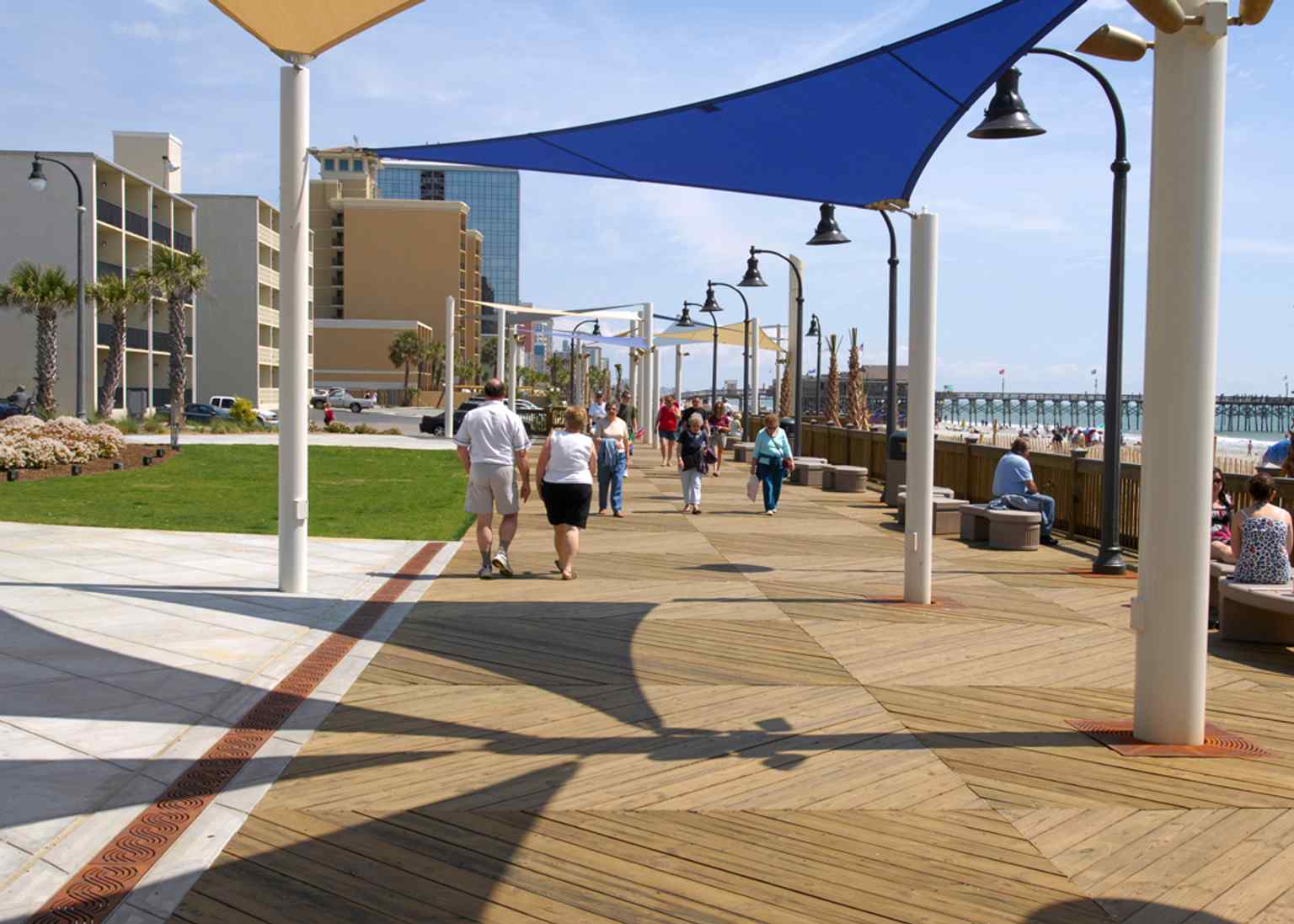
Then came the payoff. National Geographic ranked it the number three boardwalk in the United States. Travel and Leisure ranked it number two. More than nine hundred survey responses gave it four and a half out of five. Even many business owners who opposed it ended up calling to say, yes, fine, it worked. Nearby development followed, including the SkyWheel you can spot in the app image, rising beside the promenade like downtown’s oversized exclamation point.
This boardwalk turned a missing piece of Myrtle Beach into one of its defining lines. When you’re ready, keep following it and head on toward the next stop.





