
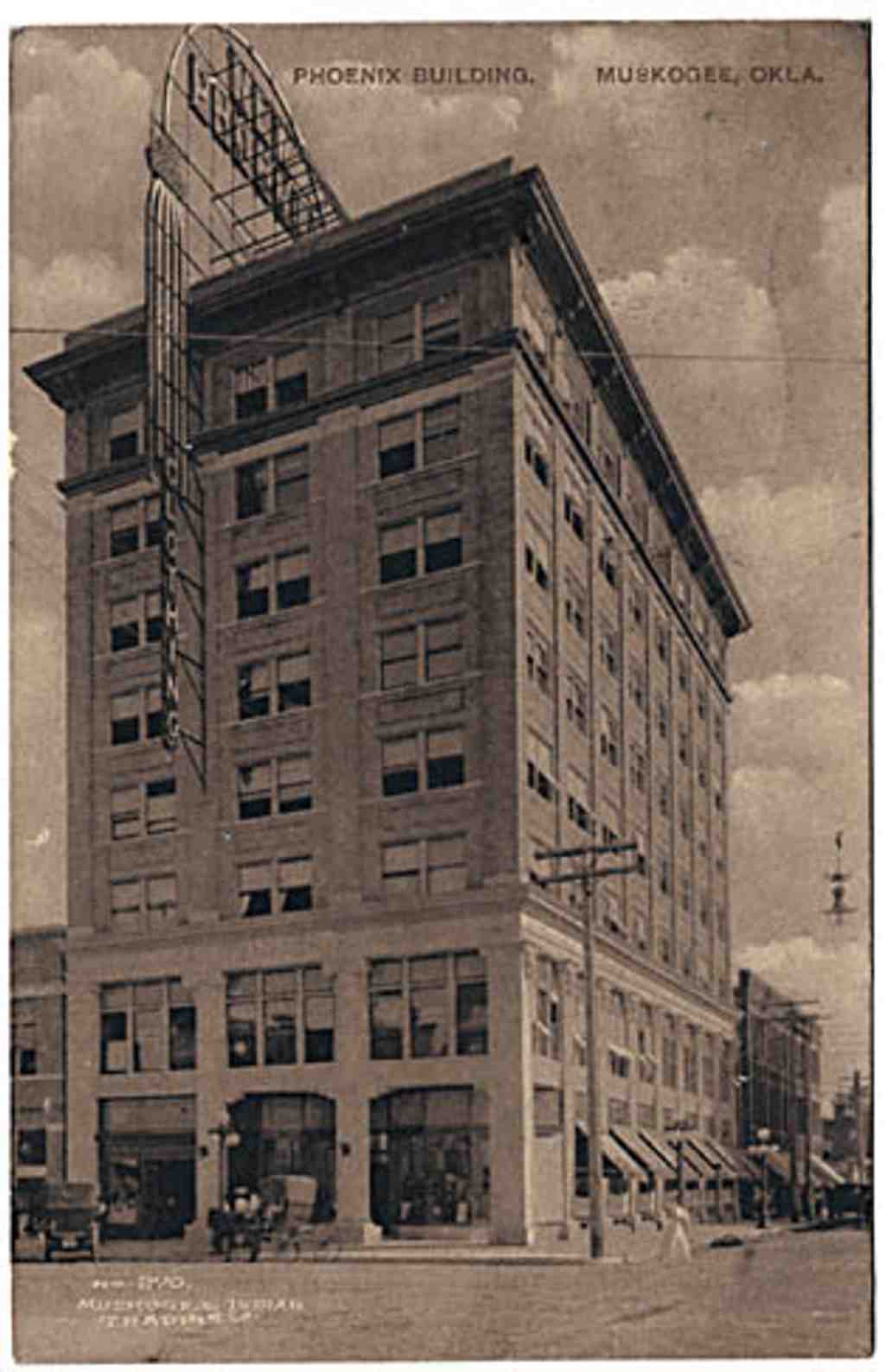
On your right stands a commanding eight-story block of gray brick, distinguished by the two-story columns framing the entrance and a decorative ledge, or cornice, separating the second floor from the rest of the tower.
In 1911, constructing an eight-story skyscraper in a state that was only four years old wasn't just ambitious. It was an act of sheer, unadulterated arrogance. But in Muskogee, confidence was the only currency that mattered. You have to understand the context of the time. Oil money had begun to flood the region, fueling a vertical ambition that transformed the skyline almost overnight. This sudden influx of wealth convinced developers that Muskogee wasn't just a prairie town, but a future metropolis in the making, and they needed the architecture to prove it.
The company behind this structure, Manhattan Construction, was actually the very first business incorporated in the new state of Oklahoma. Its founder, Laurence H. Rooney, utilized a reinforced concrete frame and wrapped it in that gray brick you see today. The design is what architects call Sullivanesque, named after Louis Sullivan, the father of modern skyscrapers. The style uses vertical lines to draw the eye upward, shouting to the viewer that this building is tall, proud, and permanent.
However, Rooney made a surprising pivot. Instead of keeping this marvel as his own headquarters, he sold it to the Phoenix Clothing Company. The new owners apparently felt that an eight-story tower wasn't quite conspicuous enough. They mounted a rotating electric sign on the roof that extended another three stories into the air. They aggressively marketed it as the largest electric sign west of the Mississippi River. Think of that vividly glaring light cutting through the dark Oklahoma plains in 1912, a beacon of commerce that could be seen for miles.
Inside, the building was a sanctuary from the harsh realities of the frontier. Advertisements boasted it was absolutely fire-proof and offered a system that circulated ice water to every floor. In an era before air conditioning, when the torrid Oklahoma summers could be unbearable, having ice water on tap was a rare luxury. It attracted attorneys, government officials, and petroleum companies who wanted the prestige of Muskogee's most advanced address.
Manhattan Construction went on to build landmarks like the Prayer Tower at Oral Roberts University, but this building remained a key branch office for decades. In 1957, a penthouse was added to the roof, creating a private living space atop the commercial hub. But as the oil boom faded, the building eventually fell silent.
Fortunately, it didn't stay that way. In 2009, developers invested nearly eight million dollars to convert the tower into affordable housing for seniors, preserving the original terrazzo floors and copper cornices. It is a graceful second act for a building born from such aggressive ambition.
Now, let's continue our walk. We are heading to the place where the cash that funded these skyscrapers actually changed hands. Please start walking toward the Baltimore Hotel, which is just a few minutes down the road.




