
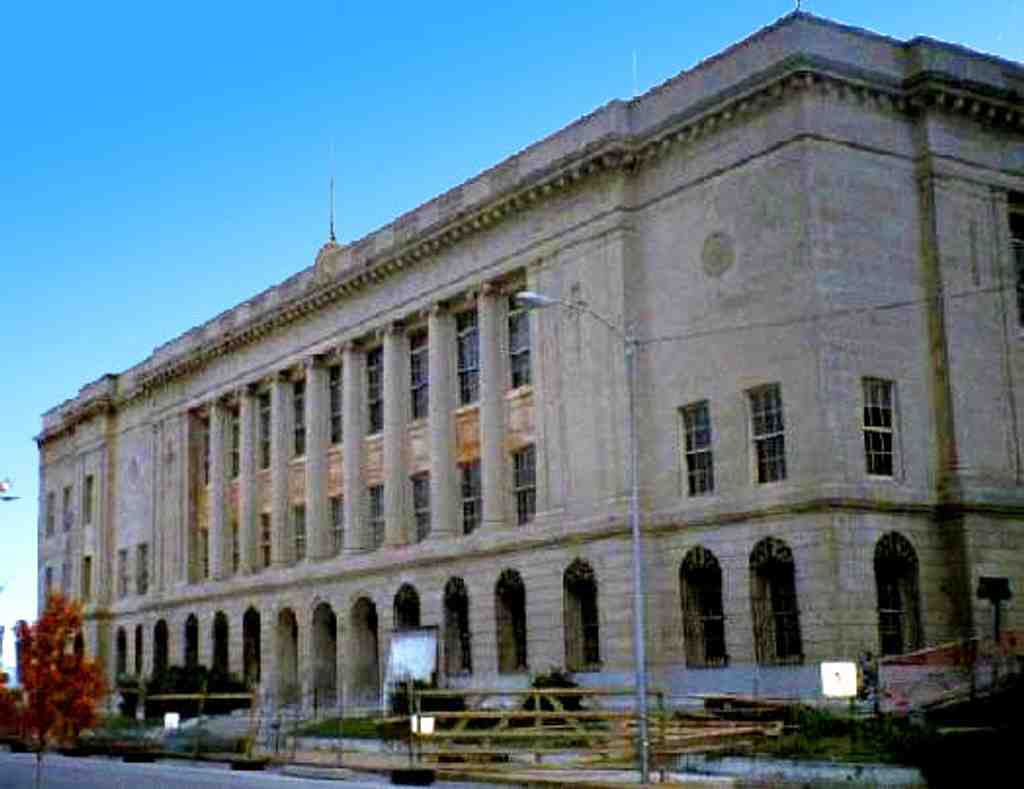
Look to your right at the massive block of buff-colored Indiana Limestone, featuring a long row of arched windows at the base and ten towering columns rising up the center facade.
Consider for a moment what stood here before this fortress of stone arrived. It wasn't grand. It was just five simple, wood-frame houses sitting on the edge of town. But Muskogee was changing. The frontier was closing, and the government needed to prove that law and order had officially arrived.
So, in 1915, they spent half a million dollars-which would be roughly fifteen million today-to wipe away those wooden porches and replace them with this. It is a heavy, permanent statement. The style is Neo-Classical, which is architecture speak for "we want this to look like a Greek temple so you know we're serious." It was designed to be the headquarters for the entire region, housing the post office, the courts, and something called the Union Indian Agency.
That agency placed this building at the center of the most chaotic period in local history: the oil boom. Inside these walls, a department known as the "Royalty" division managed the immense wealth exploding out of tribal lands. But that wealth came with a heavy price.
During the 1920s, this courthouse became a battleground for the fortunes of the Creek Nation. The local legal system developed a habit of declaring wealthy Native Americans "incompetent" so that white guardians could take control of their money. The most famous cases involved wealthy Creek citizens whose land produced millions in oil revenue. They became the center of sensational legal storms, sometimes being held prisoner in local hotels while federal judges in this very building argued over who got to control their estates. It was a clear example of how the government administered the tribes... often for its own benefit.
The first judge to preside here, Ralph E. Campbell, knew that pressure well. He was appointed by Teddy Roosevelt to transition the territory into statehood. He resigned in 1918 to join an oil company, though his tenure ended in the tragic personal mystery we discussed at the previous stop.
The building is named after a man with a slightly more stable career trajectory. Ed Edmondson was an FBI agent and a Navy lieutenant before serving in Congress for twenty years. He was part of a local political dynasty; his brother was actually the Governor of Oklahoma.
Today, this building is arguably more important than ever. Following the historic McGirt ruling we discussed, jurisdiction for major crimes shifted from the state to the federal level, transforming this quiet courthouse into one of the busiest in the nation.
So, we have gone from wooden houses to a stone fortress of federal power. But ambition in Muskogee didn't stop at three stories. Now, look up. We are about to enter the era of the skyscraper.




