
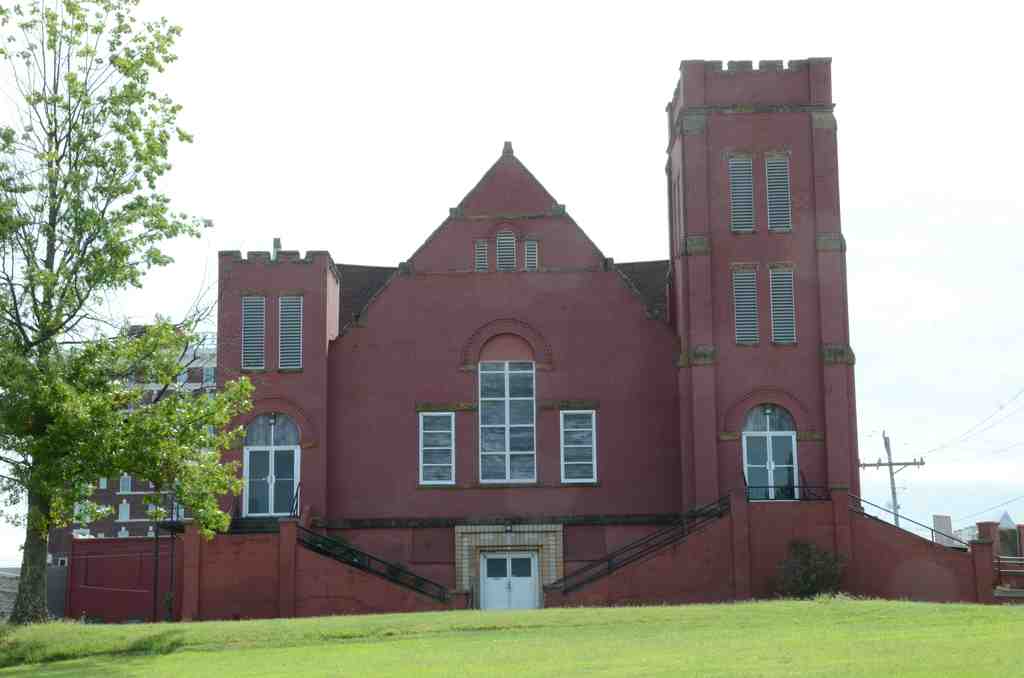
On your left stands First Baptist Church, a striking Romanesque Revival structure defined by its deep red brick, a steep gabled roof, and two asymmetrical towers topped with castle-like battlements.
This building was completed in 1903, but the soul of this place goes back much further. It began in 1877 as a mission school specifically for freedmen and Native Americans. It is a reminder that the frontier here wasn't just two groups colliding... it was a complex Tri-Racial society where Black and Indigenous histories were often deeply intertwined.
When the congregation laid the cornerstones here in 1900, Muskogee was transforming. The African American population would soon make up nearly 31 percent of the city. We talked earlier about the thriving Black business district... well, this was the spiritual anchor to that economic power. Building this massive structure with its rusticated limestone detailing wasn't just about faith. It was a declaration of permanence and pride in a segregated era.
It functioned as a secondary civic center. For decades, the historic black high school, Manual Training, held its graduations here because their own auditorium simply couldn't hold the crowds. Imagine hundreds of families packing these pews to celebrate the next generation of doctors and educators. By the 1920s, the church was so influential it hosted the National Baptist Convention, flooding the city with thousands of delegates. And when the Great Depression hit, they ran a soup kitchen to feed the unemployed when other public services were segregated or unavailable.
There is one final, fascinating chapter here. By the 1980s, the neighboring Jewish congregation had shrunk to just a few families. So, they made a unique property swap. The church took the synagogue's land to expand, and in exchange, the Baptists built a new, smaller temple for their Jewish neighbors... even carefully installing the original Jewish stained glass and holy ark doors. It is a rare example of interfaith cooperation that preserved a legacy.
Now, let’s continue our walk to another historic pillar of this community. We are heading to Ward Chapel AME Church, about an eight-minute walk from here.




