
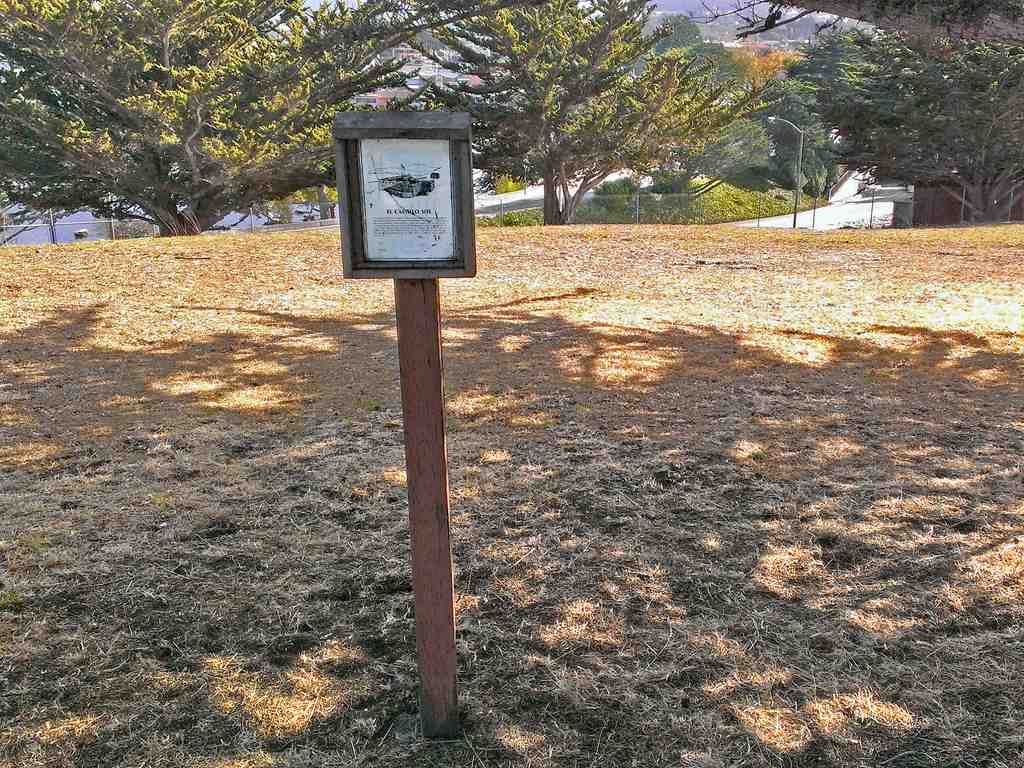
To spot El Castillo de Monterey, look for a small wooden marker with a framed sign in the middle of a grassy, open patch at the top of a gentle slope, shaded by large Monterey cypress trees-a humble reminder of a fortress that once stood watch over this very hill.
Close your eyes for a moment and picture yourself right here, but not as a modern explorer-imagine the year is 1792. Back then, this hillside was alive with the thuds of hammers, the smell of fresh-cut wood, and the nervous chatter of soldiers as the Spanish Empire rushed to build their fort against the winds of Monterey Bay. The Castillo, called simply “The Castle” by the locals (well, the Spanish had a flair for drama), stood not as an ornate palace, but as a rugged defender: seven cannons pointing out, four waiting in reserve, all lined up behind a makeshift log barricade. You’d have seen soldiers bustling about, always watchful, peering over the bay, ready to defend the Presidio and port below-maybe hoping no one would ever actually test how prepared they really were!
Well, that wish didn’t quite pan out. Over the years, the Spanish upgraded the fort-more earthworks, a wooden gun platform held steady by adobe bricks, and a barracks for the artillerymen who, rumor had it, always kept an eye on the bakery down the hill. The improvements kept coming, but the locals had a running joke: El Castillo was stubbornly “not-quite-finished.” Still, it held its head high on Presidio Hill, boasting sweeping views and just enough firepower to make invaders think twice.
Then, in 1818, Monterey’s sleepy fort life got a jolt that no siesta could cure. Argentine pirates led by Hippolyte Bouchard sailed into the bay-cue dramatic music-and turned this quiet outpost into a battlefield. The defenders’ cannons thundered, the air filled with gunpowder and shouts in Spanish, but the pirates landed at nearby Point Pinos and outflanked them. El Castillo’s defenders were overwhelmed, cannons were turned against the town, and the pirates set Monterey ablaze before vanishing into the Pacific mist-one can almost hear the “Arrrgh!” echoing off these hills.
By the 1820s, Mexico had claimed California, and the Castillo got swept up in revolutionary tides. In 1836, locals tired of the government-ranchers, Indigenous people, even some Americans-stormed the fortress, fired a single warning shot, and forced the surrender of the governor. That’s right, this fort fell to a single cannon shot. Talk about efficiency!
Then, a few years later, came an honest-to-goodness case of mistaken identity: in 1842, American Commodore Thomas Jones, convinced the U.S. and Mexico were at war (pro tip: check your mail), charged in and took the fort, only to apologize and hand it back when he realized he’d jumped the gun.
By 1846, the U.S. Navy was back, this time with official paperwork, and the stars and stripes waved over Monterey. They decided El Castillo was a little too cozy and built a new fort behind it. With all these takeovers, by 1880, the old fort had melted back into the earth.
Archaeologists uncovered its secrets in the 1960s, and today, you stand where seven flags once waved, cannons flashed, and pirates danced. This simple, quiet marker before you hides all the layers of adventure, mistake, bravery, and a little bit of mischief that made El Castillo de Monterey the “castle” with more stories than walls. Want to take a selfie and say you visited a site that’s been Spanish, Mexican, American, pirate-occupied, and mistaken-for-the-wrong-war-all in one lifetime? Only in Monterey!


