
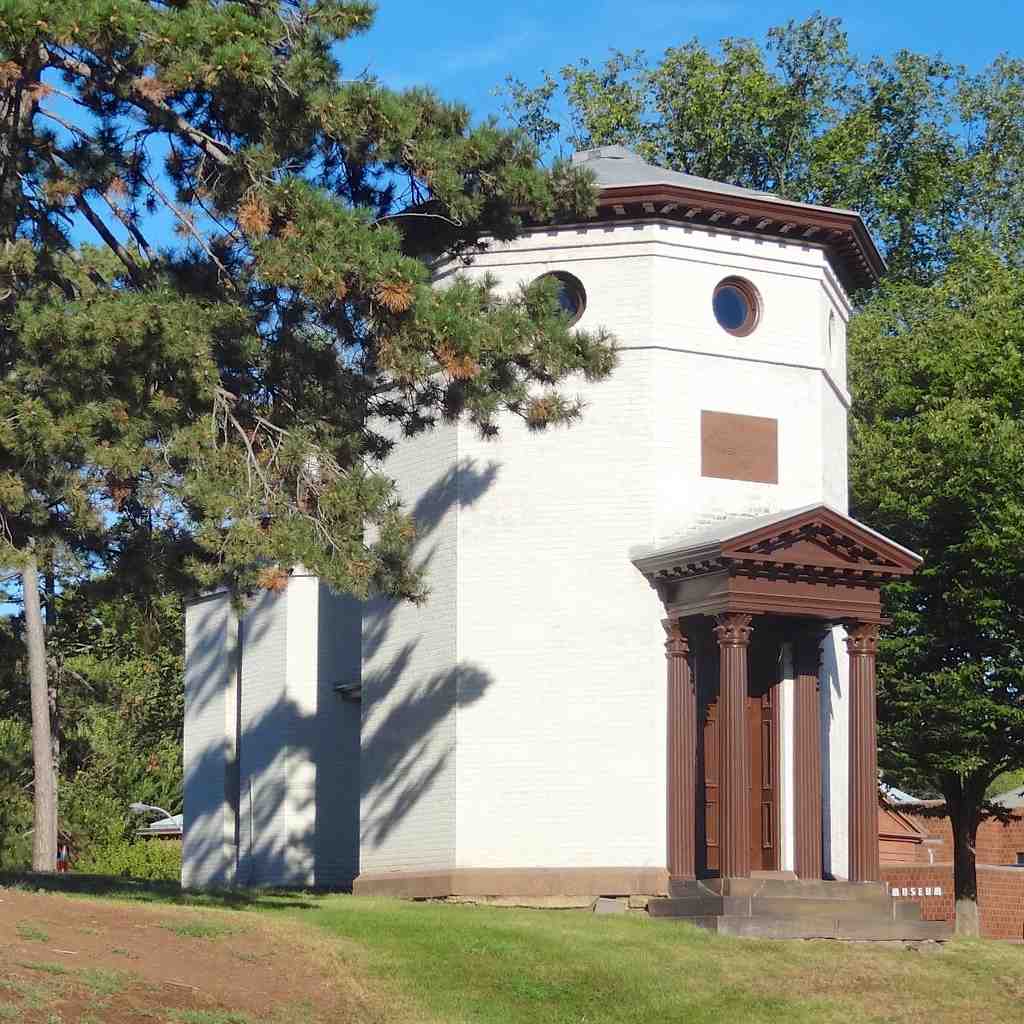
Straight ahead, you’ll spot a crisp white, octagonal brick building with a dark brown, columned porch-almost like a mini Greek temple tucked under the trees, with its round windows peering out like curious eyes.
Ah, here we are... the Daniel S. Schanck Observatory. Don’t let its size fool you-this humble, two-story structure has seen more celestial drama than your average Netflix binge. Built in 1866, it stands as Rutgers’ original science building, a time capsule from an era when measuring the heavens meant standing right here-on George Street, just a streetlamp away from college foot traffic and the wafting aroma of pizza by the slice.
Let’s go back to the mid-1800s. The United States was busy launching westward and upward, but Rutgers... was just discovering the stars. In 1864, the college got a major upgrade: federal funding thanks to the Morrill Act. Suddenly, a school built on the classics-Latin, Greek, and philosophy-needed a place for telescopes, clocks, and the whirring gears of science. Enter Professor David Murray, who championed this observatory as Rutgers’ bold step into scientific education. Now, Murray had a dream, but not a checkbook-so that’s where Daniel S. Schanck, a New York businessman with Monmouth County roots, comes in. He wasn’t a Rutgers alum. In fact, he probably couldn’t pick the Scarlet Knight out of a lineup, but when friends tapped him for cash, Schanck opened his wallet... and his son later walked onto campus as a student-two investments for the price of one.
The observatory you see was designed by Willard Smith in an ancient Roman Revival style... inspired by the Tower of the Winds in Athens, which, back in 50 BC, was sort of Google Maps and the Weather Channel rolled into a marble tower. Picture the hustle on dedication day, 1866: Joseph P. Bradley, destined to sit on the Supreme Court, gives a rousing speech, students buzz with excitement, and astronomers peer through what's now tied for the country’s seventh oldest observatory.
Inside, it was every Victorian science nerd’s dream. There were telescopes, a sidereal clock for tracking star time, and donations from campus literary societies so they’d never miss a comet-or a deadline. The grandest of these gadgets was a 6.5-inch equatorial refractor telescope, a contraption that could make a student feel like Galileo without the risk of house arrest.
But the observatory’s story isn’t a straight shot into the stars. Through the decades, it fell into periods of quiet and neglect-a victim of vandalism, stolen telescope parts, and the fickle tides of university funding. One professor after another tried to revive it, and in the ‘70s, students with big dreams and probably bigger bell-bottoms dusted off the dome. Still, by 1979, Rutgers’ astronomers had migrated to new pastures-specifically, the shiny Schommer Observatory over on Busch campus, boasting a fancier telescope and fewer bats.
There’s a happy twist, though: In 2012, a top-to-bottom restoration made this little octagon shine again, and by 2016, the venerable Georges Prin telescope-now over a century old-was rescued from obscurity and pieced back together by alumni and dedicated volunteers. Today, the Schanck is run by the Cap & Skull Society and the School of Arts and Sciences, who open its doors for guided tours during special events. Imagine standing here at midnight back in 1866, the air cool, the city’s gaslights flickering below, as a student marks the transit of the sun with just a brass telescope and a steady hand.
So as you stand before its weathered brick walls and watch the light slant across that classical brownstone porch, remember: beneath its modest roof, stars and scientists once mingled, and the very idea of “Rutgers science” took flight. That’s a lot of glory for a building you could easily miss if you blinked on your walk to class.


