
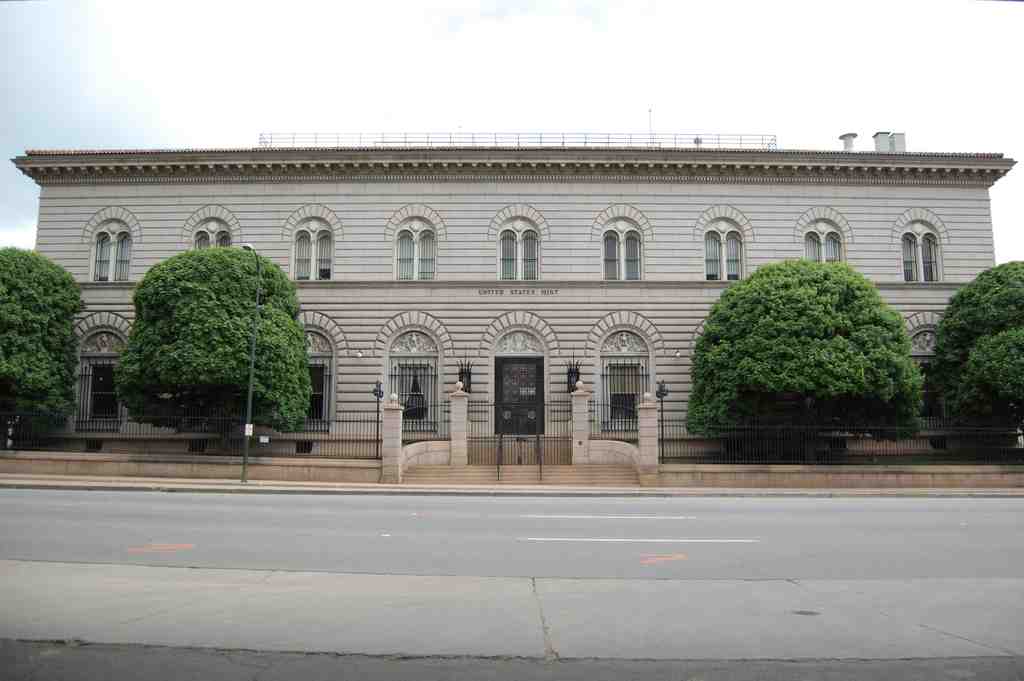
Right in front of you is a grand, two-story stone building with a row of arched windows and ornate iron gates, tucked behind neatly trimmed trees-just look for the solid, fortress-like structure with “UNITED STATES MINT” engraved above the main entrance to spot it!
Welcome to the Denver Mint, where making money is a literal job and not just something your grandparents say when you ask for an allowance! Imagine, it’s the early 1900s-the air thrums with the distant clang of metal on metal, and inside these imposing walls, millions of coins are being born, shimmering and new, ready to jingle in the pockets of Americans from coast to coast.
But before this became the grand palace of pennies you see today, Denver’s first dabble in minting wasn’t the government-it was those wild and wooly days of the Pikes Peak Gold Rush. Picture rugged prospectors trudging into town, boots caked in gold-laden mud, nuggets hidden in their pockets. Clark, Gruber & Co. set up shop in a simple two-story brick building back in 1860, where they’d take that gold dust and turn it into shiny $10 coins faster than you could say “Pikes Peak or Bust!”
These coins had actual images of Pikes Peak and “Pikes Peak Gold” wrapped around the top, a bold local flex before hashtags were a thing. Some coins even had the Goddess of Liberty with “Clark & Company” gleaming in her tiara-a little bit of Denver pride stamped right onto every piece. Now, if you think you’ve had a productive week at work, imagine them minting about $18,000 worth of gold coins per week by hand! That’s a lot of bling for a city still figuring out where to get a decent cup of coffee.
The federal government decided enough was enough and bought Clark, Gruber & Co.’s entire building and minting equipment in 1863. But, in a twist worthy of an old Western, they didn’t actually make coins for a while-just gold bars. The reason? Too many rowdy outlaws and rebel ruckus on the trails during the Civil War. Instead, the Denver Assay Office would melt, weigh, and stamp raw gold, sending those bars back to miners with an official stamp and a hopeful pat on the back.
It wasn’t until way later, after a few false starts, lots of gold, and a few ambitious business plots, that Congress finally blessed Denver with official branch mint status. By 1904, construction was wrapping up on the incredible building you see now-modeled after an Italian palace, complete with Pikes Peak granite and roof tiles all the way from Italy. In 1906, the first clangs of coins echoed out, and Denver was off to the races, minting gold and silver coins by the millions. By the first year, they’d produced 167 million coins-talk about making it rain!
If this place feels sturdy, that’s because it was once the city’s most substantial building, meant to be as tough as any mountain prospector. Step closer to the lobby (if only you could-tours are limited and security is tight!), and you’d find colorful murals showing the drama of mining and the bustle of commerce, painted by Vincent Aderente.
Over the years, the Denver Mint has not only been a fortress of finance but a Hollywood star. Its money appeared in the movie “Cliffhanger,” and it had cameo roles in TV’s “The Wild Wild West” and “Maverick.” There’s even a song named after it-“Lucky Denver Mint” by Jimmy Eat World, just in case you felt like dancing while you save your change.
Today, more than 50 million coins roll out of here every single day, destined for pockets, piggy banks, and probably your couch cushions. So next time you spot a coin with a little “D” beneath the date, remember you’ve stood at the gates of the world’s largest money-maker-where history, drama, and a little touch of Denver gold come together in every shiny cent!




