
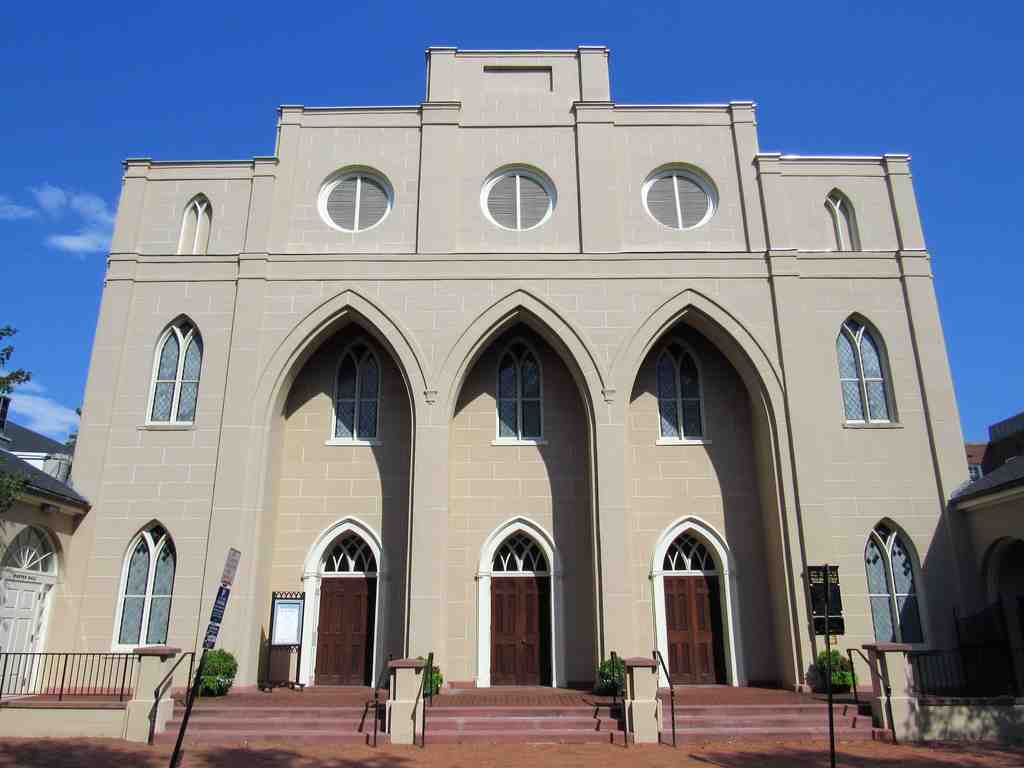
Looking up to your left, you will see a light tan facade distinguished by three towering, pointed Gothic arches that form a shallow front porch beneath a row of three round windows. It is a really striking sight, especially when you realize it was designed by Benjamin Latrobe, the second architect of the United States Capitol.
Check your screen for a clear view of this unique facade. Latrobe was famous for his grand, classical government buildings, but here he went with a style called Gothic Revival. That means he used medieval European elements, like those dramatically pointed arches, to draw the eye upward toward the heavens. Latrobe actually based this facade on a design that was rejected for the Baltimore Cathedral. The rector here at the time, a man named William Holland Wilmer, loved the Gothic look. He felt it captured the deep, historic fervor of the early church.
Wilmer was a total force of nature. When he arrived in 1812, the Episcopal Church in Virginia was struggling to survive after losing its official government funding and status following the American Revolution. Wilmer rolled up his sleeves and practically rebuilt the institution from the ground up. He wrote sermons, founded publications, and started holding classes right here in a small lecture hall. Those very classes eventually grew into the Virginia Theological Seminary.
But Wilmer's most profound legacy here might be the Sunday school he organized in 1818. Back then, Sunday schools were initially designed to teach reading, writing, and the basics of the Bible to the working poor. Here in Alexandria, this school became a quiet but incredibly powerful beacon. It educated white students, yes, but it also opened its doors to members of the local Black community.
In a society deeply entrenched in the horrific system of human bondage, this classroom offered a rare and precious resource. Enslaved and free Black men and women came here to learn to read and write. They used this knowledge to build their own networks, finding dignity and spiritual liberation within the pages of the Bible. It was a quiet, enduring act of claiming mental independence when physical liberty was completely denied.
Tragically, this sanctuary of learning was forcefully shut down. In 1831, after Nat Turner led an uprising further south, the Virginia legislature panicked. They passed draconian laws explicitly forbidding anyone from teaching Black individuals to read or write. The state forced the church to stop educating Black students, trying to crush that hard won intellectual freedom. But the seeds of devotion and strength they had already planted in this space could never be unlearned.
The building you are standing in front of holds all these complex layers of history, from Latrobe's architectural triumphs to the quiet, unyielding power of a marginalized people. Just so you know, if you want to take a look inside, the church is open Monday through Friday from 9 AM to 4:30 PM, and for services on Sunday mornings and evenings.
Now, let us continue to the personal home of one of Alexandria's most fascinating historical figures, the George Lewis Seaton House, which is just a two minute walk away.


