
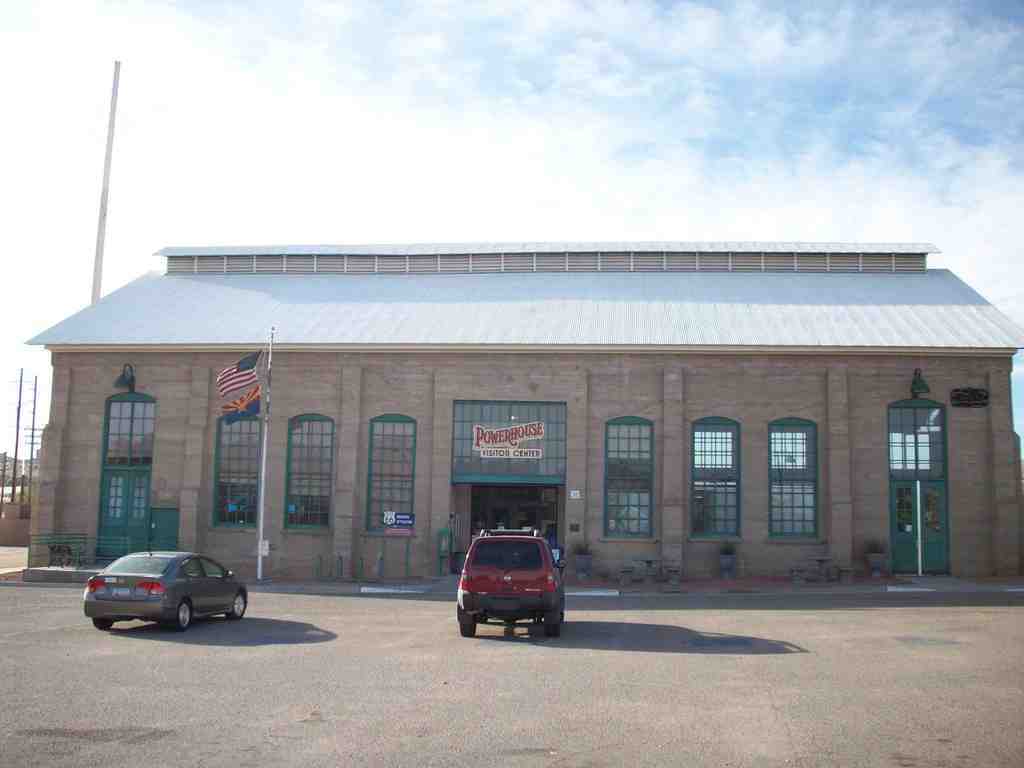
Looking to your left, you will spot a massive rectangular concrete block building capped with a long metallic roof and featuring a large central entrance framed by green window panes. This is the Desert Power and Water Company Electric Power Plant, an absolute monolith of early industrial ambition.
Back in 1906, the Mohave Mining Boom was demanding serious energy. To meet that need, an entrepreneur named Mr. Monteverde envisioned this heavy oil-fired steam plant to power both the distant mining camps and the town of Kingman itself. Construction began in 1907 and cost about three hundred thousand dollars, which translates to roughly ten million dollars today. Building it required serious grit. During construction, a wooden platform collapsed and a falling beam struck a worker named W. P. Vestal right on the head. Though he suffered a massive scalp gash and severe bruises, the tough fellow survived and was expected back on the job just days later.
The plant finally juiced its transmission lines in July 1909, ready to light up the town. Yet, the residents were oddly unimpressed. The reluctant march of progress strikes again. People were highly suspicious of invisible energy running through wires into their parlors. In fact, it was such a novelty when a resident named J. E. Perry finally wired his house a month later, it made the front page of the local newspaper. Even the prestigious Harvey House downtown stubbornly clung to their glowing coal oil lamps until the summer of 1912. The plant owners eventually had to launch a marketing campaign, practically begging locals to Do It Electrically, promising the power was as reliable as the sun itself.
Eventually, the town caught on. The plant expanded massively, and in 1922, a showroom managed by James F. Davidson was added to help locals order parts to build their very own in-home radios. But by 1938, the massive new Hoover Dam took over the region's electrical supply, making this expensive oil-fired plant obsolete overnight. The generators were stripped, leaving an empty shell that sat neglected for decades.
That changed in 1984 when two local women formed a preservation group called the Powerhouse Gang. They convinced the corporate owners to hand over the dilapidated property for a tax write-off. After years of hard work, they transformed this rugged frontier powerhouse into a modern visitor hub. In a fitting twist of fate, this former steam plant now houses the world's first museum dedicated entirely to electric vehicles. If you want to explore inside, the building is generally open eight to five Monday through Thursday, and nine to four Friday through Sunday.
Now, it is time for a proper farewell to the steam era, so let's head over to the Santa Fe 3759 locomotive, which is just a four-minute walk away.




