
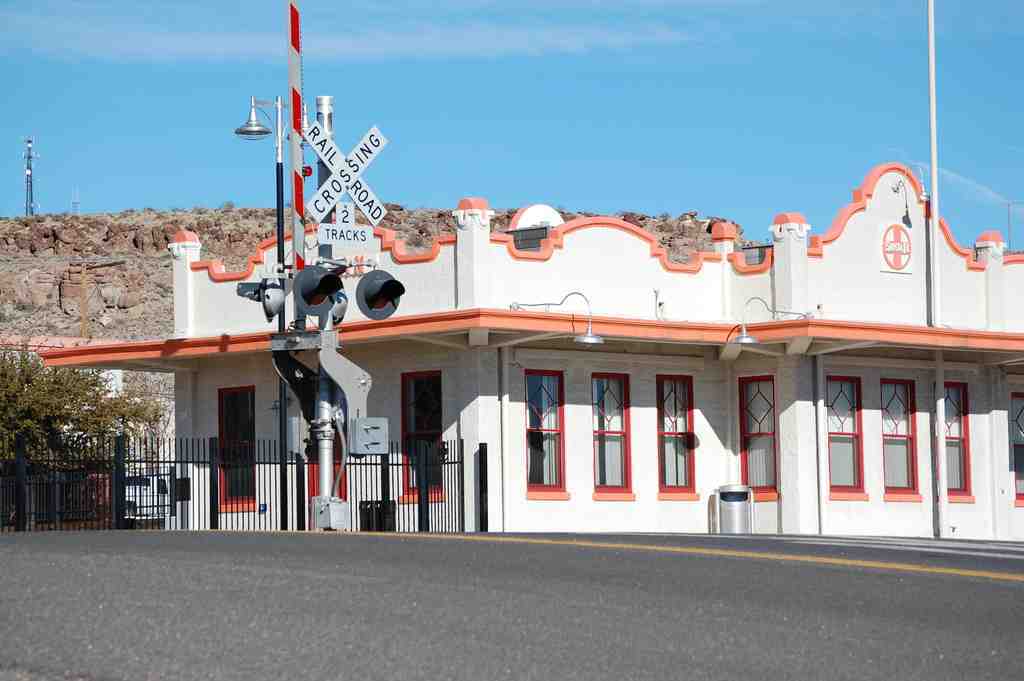
Look for the bright white stucco building with its distinctive curved roofline, vibrant orange trim, and the iconic Santa Fe cross emblem right by the tracks. The Atchison, Topeka and Santa Fe Railway literally laid the foundation for this town's existence, and to this day, it remains an active, vital artery pulsing through Kingman.
Back in the late nineteenth century, simply keeping a station standing here was surprisingly difficult. The very first depot was just a boxcar in 1883. Then came a two story wooden building, but in 1900, hot cinders from a passing steam locomotive burned it to the ground. The railway confidently built a third depot in 1901, touting it as completely fireproof. Five years later, another locomotive smokestack sparked a blaze that destroyed that one too.
Taking absolutely no chances, the railway constructed the building you see now in 1907. They used poured reinforced concrete for the entire structure, roof included, before finishing it with Spanish Mission style stucco siding. That architectural style takes its cues from the old colonial missions of the southwest, which explains those elegant, sweeping curves along the roofline. The concrete did the trick, and the curse of the fires finally ended.
With its walls secure, this depot became the town's true heartbeat. During World War Two, it processed thousands of troops arriving to train as aerial gunners at the nearby Kingman Army Airfield. Later on, mid century freight trains rolled through so slowly that a nearby bar made a habit of keeping a tray of beers ready. The train engineer would hop off the front of the moving engine, run into the bar to pay, grab the drinks, and still have enough time to jump onto the rear of the train as it passed.
Yet by the early two thousands, this grand old building had fallen into such severe disrepair that it was entirely closed to the public. Amtrak passengers were actually forced to use a makeshift waiting room in a nearby storefront, completely overlooking the historic depot next door. But a community cannot abandon its roots, and the 2011 restoration reflects a deep desire to preserve our rough and tumble past while confidently moving forward. Today, accented with that bright orange trim to celebrate the Route 66 revival, it serves as a busy Amtrak stop and a museum run by the local Whistle Stop Railroad Club. If you want to take a look inside, the building is open to visitors on weekdays from nine to five thirty.
Now, let us head down toward Beale Street to uncover the hidden lives of early merchants, starting with the Armour and Jacobson Building just a short three minute walk from here.




