
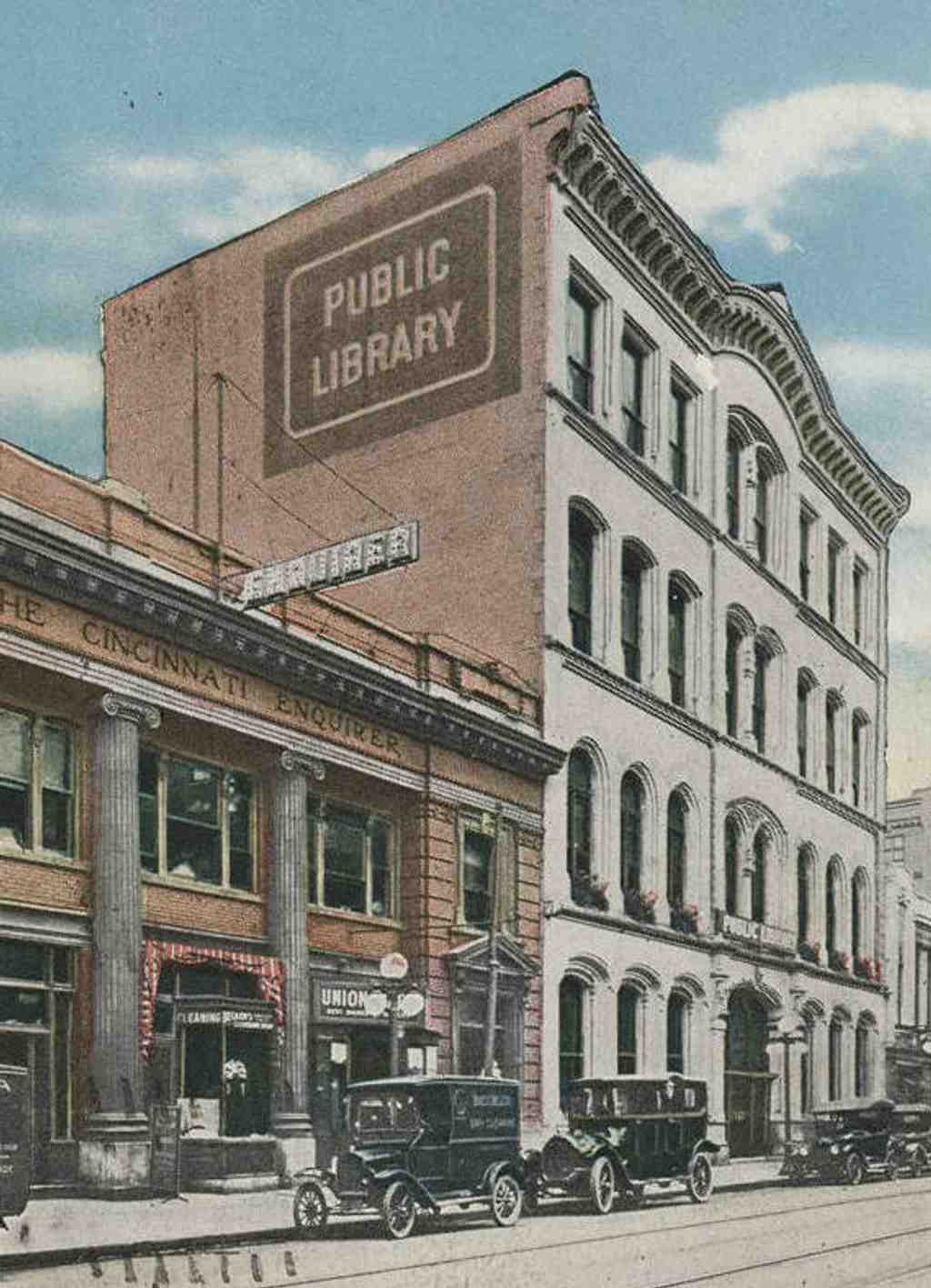
Look to your right for a grand, cream-colored four-story building with tall arched windows and a huge “PUBLIC LIBRARY” sign painted boldly up high - you really can’t miss its solid rectangular shape next to the more ornate facade of the Cincinnati Enquirer.
Now, let’s travel back to old Cincinnati: imagine the clang of horseshoes on brick, the rattle of streetcars, and the proud sight of book lovers lining up outside this stately library on Vine Street and 6th, a beacon for the curious, the scholarly, and the just-plain-nosey! It all began with a bit of good fortune - or misfortune, if you were longing for opera - because this very building was meant to be an opera house. But after the owner’s money ran out in 1868, the city swept in and transformed fresh ambition (and a half-built stage) into a library for the people. Picture architect James W. McLaughlin and the ever-creative librarian William Frederick Poole huddled over blueprints, making decisions that would shape Cincinnati’s future and leave a checkerboard marble floor under your feet and spiral staircases swirling up to whispering domes above.
The library’s grand opening spread over years, first in late 1870 and finally completed in 1874. The main hall became legendary: imagine stepping inside under sunlight streaming past a huge skylight, the air cool against polished cast-iron alcoves brimming with book spines. The busts of Shakespeare, Milton, and Benjamin Franklin watched from on high, eager perhaps to see who would borrow which tales or test which lofty thought. Newspapers raved about this modern marvel with its bright reading room, making sure every corner got a fair share of sunshine. The cost? A pretty penny: more than $9 million in today’s money. But for a city hungry for knowledge, every cent felt well-spent.
But just like my favorite pair of old jeans, the space started feeling tight-fast! Built to house 300,000 treasures, the shelves groaned with 1.5 million books by 1955! Books peered three-deep on every ledge, some banished to the fears of a flooded sub-basement. Down there, the air was so thick with the scent of wet paper that librarians weren’t allowed in for more than twenty minutes, and sometimes the wait for a rare volume stretched for days. As book after book squeezed through, the floors bent with the weight, and building inspectors nervously eyed the lantern slide collection-45,000 glass slides!-as it threatened to tumble through the third floor.
You’d need a laugh at this point: there was so much coal soot from the ancient furnaces, they hired book cleaners whose entire job was to wipe the grime off the stacks! Summers turned the place into a gently roasting sauna and, with only a sprinkle of small windows, the reading rooms sometimes resembled medieval dungeons more than scholarly havens. Even the elevators came with a warning: only library pages (the bravest souls) were allowed in the stacks, but even they sometimes met with tragic accidents.
And so, by the 1920s, the chorus began: “We need a new library!” Decades later, in 1955, the march of progress finally caught up, and a grand move was made to a new site just two blocks away. Imagine the flurry-staff taping, labeling, packing books by the inch, the city’s literary soul boxed overnight and reborn in fresher air. The old building, tough as the characters it housed, “died hard”-taking a hundred days and dozens of workers to come down, leaving behind not just bricks and rubble, but memories of heated debates, quiet dreams, and discovery after discovery.
Today, an office building and parking garage claim the spot, but if you listen quietly, you might catch the faint rustle of pages, or maybe the distant laughter of a librarian still dusting off the soot. And if you’re jealous of those long-vanished book lovers-don’t be! The busts of Shakespeare, Milton, and Franklin made the trip to the new home, ready to welcome the next generation of reading enthusiasts. No ghosts here-just the spirit of Cincinnati’s thirst for knowledge, echoing across the ages.
Yearning to grasp further insights on the background, construction and design or the challenges? Dive into the chat section below and ask away.




