
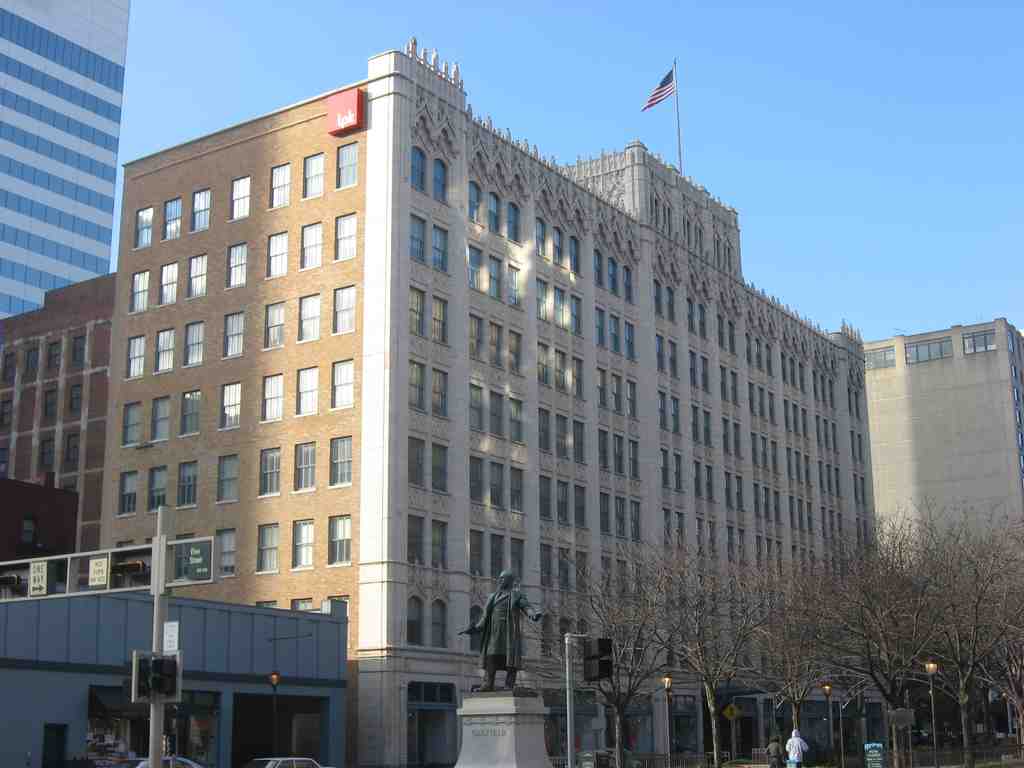
To spot the Doctors' Building, just look across Garfield Place and you'll see an eight-story structure with tan brick and ornate, pale terracotta details, crowned by an American flag waving from the roof-it's right next to the statues in Piatt Park.
You’re standing in front of a building that was truly ahead of its time-back in 1923, Cincinnati’s skyline welcomed a brand-new high-rise, but this one was special: it was built solely for doctors’ offices! Imagine a sea of physicians in white coats bustling inside, hopeful patients making their way through sleek marble-clad halls, and the gentle hum of typewriters clicking away behind wooden doors. The Doctors' Building was like a medical mall before malls were even cool.
The creative minds behind this Gothic Revival beauty were Tietig and Lee, the city's superstar architects of the era. While downtown Cincinnati was awash in Art Deco and neoclassical blocks, this eight-story marvel stood out like a dapper physician at a picnic-it was not just practical, but seriously stylish! Its facade is sheathed in intricate terracotta tiles, giving the building an almost cathedral-like appearance. If you squint, you might imagine gargoyles peeking out just above the arched windows. The marble, brick, and just enough metal accents to make you think of a shiny stethoscope tie together this icon of medicine and ambition.
But for as calm and stately as it looks now, this building has weathered many a storm in the wild world of Cincinnati real estate. Fast-forward to 1984; city planners had dollar signs in their eyes and big ideas for the area. They wanted to fill Garfield Place with gleaming new high-rises and hundreds of homes, dreaming of knocking out part of the Doctors' Building for a parking garage. In swept Ameritas Inc., buying the place for a cool $3 million, but talks with the city hit a brick wall faster than you can say “malpractice insurance.”
Drama wasn’t done yet! In the late ‘80s the building was renamed Presidential Plaza to honor the neighboring statues of U.S. Presidents Harrison and Garfield. Imagine the presidents looking on approvingly-or maybe suspiciously-at all the hustle below. But even big names and starry plans couldn’t keep the finances healthy. Renovations ballooned in cost like a hospital bill, and construction was followed by a rapid shuffle of owners, lawsuits, and unpaid contractors. Star Bank jumped in with millions in loans, but by the early 1990s, it all tumbled into foreclosure, leading to auction drama and a parade of partners and suitors.
Eventually, the groups Wolf Blumberg Krody and LPK stepped in, eager to make their mark (and maybe stop the revolving door of owners). Over the years, the building evolved, office by office, into a creative and business hub, with LPK eventually occupying over half the space.
And just when things seemed to settle, in 2024 the story picked up speed again. LPK sold this iconic landmark to Ashley Builders Group, who aimed to sprinkle a little bit of everything in here: 52 sparkling apartments, offices for dreamers and doers, and a café for morning caffeine emergencies. The city pitched in with a tax break and construction began again in winter 2024, even as Ashley Builders Group crossed its fingers for $1.3 million in historic tax credits. By 2025, costs had nearly tripled to $12.9 million, but the transformation of this building from medical mecca to modern mixed-use marvel was finally moving into its newest chapter.
So as you stand here, gaze up at a building that’s survived medicine, money, and mayhem-with a little bit of Gothic swagger and a dash of presidential company. It’s living proof that if you keep your architectural heart beating, you’ll never fall out of style!




