
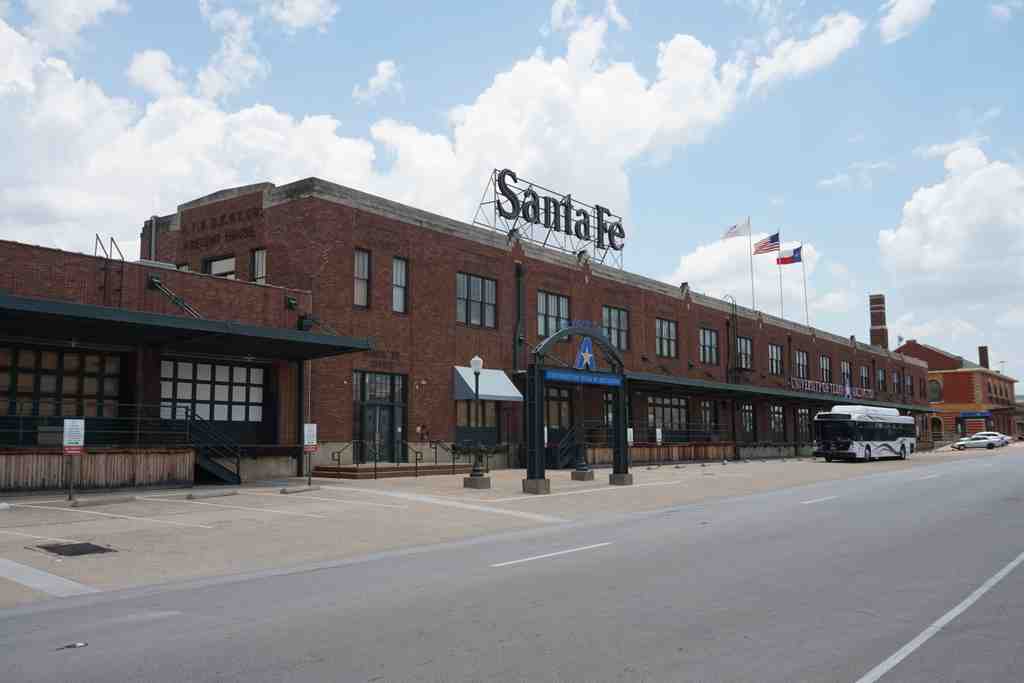
Look to your right at that long, two-story rectangular building, distinguished by its stepped roofline parapet and the bright neon Santa Fe sign mounted on the exterior.
It stands solid, doesn't it? This structure appeared in 1938. That year wasn't exactly a party. The Great Depression had been grinding the American economy into dust for nearly a decade. While much of the country was paralyzed by economic despair, Fort Worth used federal PWA funds to fuel a surprising building boom. This freight depot was a bit of a defiant gesture against the hard times, a symbol that commerce was still moving, even if it was moving slowly. It cost nearly a hundred and twenty-four thousand dollars to build-which is well over two and a half million in today's money. That was serious cash for a warehouse back then.
The design here is quite specific. It represents a style called PWA Moderne. You can think of it as Art Deco on a budget. Classic Art Deco is all about glamour, zig-zags, and gold leaf-the kind of flashiness you see in movies about the Roaring Twenties. PWA Moderne-named after the government's Public Works Administration-stripped all that excess away. It kept the sleek lines and the reinforced concrete but focused on stability and strength. It’s utilitarian, sure, but it has a quiet dignity. The style was popularized by federal projects to project efficiency, and private companies quickly adopted the look.
Originally, this was a joint operation between the Santa Fe Railway and the Southern Pacific Company. The ground floor was packed with cold storage for perishable goods coming off the rails, while the railway bosses and division superintendents pushed paper in the offices upstairs. It took up to a hundred workers to build it, though construction was actually delayed by the Little Steel strike in the summer of 1937.
But like the neighborhood around it, this building had to figure out how to survive when the trains stopped being the center of the universe. By the mid-nineties, the depot was vacant and crumbling, listed as one of the city's most endangered historic properties. But Fort Worth hates to waste a good foundation. In 2002, developers tried to turn this into the Fort Worth Rail Market. It was an open-air hall with boutique shops, a place called Hot Damn Tamales, and even the city's first vegan spot, Spiral Diner.
It sounds charming, but the financials were a disaster. The market bled money-hundreds of thousands in the red-and amidst finger-pointing between merchants and city managers, the whole thing shut down by 2005. The profit margins just weren't there, and the public interest wasn't either.
That could have been the end, but reinvention is a habit here. In 2006, the University of Texas at Arlington stepped in. They dropped over a million dollars to overhaul the interior, turning cold storage lockers into classrooms. Since 2007, this depot has served as UTA’s Fort Worth satellite campus, churning out thousands of degrees in everything from business to social work.
It is a nice evolution when you think about it. A place built to store perishable freight now stores knowledge, which has a much longer shelf life. As we move to our next stop, consider how buildings, like people, often have to reinvent themselves to survive. We're going to keep with that theme of education and adaptation as we head to the Texas A&M University School of Law, just a four-minute walk from here.




