
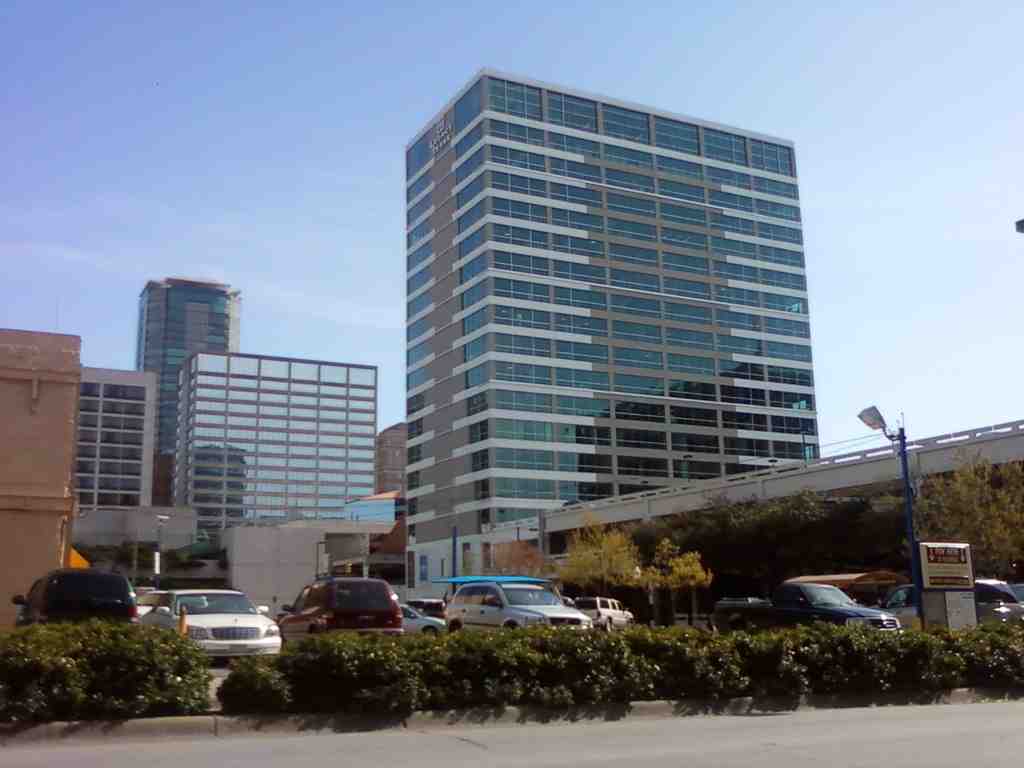
Look to your left at the towering rectangular structure defined by a geometric grid of blue-tinted glass alternating with stark white horizontal bands.
You are looking at City Place, but locals of a certain age might still call this the Tandy Center, or even Leonard’s. This site is a perfect example of how this city constantly paves over its past to build something new, only to have the old stories linger in the foundation.
It started with Leonard’s Department Store. This wasn't just a shop; it was a lifeline. Back in 1933, during the Great Depression, the banks froze cash flow. So, the owners printed their own money. They called it Leonard’s Scrip. It worked because the community trusted the family behind the counter more than the government. That loyalty ran deep. Years after the store closed, a man known only as Jimmy left a one hundred dollar bill at a museum with a note confessing he had stolen books as a poor child and wanted to finally settle his debt.
To get people to the store, the founders, Marvin and Obie Leonard, built the Leonard’s M&O Subway. It was a private underground train system, the only one in the country, which even got a mention in Ripley's Believe It or Not. For forty years, people rode those rattling streetcars from the parking lots. There was a distinct smell of electrical ozone and that sudden, jarring shift from the blinding Texas sun into the dark tunnel that everyone remembers.
In the seventies, the RadioShack corporation-then called Tandy-took over. Their boss, Charles Tandy, was a man who lived by the motto, "You can't sell from an empty wagon." He turned this site into a corporate fortress with these twin towers. They added a mall and a famous indoor ice skating rink where generations learned to stay upright on blades.
But corporate fortresses aren't invincible. In 2000, the same tornado that damaged The Tower struck here with terrifying force. The glass walls failed completely. Shards rained onto the street. One tenant returned to his office on the 13th floor to find it decimated by the wind. It looked like a bomb site, yet he found his father’s Bible sitting there, untouched amidst the wreckage.
The mall eventually died a slow death, becoming a ghost town of trash-strewn corridors before the retail section was demolished. Now, it is shiny office space. But forty-two feet below your shoes, the old subway tunnel still exists. It is sealed off and rotting in the dark. One manager described it as looking like a zombie movie set, silent and eerie. They keep a polished subway car in the lobby as a tribute, but the real history is buried in the dark, just beneath the surface.
Let's walk to our final stop, a place dedicated to making sure these kinds of stories aren't forgotten.




