
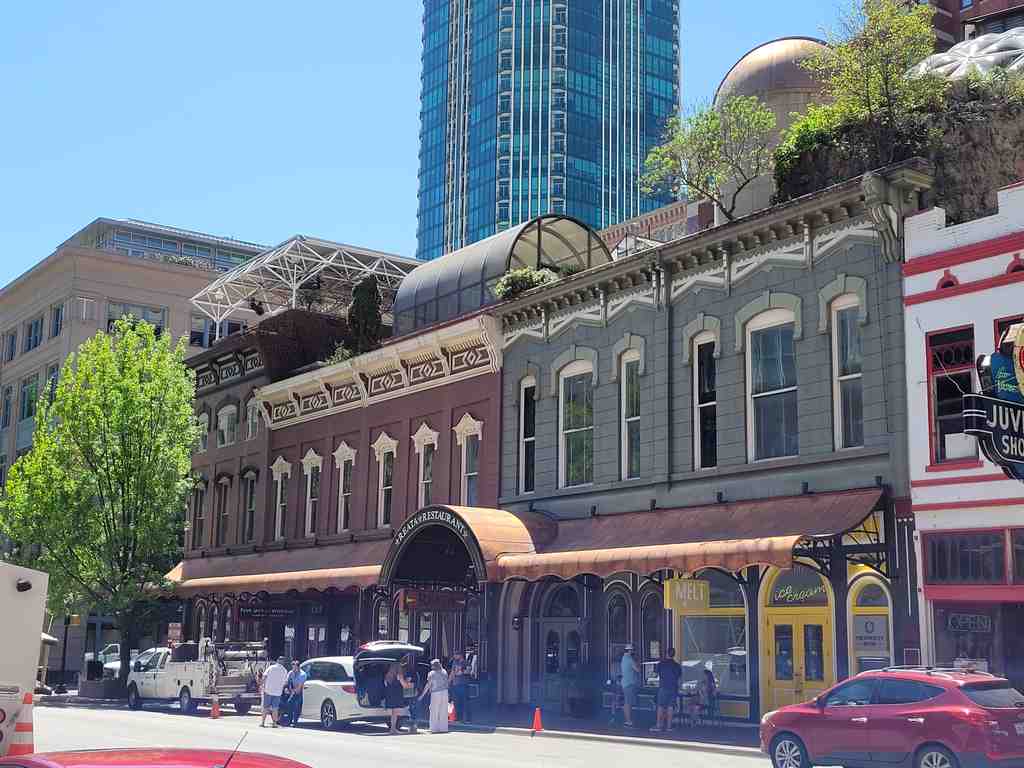
Look to your left at the building combining a vintage 1880s brick facade with a modern structure rising behind it, capped distinctively by a glass geodesic dome on the roof.
Back in the early 1980s, Fort Worth was working hard to shuffle off its reputation as just a cow town. While the stockyards were embracing their history, the central business district was looking for a new rhythm. And they found it right here. This building was the Caravan of Dreams. It was a performing arts center that felt like a hallucination in the middle of Texas, financed by billionaire oil heir Ed Bass.
Ed Bass and the artistic director, Kathelin Hoffman, had a vision that went far beyond a simple honky-tonk. They wanted a meeting place for the avant-garde... which is just a fancy way of saying experimental, unorthodox art that pushes boundaries. The facility was actually new construction built behind those historic 1880s facades you see, blending the old frontier with something radically new.
When it opened in 1983, it was a massive event. The opening celebration featured Fort Worth native Ornette Coleman. Coleman was a titan of free jazz, a style that abandons traditional structures for pure expression. The city was so proud they declared it Ornette Coleman Day and gave him a key to the city. Imagine that night... the complex rhythms of Prime Time, Coleman’s ensemble, spilling out onto Houston Street.
But the Caravan was more than a nightclub. It was a creative factory. It housed a 212-seat theater, two dance studios, and a multitrack recording studio. They even ran their own record label here, pressing albums for Coleman and spoken word recordings by counterculture literary figures like William S. Burroughs. It was an international hub. A Turkish playwright named Ferhan Sensoy even wrote about coming here to discuss projects with the management, a testament to how far the Caravan's reputation reached.
If you look up at that glass structure on the roof again, that is a geodesic dome... a spherical structure made of interconnected triangles. It housed a rooftop garden filled with hundreds of cacti and succulents. Here is a fun fact. The expertise gained from building that dome and maintaining the garden involved some of the same individuals who would later work on Biosphere 2, that massive science experiment in Arizona designed to simulate a closed ecological system.
Over time, the venue shifted gears. The experimental edge softened, and under new management, the nightclub began hosting more mainstream acts like jazz guitarist Peter White and the band Acoustic Alchemy. The wild, artistic fever dream eventually faded, and the club closed its doors in 2001, exactly eighteen years after that first legendary night with Ornette Coleman.
Today, the building has reinvented itself again. It now hosts the popular restaurant Reata and the Four Day Weekend comedy theater. It remains a place where people gather to laugh and eat, proving that while the tune might change, the music never really stops.
Prepare yourself. The next building was ground zero for the most destructive event in modern Fort Worth history.




