
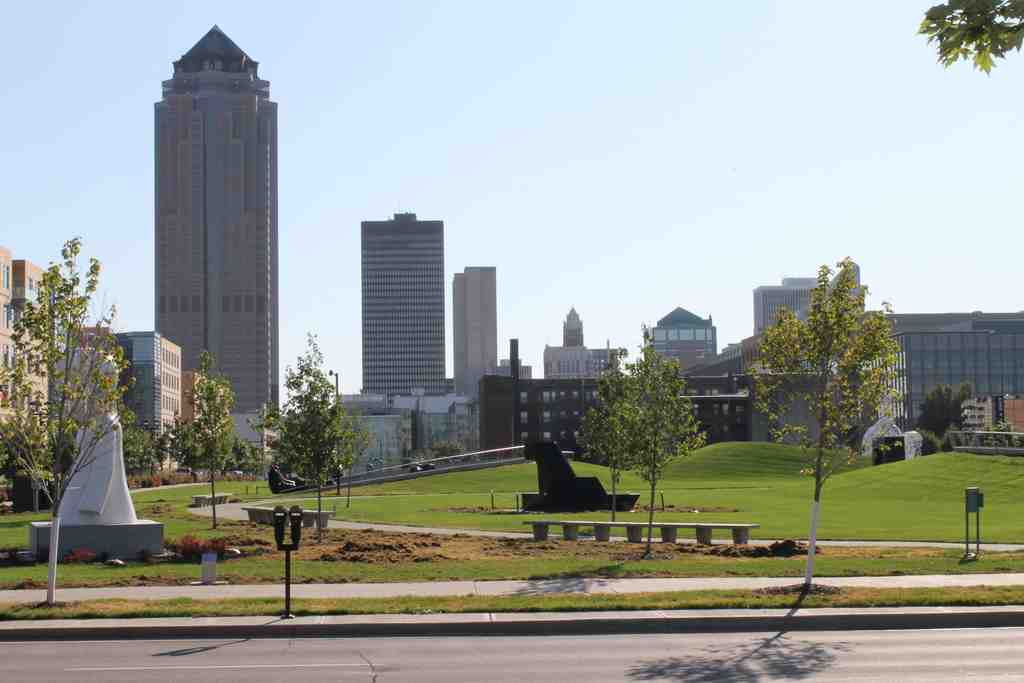
On your left, you will see a sprawling, four point four acre green space anchored by massive steel and bronze sculptures, including a towering, twenty seven foot hollow human figure made entirely of white painted steel letters.
This is the John and Mary Pappajohn Sculpture Park. The story behind this place is one of the most remarkable transformations in the city.
John Pappajohn was a Greek immigrant who grew up during the Great Depression. He started working at age five in his family's grocery store for just ten cents a day, which is about two dollars in today's money. From those origins, he became a highly successful venture capitalist, someone who provides funding to help new, unproven businesses get off the ground. He and his wife Mary built an extraordinary life, eventually gifting twenty four sculptures, valued at about forty million dollars, to the city of Des Moines.
Their entry into the elite art world started quite small. They bought their first painting in nineteen sixty one for one hundred dollars, which is roughly a thousand dollars today. But decades later, their private yard was absolutely overflowing with monumental sculptures. People used to drive slowly past their house just to gawk, as if it were a roadside attraction. Eventually, Mary noted that keeping these massive artworks entirely to themselves was a slightly selfish thing to do. They needed a bigger gallery.
Now, let us look at the history of the land you are standing by. In the early two thousands, the west end of downtown Des Moines was dilapidated. It was a bleak five block stretch of worn out buildings, seedy businesses, and auto repair shops. The city spent years bulldozing the derelict structures to create a massive green space called Western Gateway Park. John Pappajohn drove past the fresh dirt, saw the empty grass, and realized it was the perfect canvas for their collection.
The timing was incredible. The park opened in two thousand nine, offering a beautiful, optimistic counterpoint to the gloomy Great Recession. It completely transformed the real estate value of the neighborhood. It is a stunning example of private ambition and private wealth being leveraged for undeniable public good. By replacing urban decay with world class art, this project redefined preservation and progress.
The landscape architects who designed the park created grassy mounds with parabolic cutaways, which are essentially curved, bowl like depressions in the earth. These cutouts act as natural, walled in rooms to group the sculptures.
One piece you cannot miss is Louise Bourgeois's bronze Spider. John purchased it for four hundred thousand dollars, a massive bargain considering similar spiders by Bourgeois later fetched tens of millions at auction. Despite looking like a terrifying monster from a science fiction film, the colossal arachnid is actually a loving tribute to the artist's mother. Her mother managed a tapestry restoration workshop, so Bourgeois viewed spiders simply as clever, friendly, and protective weavers.
And that giant man made of white letters I mentioned earlier? That is Nomade by Spanish sculptor Jaume Plensa. You can actually walk inside the hollow body. The letters do not form meaningful words, but rather express the symbolic essence of language.
We are now going to head to our final stop to see a triumphant example of neighborhood preservation. Let us make our way to Murillo Flats, which is about an eight minute walk away.




