
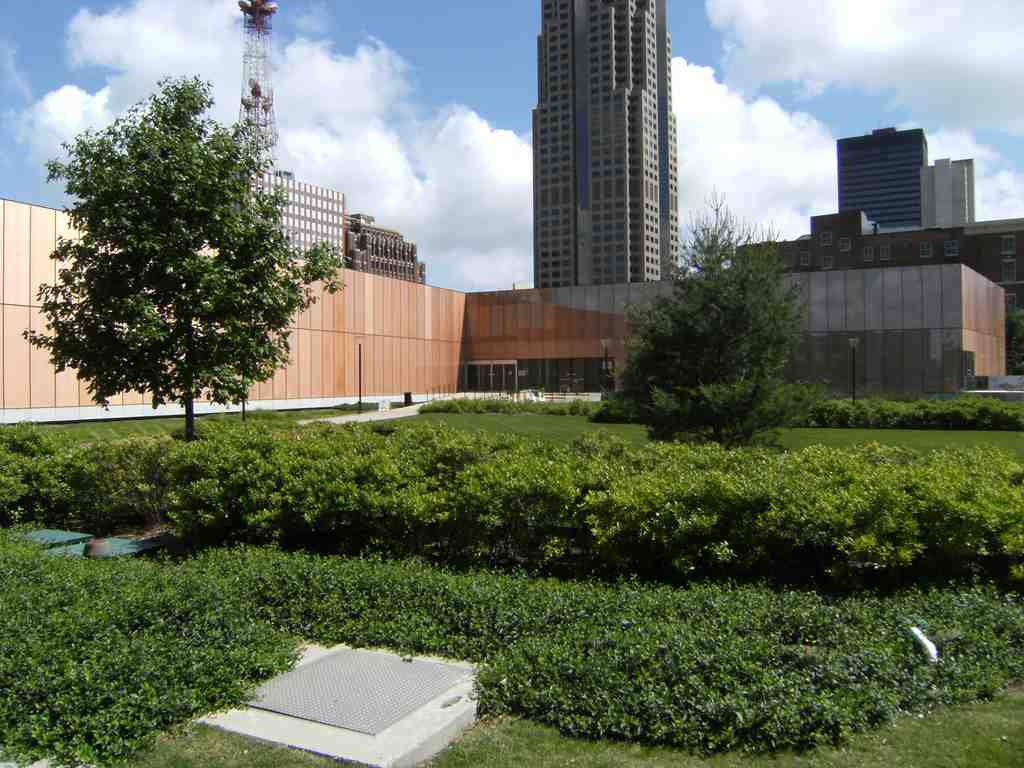
As you stand here near the back exterior, look to your right at the sprawling, flat profiled structure entirely wrapped in massive, copper tinted glass panels.
We just walked from the First United Methodist Church, which is fitting, because this entire library system actually began in 1866 in the basement of a Methodist church. It is safe to say the city has come a remarkably long way from the muddy log huts of Fort Des Moines, evolving into a place that builds architectural marvels to house over half a million items.
This Central Library building, completed in 2006, is a masterclass in clever problem solving. The architect, David Chipperfield, wanted a library bathed in natural light, which is famously the absolute worst thing you can do to books. To prevent the collection from bleaching in the sun, Chipperfield utilized a groundbreaking material called Okalux glass. The exterior is made of 355 glass panels, each weighing a staggering 1,400 pounds. Sandwiched inside the panes is a layer of expanded copper mesh. It took a frankly ridiculous global relay race to make these panels. They were designed in Germany, extruded in China, anodized in Minnesota, and finally assembled right here. The mesh blocks 87 percent of ultraviolet rays, protecting the books while letting people see out into the park.
Look up toward the roofline. There is a hidden environmental trick up there. The entire building is covered in a sedum roof, which is a living layer of hardy, drought resistant plants. It insulates the building and retains more than 187,000 gallons of rainwater runoff.
The library has always been a place where people took bold stands. Back in 1938, library director Forrest Spaulding watched totalitarian regimes burning books in Europe and domestic groups banning works like The Grapes of Wrath. Spaulding drafted the Library Bill of Rights right here in Des Moines, turning the library into a fortress against censorship. His policy was so bulletproof that the American Library Association adopted it nationwide the very next year.
There was another massive fight in the 1950s over the old library building, which the city originally bought the land for in 1898 for 35,000 dollars, roughly 1.3 million dollars today. Inside the old building, artist Harry Donald Jones had painted a massive fresco, a technique of painting directly into wet plaster, mapping the social history of Des Moines. The artwork was a New Deal project that favored workers and highlighted historical injustices. During the conservative 1950s, the library board voted to paint over the entire thing. The mural was only saved at the absolute last second because prominent local philanthropists, including a feminist named Louise Rosenfield Noun, caused a massive uproar and forced the board to back down.
Today, this institution is the ultimate cultural anchor. That is best seen in the AViD Literary Program, which stands for Authors Visiting in Des Moines. Started in 2001, the AViD program brings world famous, best selling authors to the city to share their stories with the community, serving as a brilliant symbol of the city's modern cultural elevation.
It is a perfect capstone of downtown's revitalization. Now, let us head toward our next stop, the Pappajohn Sculpture Park, which is about a seven minute walk away.




