
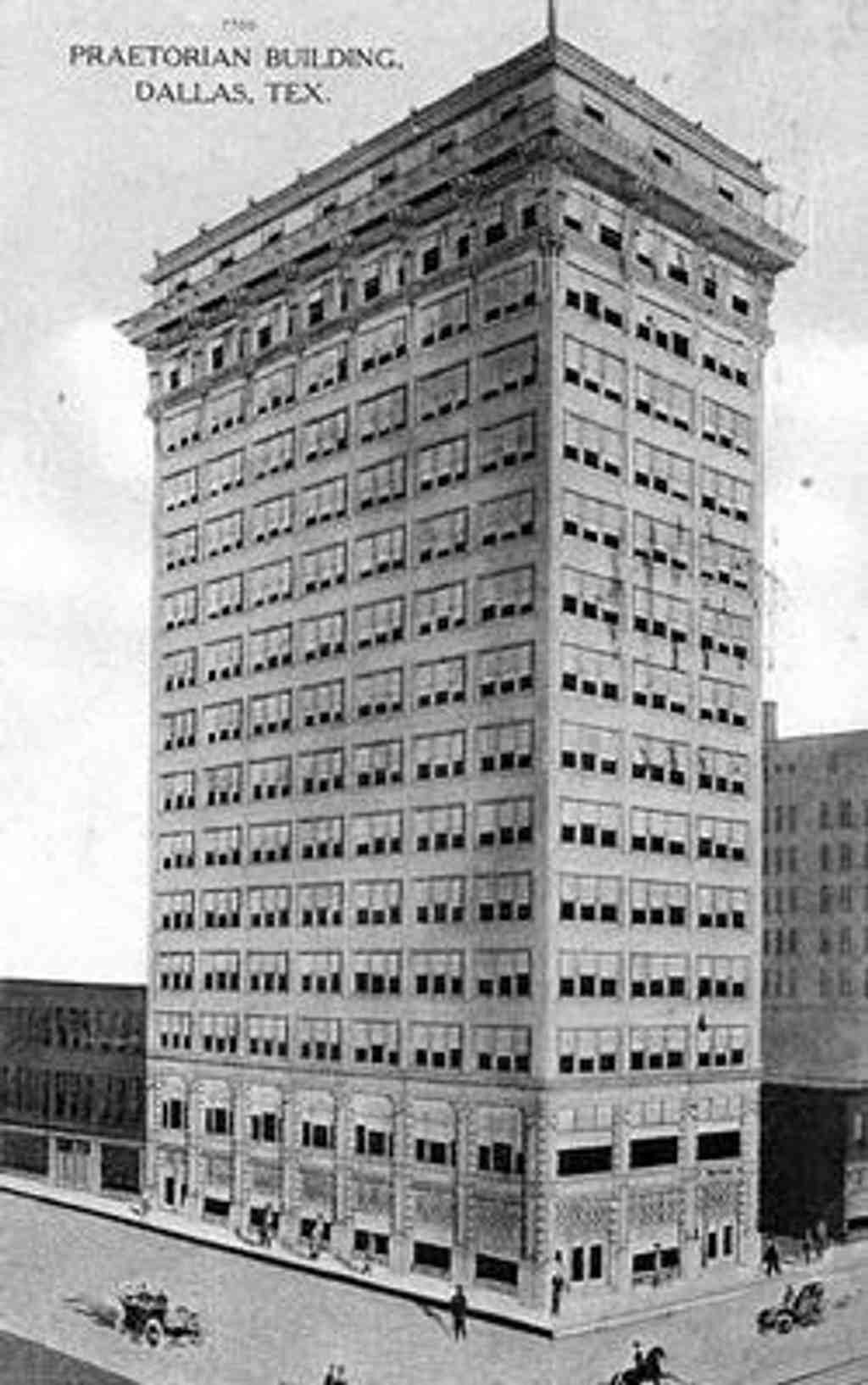
If you look at the historical image to spot what used to stand right here, you will see a fifteen-story rectangular tower built with a uniform stone facade and a highly decorative cornice crowning the roofline.
Yeah, look up. It is entirely gone. What you are actually standing in front of today is a thirty-foot fiberglass bloodshot eyeball. Welcome to the ghost of the Praetorian Building.
Back in 1905, this very spot was the epicenter of some seriously outsized ambition. Charles Gardner, a bookseller who founded the Praetorian Order, which was a fraternal social club that also sold life insurance, wanted to make an enormous statement. He did not just want a nice headquarters. He wanted the first skyscraper in the entire Southwestern United States. He wanted to build higher than anyone else just to prove he could.
But grand egos usually clash with hard reality. They dug a huge hole for the foundation, but then a two hundred and fifty thousand dollar loan, roughly eight million dollars today, completely evaporated. The giant pit sat abandoned for over a year, filling up with rainwater. Skeptical locals ruthlessly mocked the project, calling the giant puddle Gardner's Folly or Gardner's Swimming Pool.
Gardner eventually found the money, and the building, which cost about twenty-seven million dollars in today's money, opened in 1909. It was so tall that some folks were genuinely terrified it would collapse under its own weight. Curiosity eventually won out, and crowds eagerly paid twenty-five cents to ride the electric elevators up to the rooftop observatory. For a brief, glorious moment, it was the undisputed king of the city. But that reign was incredibly short. By 1912, just three years later, other vanity spires had already eclipsed it. Around here, someone is always hungry to build just a little bit higher.
The building's desperate need to stay relevant was its doom. In the 1960s, owners stripped away the beautiful neoclassical details, those grand, Roman-inspired columns and stone accents, and covered the original steel frame in a blindingly bright metal known as Praetorian Yellow. That harsh makeover completely ruined the historic structure. After changing hands and falling into foreclosure during an economic bust, the building finally sat empty. When developers bought it in 2010, the structural damage from that yellow metal cladding was so severe it could not be saved. Preservationists fought hard against the city's wrecking ball culture, successfully demanding the building be taken down safely piece by piece instead of using explosives.
Now, artist Tony Tasset's giant eye watches over the empty lot, an ironic nod to the monumental past that once dominated this spot. Let us move on to another iconic Dallas institution shaped by intense personal drive and high drama. Keep walking toward the Neiman Marcus Building, which is just a two-minute walk away.




