
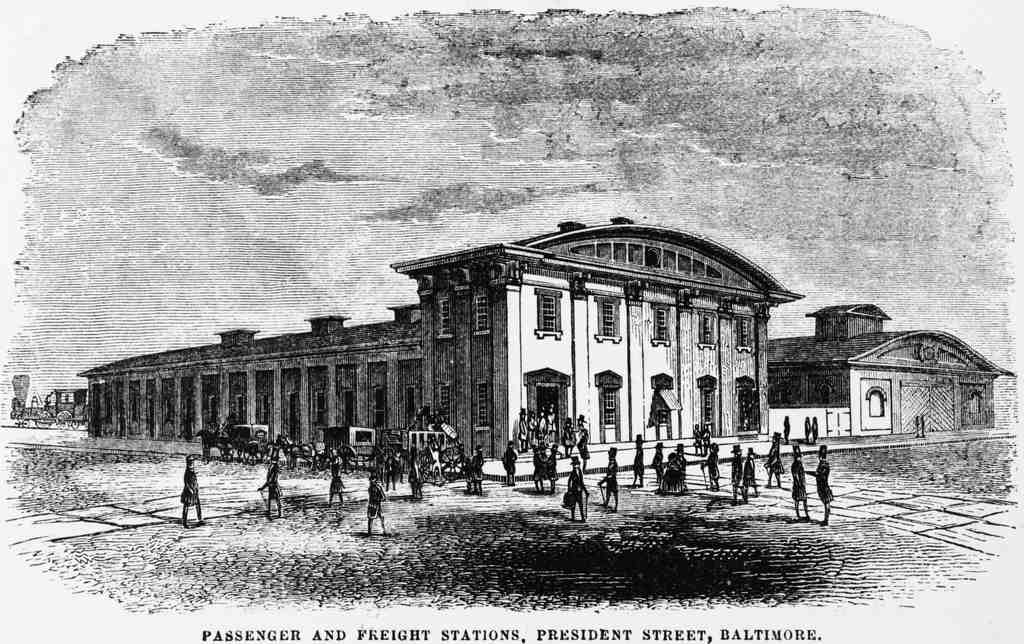
To spot President Street Station as you walk, look ahead for a grand, rectangular brick building with tall windows and a dramatic arched roofline, standing out boldly at the street corner.
Now, let’s travel back in time together and bring President Street Station’s fascinating history to life. Imagine you’re standing right in front of this impressive Greek Revival building in the early morning mist. The year is 1850, and the station has just opened its doors. The air is buzzing with excitement as travelers hurry up and down the stone steps, carriages rumble by, and horses snort impatiently outside. This isn’t just any old building-this is the oldest surviving big-city railroad terminal in America!
Picture the city back then: Baltimore was a booming hub, teeming with commerce, and the railroads were the arteries that kept everything moving. The Baltimore and Port Deposit Rail Road laid tracks all the way to the edge of the Inner Harbor, right here on President Street. But there was a twist-early city leaders were so afraid of wild horses and the risk of fire that they banned locomotives from running right into the city. So, believe it or not, passengers had to hop from their steam-powered train into horse-drawn cars for the last leg through downtown. It must have looked like a relay race-man versus technology!
But the real drama came in the spring of 1861. Imagine the tension in the air as whispers of war blew through these very streets. President-elect Abraham Lincoln was trying to sneak through Baltimore under cover of darkness, hoping to dodge an assassination attempt before his inauguration. He slipped through the station in secret, switching trains on his way to save the Union. Just months later, on a Friday in April, the peaceful buzz turned into chaos. Union troops from Massachusetts, rolling through town to defend Washington, D.C., were suddenly set upon by an angry mob of Confederate sympathizers. Four soldiers and many civilians lost their lives just steps from where you stand, making this the site of the first bloodshed in the American Civil War.
Back in those days, this station wasn’t just about passengers. There was a 208-foot-long train shed out back, huge roundhouses and bustling freight yards-six city blocks brimming with steam and the clang of iron. The station was alive with merchants, soldiers, and anxious families saying farewell or welcome home. But as railroad lines shifted and new stations sprang up further north, President Street Station quieted down. Passenger trains became fewer, until only freight rolled through. The grand old train shed was lost to a fire, leaving behind just this sturdy head house-a survivor with a thousand stories.
The 20th century wasn’t always kind to the station. It became a lonely warehouse, then sat abandoned, the victim of snow and fire, even dodging city plans to bulldoze it for a highway. But Baltimore isn’t a city that forgets its heroes, and a determined band of locals and preservationists stepped in. Through the 1990s, they fought to save this landmark. After careful renovations, it reopened as the Baltimore Civil War Museum-allowing new generations to walk the halls where history was made.
Even today, this building is still in the middle of a new chapter. Its future-whether as a museum, a landmark, or something else-is being decided with careful thought so that the echoes of the past aren’t drowned out by tomorrow’s noise. So as you stand before President Street Station, take a moment to imagine the chug of the trains, the surge of the crowd, and the anxious voices of a nation teetering on the brink. Not bad for a building that’s seen more drama than a whole season of TV, right?
So, onward on our adventure! Don’t worry, there are no angry mobs on this tour-just your friendly digital guide with some history up my sleeve.




