
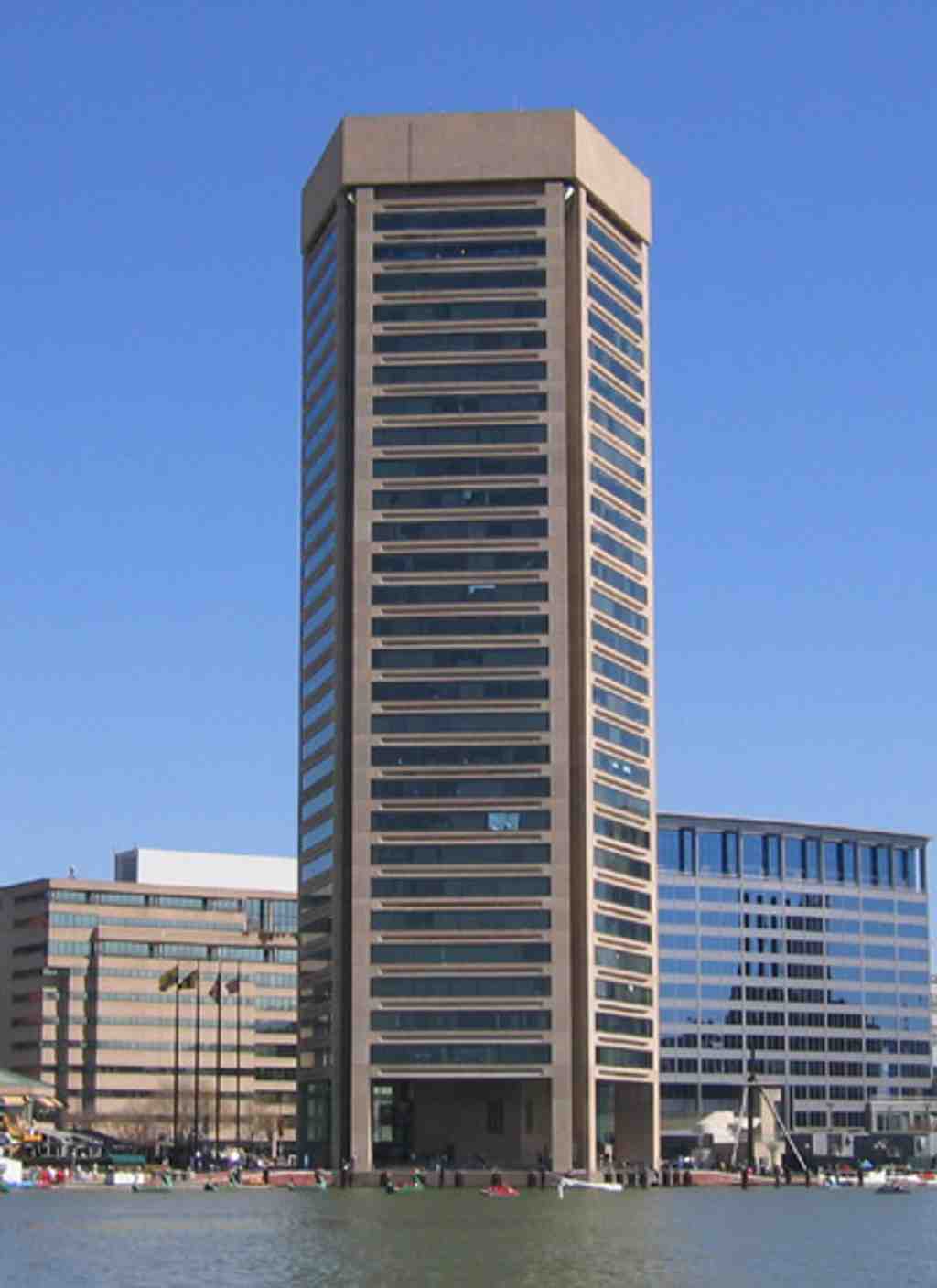
Right in front of you stands a tall, sleek tower with sharp angles and smooth lines, rising high above the water’s edge-if you look toward the harbor, it's the tallest and most striking five-sided building nestled right by the waterfront.
Now, let’s step back in time for a moment. Picture yourself in Baltimore’s Inner Harbor in the late 1960s-a city bustling with anticipation, sharing whispers of a new project that would soon scrape the sky. The Baltimore World Trade Center, designed by the geniuses at Pei Cobb Freed & Partners, especially architects Henry N. Cobb and Pershing Wong, began its journey in plans and dreams all the way back in April 1966. Construction kicked off in October 1973. By January 1977, at a cost of $22 million, this epic skyscraper was finished-towering 405 feet and 30 stories above the one-acre plaza. Quite a skyline shakeup for a city known for its low, historic brick buildings!
But this isn’t just your everyday tall building. No, if you squint, you’ll really notice-its five equal sides form a perfect pentagon shape, making it the tallest regular pentagonal skyscraper in the world. Well, unless you count the one in Houston, but their angles are just a bit off! On a clear night, this mighty tower becomes a beacon. At each corner, powerful 4,500-watt xenon spotlights shoot up into the sky, reflecting off giant parabolic mirrors at the top. The lights form five glowing V’s, inspired by lighthouses from the Chesapeake Bay. On some nights, those sparkling rays are visible seven to ten miles away-almost like the building is trying to signal mysterious sea creatures, or maybe just let lost late-night pizza delivery folks know where the party is!
There’s cleverness in the building’s design too: its front corner points straight out over the harbor, just like the prow of a ship sailing boldly into the Chesapeake. Stand here at the edge, and it’s almost as if the structure is leaping out of the water, leading Baltimore into the world with serious style.
The World Trade Center is home to organizations all about big business and world commerce, like the Maryland Port Administration and the World Trade Center Institute. But the heart-pounding highlight has to be the “Top of the World” observation level-up on the 27th floor. Take a deep breath and imagine stepping from the elevator into a dazzling perch offering 360-degree views, cityscapes in every direction, rotating art exhibits, local history, and the 9/11 Memorial of Maryland.
And speaking of 9/11, this tower has its own chapter in those tense and tragic days. Just two hours after the attacks in New York, Baltimore’s building was abruptly evacuated, a “credible” threat sending everyone rushing for the exits. Concrete barriers and barges suddenly turned the usually open plaza into a fortress, and bomb threats rang out in the days that followed. Eventually, the city relaxed, the barriers came down, but the memory lingers. Right outside, on the pedestrian walkway, is a powerful memorial-three twisted steel beams salvaged from the North Tower in New York sit on a marble platform listing the names of sixty-eight Marylanders lost that day. And in a moving touch, the building’s shadow acts as a sundial, touching inscriptions at the exact times key events unfolded every September 11. This living reminder even features a glossy block to remember the Flight 93 passengers, and the windows above are inscribed with all of that day’s victims' names.
Of course, this skyscraper’s story isn’t just one of tragedy or grandeur-it’s also one of resilience. Hurricane Isabel slammed Baltimore in 2003, filling the building’s basement with a jaw-dropping three million gallons of harbor water. Water sloshed and gurgled into the electrical equipment, shutting things down and leaving sixty tenants adrift for more than a month.
Ownership dramas and questions of “sell or keep” have filled recent chapters. It costs a pretty penny to keep all that glass and concrete humming, and for a time, occupancy plummeted. But the state of Maryland has held on, streamlined leases, and even started thinking a bit more green: look down near the harbor’s edge, and you’ll spot floating gardens, built from trash and plastic bottles. These little marshes help clean the harbor and offer a cozy home to everything from barnacles and eels to (I’m not kidding) adventurous Baltimore crabs.
So, when you look up, know that the Baltimore World Trade Center isn’t just a slab of stone and steel. It’s a lookout, a lighthouse, a memorial, and a symbol of Baltimore’s hope-and maybe even a secret meeting place for those clever harbor crabs. After all, in a city like this, you never know what kinds of stories are hiding behind glass and stone.
To expand your understanding of the name, alignment and lighting or the top of the world, feel free to engage with me in the chat section below.




