
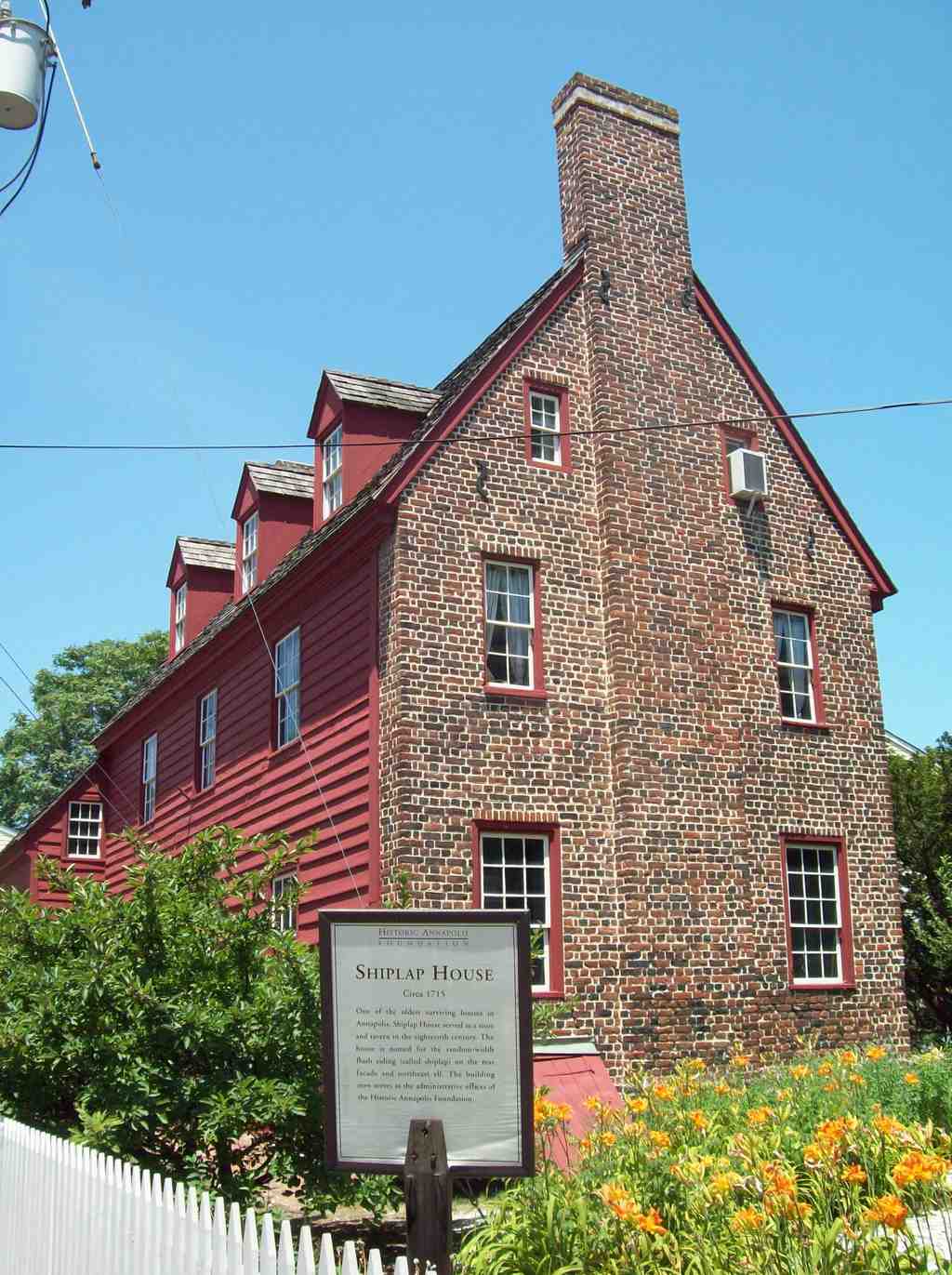
You are standing before a sturdy colonial structure defined by its multi-tonal brick facade, a massive brick chimney climbing the right side, and a slanted roof punctuated by distinct dormer windows. We have finally reached the Colonial Annapolis Historic District.
With roughly one hundred and twenty original eighteenth-century buildings still standing, this area presents an incredibly polished, idyllic picture of early America. Naturally, the reality is far more complex.
Take a look at the third image in your app. This aerial view reveals the city's underlying blueprint, laid out in sixteen ninety-five by Francis Nicholson. His design was not a standard, practical grid. It was a grand Baroque vision. In urban planning, the Baroque style relies on theatrical, sweeping geometries inspired by the royal gardens of Versailles, deliberately designed to impress the absolute power of the Crown and Church upon the landscape.
Nicholson placed two prominent circles on the city's highest hills. State Circle was for the government, and Church Circle was for the Anglican parish. The streets radiate outward from these hubs like the spokes of a wheel. But Nicholson included a very specific quirk. He used a pinwheel alignment. Instead of designing straight avenues that gave you a long, dramatic view of the buildings from a distance, he offset the approaching streets.
Because of this grand design, you never see the Maryland State House coming. It does not wait patiently at the end of a long boulevard. Instead, as you navigate the curved streets, the massive structure suddenly appears right on top of you, looming around a tight corner. It is a brilliant psychological trick, engineered to make the citizen feel small and the state look monumental.
Yet, this meticulously engineered order constantly masked the turbulent reality of the people living inside it. The grandiose mansions of the elite often hid deep personal failures, like Samuel Chase completely bankrupting himself halfway through building his massive home. The polite society rules of the time were just a facade for boiling political tensions. In seventeen seventy-four, a mob dragged a ship owner out of his house and forced him to personally set his own vessel, the Peggy Stewart, on fire right in the harbor simply because he paid a British tax on imported tea.
Even the ultimate moments of American heroism here were fraught with immense human frailty. When George Washington stood inside that looming State House in seventeen eighty-three to resign his military commission, his hands were visibly trembling. At a time when military victors usually declared themselves kings, Washington was terrified by the gravity of voluntarily surrendering his immense power back to civilian rule.
As our tour concludes, take a final look at the streets radiating out around you. Today, they are peaceful, filled with casual tourists and midshipmen in crisp white uniforms. But Annapolis remains a masterpiece of contradiction. The true fascination lies in the tension between Nicholson's rigid, engineered fantasy of absolute control, and the messy, rebellious, and entirely human history that actually unfolded on these bricks. Enjoy the rest of your time exploring these beautifully layered streets.


