
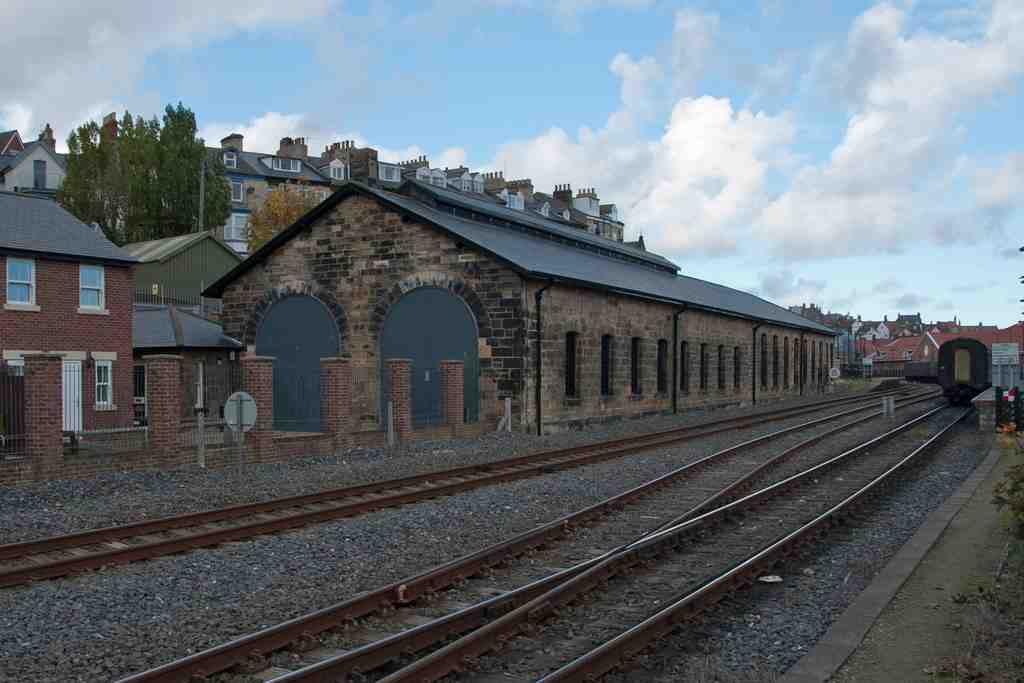
To spot the Whitby engine shed, look just beyond the railway tracks for a long, low stone building with large, rounded archways and a row of tall, narrow windows running along its side.
Now, take a deep breath and imagine stepping back in time, right where you stand. It’s the mid-1800s, steam is king, and this very shed is brand new, its stone walls still smelling faintly of the River Esk, whose waters once lapped at this reclaimed land. You might have heard the clatter of horses' hooves not too long before-right up until the York & North Midland Railway swapped out horses for steam engines in 1847. The shed itself rose on the bones of earlier industry, built on ground where the Whitby and Pickering Railway’s very first station stood, and even before that, where shipbuilders like Thomas Fishburn launched vessels with a splash into the harbor.
Picture the air, thick with coal smoke and the hiss of steam, as engines rumbled in for the night after working the lines to Loftus, Stockton, Middlesbrough, and Malton. You could spot a worker shifting between the two internal tracks or hear the metallic clang of wheels and bogies being swapped out on the sidings. Just outside, maybe kids watched in awe as the giant locomotives turned, creaking and groaning on the massive 50-foot turntable, before heading back out to adventure.
During its heyday, this shed was more than just stone and tracks. It had a workshop, a forge-perfect for fixing up the battered old engines-and an office bustling with the daily business of running railways. You might notice the west side has no windows; that’s because a steep bank stands just beyond, making for a gloomy wall but keeping the wind at bay. Even the route inside was a bit of a puzzle: engines entered only by a reversal maneuver at the Bog Hall signal box-imagine trying to park a massive train backwards without a scratch!
One of the most curious sights would have been the “Whitby Bogies,” Edward Fletcher’s quirky 4-4-0 steam engines, specially built to handle tricky turns through Newton Dale and steep climbs heading out of Grosmont and Pickering. Then came the chunkier NER Class W 4-6-0T, with extra space for coal and an appetite to match. And when the tourists left in the off-seasons, Sentinel steam railcars took up the slack, puffing steadily through the quiet months.
Danger didn’t stay away, either. Imagine the night in 1940-an air raid shakes the town as bombs rain down, smashing the goods shed and reducing the engine shed’s offices to rubble. But the shed stood strong, and trains kept rolling... until the age of steam finally wheezed out in 1959, replaced by the relentless advance of diesel engines.
Now, if you peek in today, you might find holidaymakers instead of hardworking railmen-because the old shed has swapped steam and steel for cozy apartments. It’s one of just a handful designed by G T Andrews that still survive in North Yorkshire, and in 1991 it even made the grade as a protected historic building.
So, as you stand by these tracks, take a moment to imagine the ghosts of grinning engine drivers, the clang of hammers, and the ever-present promise of the North Yorkshire railways. Who knows, maybe the old “Whitby Bogies” are still rumbling around in the echoes of history-if you listen close, you might just hear them!




