
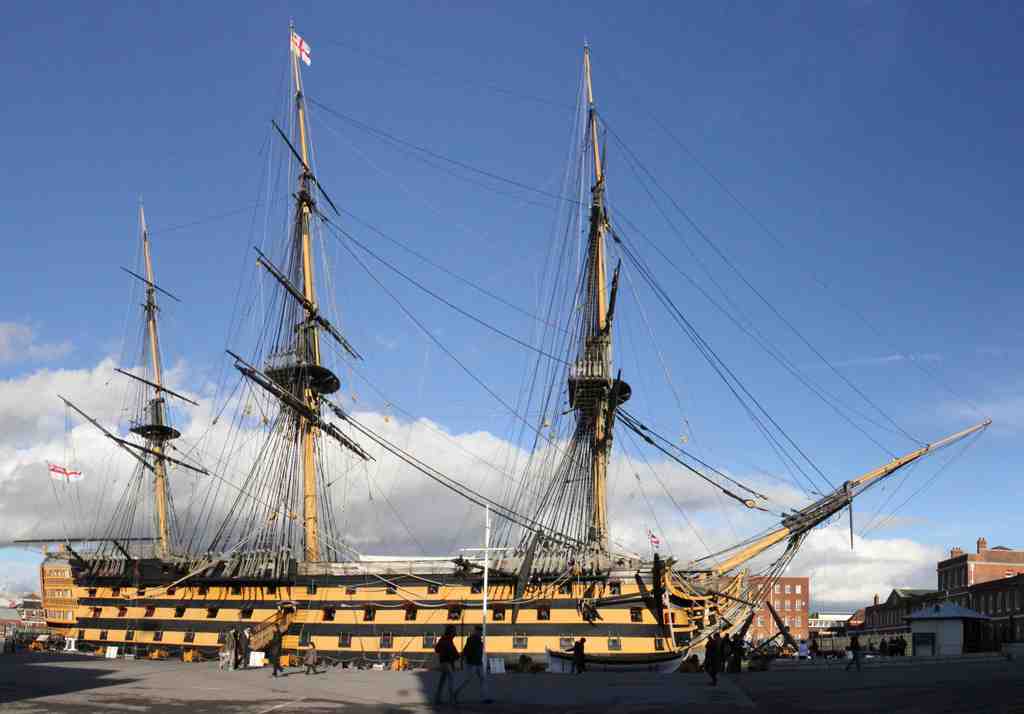
Just ahead, you’ll spot HMS Victory by her towering three masts and distinctive yellow-and-black stripes along her wooden hull-no hiding this giant ship, she looks like she sailed straight out of a swashbuckling adventure!
Welcome, my friend, to the legendary HMS Victory! Standing before her, you might imagine the creak of timber under your feet, the snap of canvas sails high overhead, and the salty tang of the sea carried on the wind. Now, close your eyes for a second-listen. You’re about to step into a story that stretches back nearly 250 years, and it’s anything but dry history.
Built from an astonishing 6,000 trees-90% of them oak-Victory was ordered in 1758, in an age when Britain was desperate to rule the waves. Picture the bustle at Chatham Dockyard as hammers ring out and shipwrights sweat over the rugged planks. She was finally floated in 1765, but here’s the first twist: by then, peace had broken out, so Victory-named to inspire just that-was left to rest, not fight.
Wooden warships like this didn’t come cheap, and they didn’t come easy. Victory’s frame was so broad, they had to shave down the dock gates just to launch her! She was so heavy in the water that the lower gunports sat just four and a half feet above the sea-one rough wave and suddenly your cabin’s got a saltwater Jacuzzi.
It took decades before Victory saw full action. When war broke out across the Atlantic, she was callsigned into service in 1778, bristling with 104 thundering guns and crewed by 850 men-imagine the rumbling sound of multiple broadsides and the chaos of battle. Victory fought at Ushant, Gibraltar, and Cape Spartel, and survived it all. For much of her long career, she bobbed in and out of “ordinary”-a Royal Navy word for mothballs-but each time the world turned dangerous, she was ready to join the line of battle.
Her true moment of glory? That would be 1805’s Battle of Trafalgar. Picture Lord Nelson climbing the quarterdeck, using Victory as his flagship. The suspense is building, the Royal Navy faces a combined French and Spanish fleet, and the fate of nations is at stake. Nelson rallies the crew: “England expects every man will do his duty!” Those words were sent up as flags, flapping in the wind. Victory led the attack, smashing through enemy lines. It’s chaos, smoke so thick you can hardly breathe, splinters flying, cannons roaring, men shouting orders. In the heat of it all, Nelson is fatally wounded, but the British emerge victorious, and the world remembers Victory forever.
But life aboard wasn’t all battles and glory. The ship could carry supplies and food for months-though if you’d like your bread with a side of weevils or salted beef that could break your teeth, Victory was the place for you. Below deck, it was crammed, noisy, and always slightly damp, but this was home to hundreds of sailors, young and old.
Victory is not just a survivor of storms and gunfire; she was adapted again and again. After Trafalgar, she became a harbour ship, then a floating hospital, and later a museum. If you look closely at her hull today, you’ll spot the “Nelson chequer”-those iconic yellow and black stripes, painted to mimic the look she carried into Trafalgar, a style so dashing it was copied across the whole Royal Navy.
Restored and preserved in dry dock since 1922, Victory is still officially in commission and serves today as the flagship of the First Sea Lord. She’s the oldest warship still in service anywhere in the world. So, as you stand here, remember: twelve sails, three gun decks, enough timber to build a small forest, and a whole century’s worth of war stories. There are ghosts in these decks, and not a one of them would ever let you forget-this is HMS Victory. Go on, take in her towering masts and bold stripes. She’s sailed through more drama than any soap opera!
Interested in knowing more about the design, construction and armament, early service or the french revolutionary wars




