
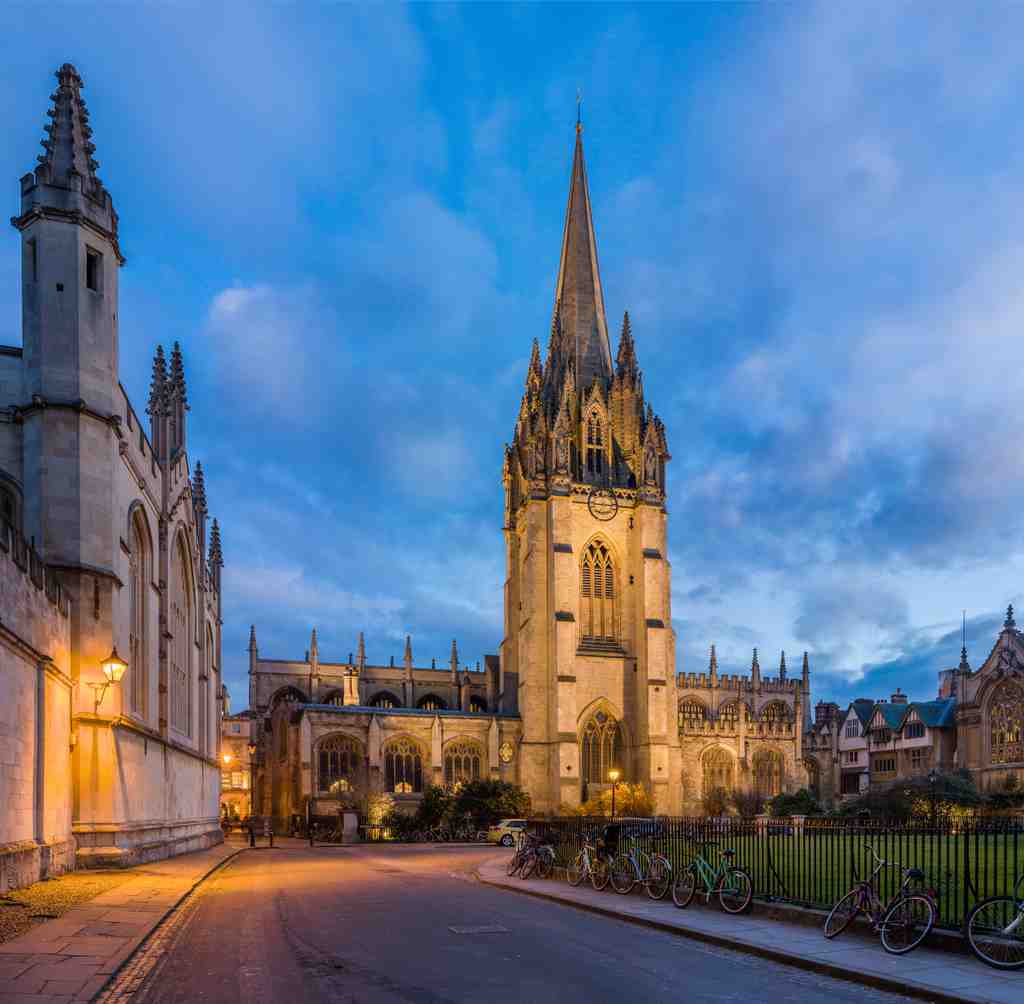
To spot the University Church of St Mary the Virgin, look straight ahead for a tall, striking stone spire rising dramatically above the street, with ornate windows and decorative statues perched along its tower, just opposite the High Street.
Welcome to the heart of Oxford’s history! Just imagine-centuries ago, this very site was surrounded by old city walls, heavy stone and bustling markets, and the chimes of the church bell would have echoed across the town. You’re looking at the birthplace of the University, the grand old University Church of St Mary the Virgin-or St Mary’s, if you’re on friendly terms. People have worshipped here since Anglo-Saxon times, and by 1086, it was already considered ancient!
Gaze up at that spire: some say it’s the most beautiful in all of England, and with its delicate pinnacles, noble statues, and fierce-looking gargoyles, it’s easy to believe. Just watch out for rain-those gargoyles like to spit! At nearly 200 feet high, the tower was raised way back in the 13th century, and if you’re feeling bold, you can climb it for postcard views over Oxford. Imagine the sights from up there on a quiet morning: the soft ring of distant church bells, the gentle sound of wind whistling past your ears, and a patchwork of rooftops stretching out toward the past.
Now, picture the 1300s. Where you’re standing, university scholars in strange robes would gather in St Mary’s, not just for prayers, but also for heated debates, degree ceremonies, and boisterous arguments. In fact, before Oxford had any grand halls or libraries, this church was the center of it all! The original university library? That was upstairs, filled with dusty books from Bishop Cobham. Where students now sip coffee in the Vaults café, university “parliament” once met to decide the fate of Oxford itself. Oh, and you can thank Adam de Brome, the clever rector who managed to funnel church funds to his new college-Oriel College-by, well, creative paperwork. It seems bureaucracy is as old as the hills!
If these stones could talk, they’d tell stories of both faith and fire. In the 16th century, three brave bishops-Cranmer, Latimer, and Ridley-were tried here for heresy, and the church echoed with the sound of angry crowds and nervous shuffles. Cranmer was forced to stand upon a stage, propped up by a shelf hastily cut from one of these very pillars, for a humiliating sermon before being led to the flames. They say Cranmer vowed the hand that signed his recantations would burn first-and so it did. If you look for a pillar with a piece missing, you’ll find a silent witness to a dramatic moment in history.
Think graduation ceremonies today are wild? Well, centuries ago, Oxford students celebrated so loudly here that the church rang with laughter and shouts, mixing prayers with cheers until one Archbishop of Canterbury declared enough was enough. He decided a new building was the only solution-thus, the Sheldonian Theatre was born, freeing St Mary’s to become, once again, a place of worship instead of student parties. It’s the church that gave the University its serious face-you could say it “taught Oxford how to behave”!
Step closer to the porch, and you’ll find a slice of scandal from the 1600s. The curly Baroque stonework with its spiral columns and a statue of the Virgin and Child was considered so shocking by the Puritans that it was cited as evidence in an Archbishop’s trial! To top it off, when Cromwell’s troops stormed Oxford, the statue got riddled with bullet holes-talk about souvenirs with a story.
The inside dazzles as well-gothic arches, tracery, hidden faces of angels carved high above, and windows glowing with the last rays of sunlight. Some glass is nearly 600 years old; others were designed by Augustus Pugin, who helped create the look of Big Ben. Don’t miss the mighty organ at the back-today’s instrument was built by Swiss craftsmen but sits in a case inspired by Father Smith’s original organ, which was sadly lost in a fire after WWII.
But this isn’t just a church of stories and echoes-it’s still a living, breathing part of Oxford. Sundays bring the sound of a choir filling the vast space, and visitors come from around the world to soak in the calm and the centuries of history. So next time you hear the bells or feel a breeze up your spine, remember: you’re standing at the crossroads of faith, learning, drama, and a good bit of university mischief. Quite simply, St Mary’s is the soul of Oxford-where the past and present dance together under one glorious spire.
Yearning to grasp further insights on the overview, architecture or the organ? Dive into the chat section below and ask away.




