
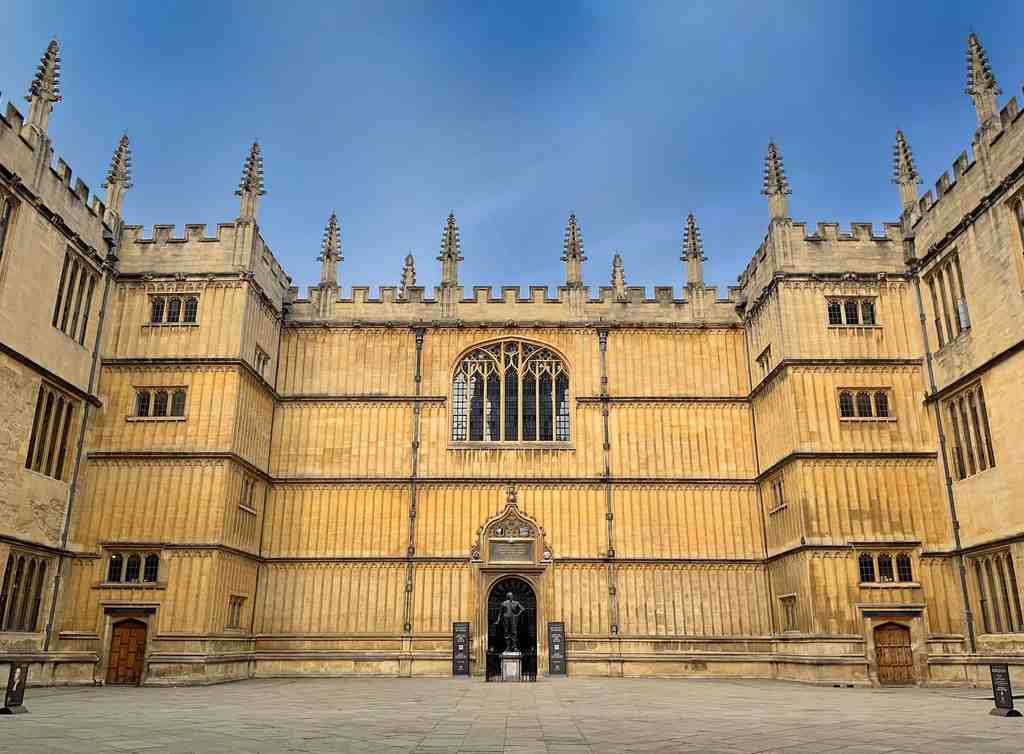
To spot the Bodleian Library, look for a grand, old stone building with a massive arched doorway, decorated wooden panels studded with colorful crests, and two small stone angels keeping watch at either side.
Now, as you stand before these towering doors, take a deep breath and imagine the musty scent of ancient books floating through the air. Welcome to the Bodleian Library, or as Oxford folks like to call it, “the Bod”-not to be confused with your gym routine. This isn't just any library. It was founded in 1602 by a determined chap named Sir Thomas Bodley. He was so keen on giving Oxford a literary heart that he once wrote a letter saying he’d take on the “charge and cost” of bringing a library back to life. Spoiler alert: Bodley delivered. Imagine it’s the 17th century. Bodley’s team is busy reinstalling books in a refitted room above the Divinity School, bringing new treasures in from all over the world, and hoping that none of the manuscripts go wandering off like students during exam week.
By the way, don’t let those doors fool you-inside, there are over 13 million printed items, making it Britain’s second largest library. If you dropped a pin in here, the echo would probably disturb a medieval philosopher still looking for the right scroll.
But let’s rewind the clock. The first Oxford library was born in the 14th century, high above St Mary’s church, with a bunch of chained books (so students couldn’t walk off with them-clearly, book theft is a time-honored tradition). Fast forward to the 1400s, and Duke Humphrey, brother to King Henry V, donates a mountain of manuscripts. The collection outgrows the space, so they build what is still called Duke Humfrey’s Library, right here above your head.
Alas, in the late 1500s, the place falls on hard times. Monks sell off the furniture, books vanish, and religious reforms sweep away “superstitious” texts. The library is more or less a ghost town until Sir Thomas Bodley blows the dust off and dramatically reopens the doors in 1602. He even placed a Benefactor’s Register on proud display-hoping to guilt, I mean, encourage visitors into donating more books.
Imagine the hustle and bustle. Scholars from all over Europe are sending in rare volumes, Bodley is trying to collect Turkish and Chinese manuscripts (even when nobody at Oxford could actually read them), and Francis Bacon himself declares the Bodleian to be “an Ark to save learning from deluge.”
The rules have always been strict. Even today, before you can enter, you must promise (traditionally out loud) not to steal, damage, or light fires among the ancient tomes. They have this declaration translated into over a hundred languages, just in case you thought you could sneak a matchstick in by speaking fluent Klingon.
As centuries roll by, the Bodleian expands-a dazzling tower called the Tower of the Five Orders rises as the grand entrance, each floor decorated with a different kind of ancient column: Tuscan, Doric, Ionic, Corinthian, and Composite. Lecture rooms become book-filled havens, underground bookstacks snake beneath the earth, and tunnels even connect the “Old” and “New” Bodleian buildings. At one point, there was a Lamson tube system under Broad Street to deliver book orders-basically, Victorian Amazon Prime, with a lot more whooshing sounds.
The treasures here are jaw-dropping: illuminated manuscripts, Aztec codices, four Magna Carta originals, Tolkien’s notes, Jane Austen’s letters, Beethoven’s works, and even Shakespeare’s First Folio. If Indiana Jones were a professor, he’d be knocking at this door every morning.
Film buffs, take note: you’ve seen this place in Harry Potter as the Hogwarts library and hospital wing, and in The Golden Compass and plenty of other movies. Don’t try any spells though; the only magic here is the library’s ability to always, mysteriously, have another room full of books tucked away somewhere.
So, as you stand under the watchful eyes of those stone angels, you’re not just looking at an old stack of books. You’re standing at the beating heart of centuries of learning, secrets, drama, and a fair amount of English stubbornness. The next time you borrow a library book and forget to return it, just remember: the Bodleian’s been keeping tabs on its collections for over 400 years… and they probably know where you live!
Interested in a deeper dive into the sites and regulations, copying and preservation of material or the treasures of the library? Join me in the chat section for an insightful conversation.




