
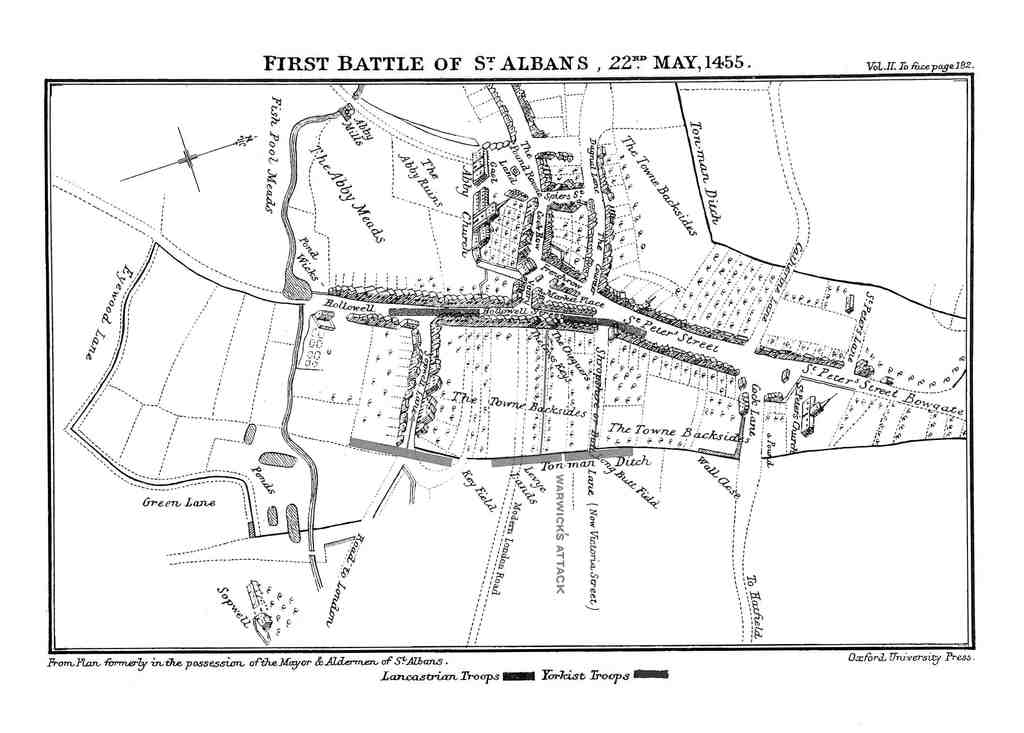
To spot the site of the First Battle of St Albans, look down the historic streets radiating from the city center, where medieval lanes and old market squares still echo the narrow, tangled routes you see on this old battlefield map.
Close your eyes for a moment and imagine the town of St Albans as it was in May 1455. The sun is just rising, the streets are narrow, lined by timbered houses, the air filled with the sharp tang of morning and the distant voices of traders. But on this day, there’s a tension running through the town like a tight, invisible wire. St Albans is about to become the unlikely stage for a brutal and messy beginning: the very first clash of the Wars of the Roses.
Now, instead of ordinary townsfolk, picture thousands of armed men gathering where you now stand. Richard, Duke of York, has marched south, flanked by his powerful allies, the Neville Earls of Salisbury and Warwick. Their army, almost seven thousand strong, camps to the east in Keyfield, weapons clinking and armour shining in the half light. On the other side are the Lancastrian forces, about two thousand men commanded by Humphrey Stafford, Duke of Buckingham, though much of the planning has come from Richard’s fiercest rival, Edmund Beaufort, Duke of Somerset. The two armies wait, tension thick in the air.
The strange part? This isn’t happening in open fields but right here, in the tangled heart of the town itself. Imagine negotiations, frenzied heralds running back and forth along St Peter’s Street, fingers white on sealed letters. Voices echo down alleyways as leaders try, and fail, to avoid violence. At one point, King Henry VI himself stands defiant, refusing to hand over Somerset: “By the faith I owe to St. Edward and the crown of England, I shall destroy every mother's son and they shall be hanged, and drawn and quartered.” There’s no backing down now.
Suddenly, swords flash and shouts erupt. The Yorkists charge twice at the barricades near St Peter’s Church, arrows thudding into walls, but are beaten back. The streets fill with the roar of battle. Then, young Richard Neville, known as the Earl of Warwick-the man who will become famed as “the Kingmaker”-spots an opening. He leads his men into the town through back gardens and unguarded lanes, bursting into the market square where the king’s troops, caught without helmets, are lounging, talking, unsuspecting. In an instant, everything changes. Arrows hiss through the air; archers fire into the cluster of guards around the king, leaving several dead and Buckingham wounded.
The fighting rages along the streets and spills around the Castle Inn. There, Somerset, knowing he’s lost, bursts out the door, sword swinging, cutting down four men before he’s finally brought down. Allies of Percy and Somerset fall; Northumberland is killed trying to reach the safety of the inn; and Lord Clifford is mercilessly hacked down right on the main street. Within half an hour, it’s over. The barricades crumble, Lancastrians flee, and the stunned townspeople peer out from behind their shutters at the mayhem.
When the dust settles, fewer than sixty are dead. But the true victory isn’t in the body count: Richard of York has captured King Henry VI himself. This one decision knocks the whole country off balance. The king, pale and dazed, is escorted back to London the very next day by his captors-and just months later, Richard of York is named Protector of England.
The aftershocks of this morning ripple far beyond St Albans. Families are split, loyalties shattered, and the Wars of the Roses, with all their drama and tragedy, have thundered from rumor into bloody reality. Shakespeare would later immortalize this moment, and writers from every century have returned to these streets to imagine the confusion, rage, and wild hope of that day.
As you stand here, try to hear the echoes of steel and panic-the sense that what began as political intrigue became, in these very lanes, a legend. Welcome to the beginning of the Wars of the Roses-right under your feet.
Want to explore the background, prelude or the battle in more depth? Join me in the chat section for a detailed discussion.


