
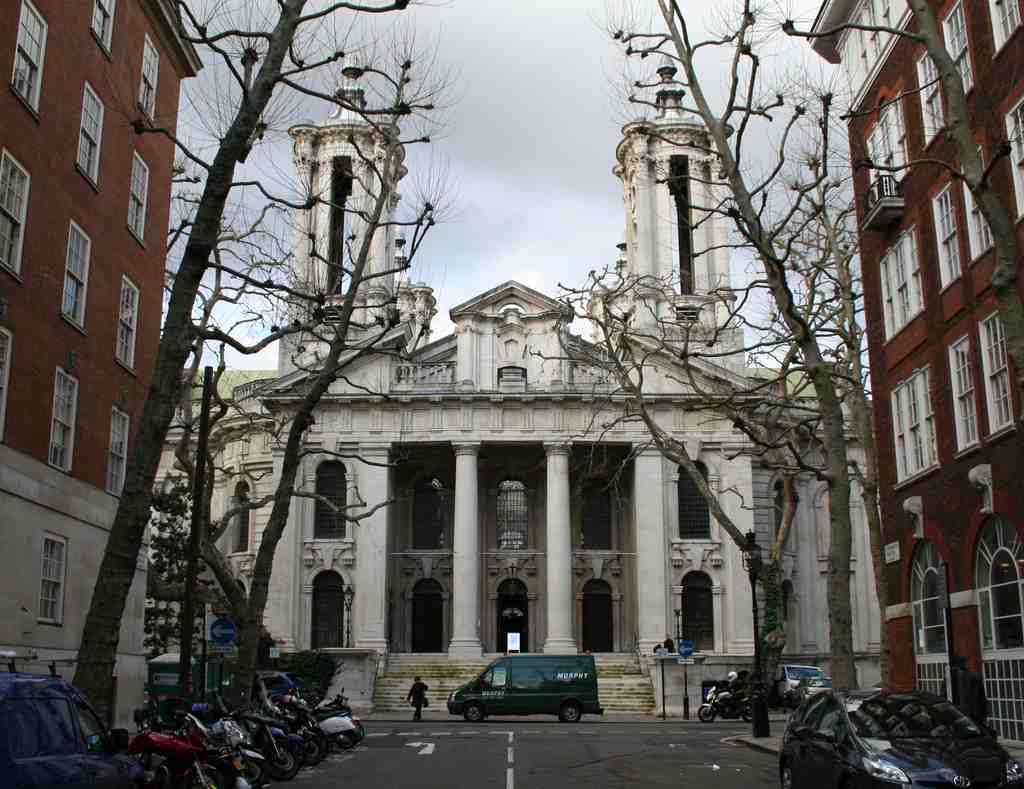
Right ahead of you, looming at the end of Smith Square, you'll spot an impressive Baroque building with four tall corner towers that spring up like the feet of a giant marble table-just look straight towards the grand steps and the cluster of white pillars under a forest of skinny trees.
Now, take a good look at Smith Square Hall, though not long ago folks around here would’ve called it St John’s Smith Square. Don’t let its stately columns and dignified towers fool you: its story is packed with quirks, catastrophes, and a knack for transformation that would make any magician jealous.
Our tale kicks off in the early 1700s, back when London church politics were almost as dramatic as its theatre scene. The Whigs, who’d been running things for years, got booted out by the Tories-who were so alarmed at the “Church in Danger!” they rallied Parliament to build fifty new churches to save the city’s soul. And what better way to fund such piety? Why, by taxing coal coming into London. So every warm London fireplace helped pay for this building and its kin.
Enter Thomas Archer-the sort of architect who didn’t get his start on blueprints, but rather by hob-nobbing with royalty. A well-mannered gent with a hefty fortune, Archer was better known in courtly circles, reportedly even running the gambling at Queen Anne’s court. But what really sets this building apart is its completely bonkers origin story. Legend has it, Archer went to Queen Anne herself to ask what she wanted her new church to look like. Possibly fed up, the Queen simply upended her footstool and snapped, “Like that!”-leaving Archer to dream up a church with four great towers at the corners, just like the legs of the Queen’s flipped footstool.
It’s not just a witty story-locals started calling it “Queen Anne’s Footstool,” and gawkers throughout history have been equal parts amused and confused. Novelist Charles Dickens memorably described it as a “petrified monster... on its back with its legs in the air.” Some might say it’s out of place in this cozy square of red-brick and white-windowed houses, but that’s half its charm-its baroque swagger challenges you to a stare-down from every angle.
Of course, the building’s life as a church was anything but peaceful. The interior was gutted by fire in 1742, struck by lightning in 1773, and by 1815 its towers needed serious shoring up. And then came World War II: on a single night in May 1941, firebombs rained down and turned the church into a ghostly shell open to the sky. Want a chill? There’s even a handwritten account of that fateful night hanging inside-scribbled memories of chaos, smoke, and London’s darkest hours.
For more than twenty years, the ruins stood here-haunted by pigeons and echoes until a heroic lady named Lady Parker of Waddington raised the funds to resurrect it. By 1969, the doors opened as a concert hall, the grand organ returned, and music once again rang through its whitewashed arches. Its crypt, by the way, never housed burials like so many other London churches. Instead, it stored barrels of wine and beer for much of the 18th and 19th centuries-talk about spirits of a different kind!
These days, newly named Smith Square Hall and now under the wing of Sinfonia Smith Square, this place is all about music. Its acoustics are so good even the BBC got involved, broadcasting concerts from here because not even the thundering London Underground spoils the sound. Inside, you’ll find Corinthian columns, open spaces, and a calm pale light-a world away from the bustling city or any notion of a “monster on its back.” Down in the crypt (now the Footstool Restaurant), the ancient vaults still hunch under the weight of Archer’s wild vision. And fittingly, to this day, the hall doesn’t rely on government funds; it survives through music, generosity, and a collective love for its eccentric, indestructible elegance.
So, as you stand in the square, listen for an echo of centuries-thundering organs, wartime sirens, the tickle of a royal footstool, and maybe, if you linger long enough, the faint applause of Londoners who’ve never quite figured out if this place is quirky, grand, or just uniquely itself. And after all, isn’t that the very heart of London?
If you're curious about the rectors of st john's, smith square, architecture or the restoration as a concert hall, the chat section below is the perfect place to seek clarification.




