
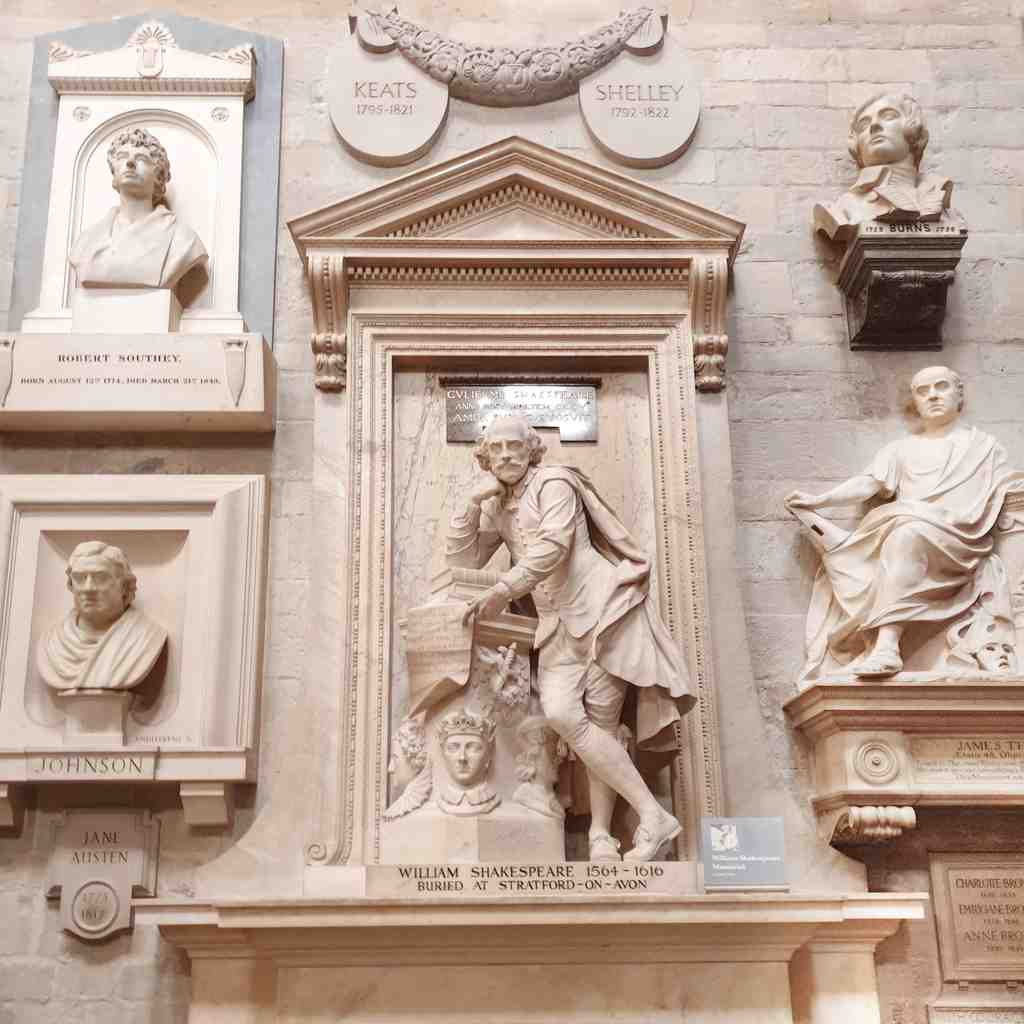
Right in front of you, you’ll see a stone wall filled with beautifully carved busts and monuments of famous poets-just look for the striking, life-sized sculpture of William Shakespeare, surrounded by other literary legends, to spot Poets’ Corner!
Welcome to the legendary Poets’ Corner, one of the most storied spots inside Westminster Abbey! Let’s imagine we’re opening an ancient book, each page rustling with stories of wit, glory, and, occasionally, a little scandal. The stone around you almost seems to whisper with voices from the past.
Back in 1400, the first resident of Poets’ Corner wasn’t buried here for being a famous writer-no, Geoffrey Chaucer, the father of English poetry, actually got his spot because he was Clerk of Works for the Palace of Westminster. Turns out, sometimes it’s not what you write, but who you know! It wasn’t until 1556 that Chaucer’s remains were moved and an impressive tomb was crafted by Nicholas Brigham, planting the seed for a tradition that would bloom across centuries.
Soon after, in 1599, Edmund Spenser-another poetic superstar-joined the literary neighborhood, and from there, burial or commemoration in this little nook became the highest honor for those who have shaped British culture with nothing but ink and imagination. But don’t think every famous writer found an easy welcome. Take Lord Byron, who wowed the world with his poetry and shocked it with his wild lifestyle. He died in 1824, yet his memorial didn’t appear until 1969-talk about making a grand entrance, fashionably late! Then there’s Shakespeare, the Bard himself: buried far away in Stratford-upon-Avon in 1616, but finally immortalized here with a monument over a century later in 1740. Sometimes, even the greatest must wait their turn!
But it was never just poets-some deans, canons, and even the legendary Thomas Parr (said to have lived to 152!) lie nearby, their stories tangled among the literary giants. Not everybody wanted the honor of a stone inscription, though. Samuel Butler’s epitaph, written by Samuel Wesley, pokes a little fun at the whole thing-proof that even death can have a sense of humor. Still, a few, like actress Kitty Clive, were denied a spot. One Dean of Westminster famously grumbled that if they let every dramatist in, the Abbey would become a “Gothic Green Room!” I suppose even literary fame can be a bit dramatic.
As you look around, you’ll see that memorials come in every shape and size: some are simple stone slabs on the floor, carved with a beloved name; others are grand, like Shakespeare’s statue, or elegant tablets and busts. There are even group tributes, like the joint memorial for the Brontë sisters-commissioned in 1939 but unveiled almost a decade later thanks to a certain world war.
Space is precious here, so when they began running out of floor and wall, it was time for a creative twist. Now, a stained glass window keeps the tradition alive, each pane holding a name-so far, only six have been inscribed, with room for more storytellers yet to come. In 2010, Elizabeth Gaskell took her place in the glass, ensuring that the corner keeps growing, quietly and beautifully.
And don’t overlook the memorial stone to the sixteen poets of the First World War. Unveiled on Armistice Day in 1985, etched with the haunting words of Wilfred Owen: “My subject is War, and the pity of War. The Poetry is in the pity.” It’s a powerful reminder that in every age, poetry gives voice to those who might be lost to time.
There are a few quirks, too-Ben Jonson, another legend, requested only an “eighteen inch square” for a grave, and so was buried upright elsewhere in the Abbey. His memorial still found its way here, though: “O Rare Ben Johnson,” it reads-not bad for a man standing up in his own grave! Sometimes, wall tablets have even been moved just to discover hidden medieval paintings beneath.
As you stand among these stone legends, imagine the gatherings: authors debating over tea, actors reciting verses, the very air buzzing with inspiration and mischief. Here, you don’t just see history-you feel it all around you, a living web of stories in stone. And remember, every time a new name is added, the Abbey throws a little ceremony with readings and laughter-because stories, after all, are meant to be shared.
If you listen closely, maybe you’ll catch a bit of poetic magic lingering on the air. Now, don’t get stage fright-onward to our next stop!
Exploring the realm of the memorial types, burials or the royal ballet? Feel free to consult the chat section for additional information.




