
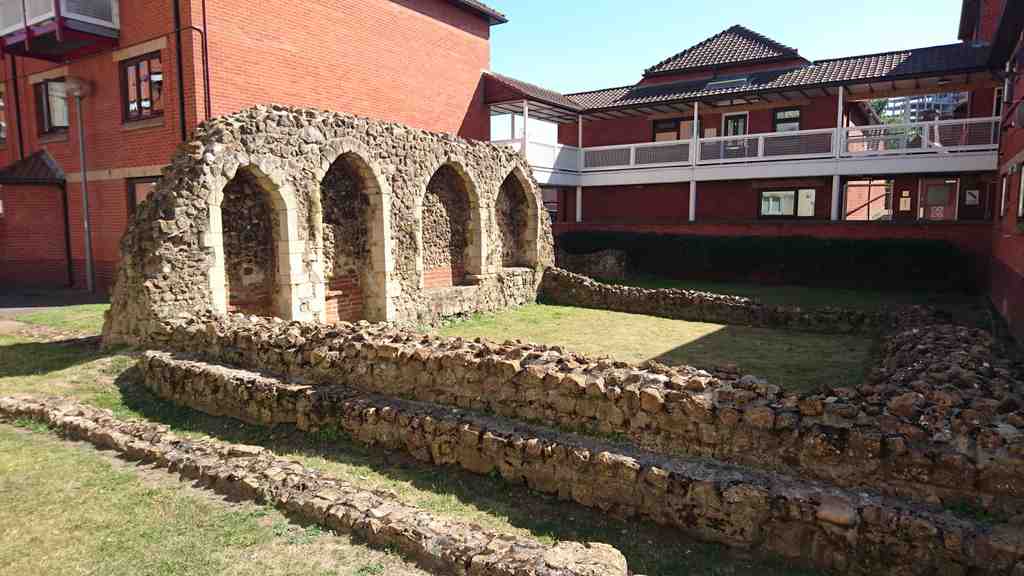
On your left, look for a low, rough flint-and-stone ruin with three pale arched openings, sitting in a neat patch of grass and framed by modern red-brick buildings.
This is Ipswich Blackfriars… or, more accurately, what time, politics, and redevelopment have decided to leave us. Back in 1263, this wasn’t a quiet little lawn with a picturesque wall. It was a full Dominican friary-Friars Preachers-founded by King Henry the Third. Yes, the king himself. He bought land here and basically handed over the keys, telling an official to come down and make it official, medieval-style. The Dominicans weren’t monks tucked away in the countryside. They were town people: preaching, teaching, begging their daily support from locals… and staying right in the middle of the action.
And Ipswich had options. The Franciscans-Greyfriars-were already established, and the Carmelites-Whitefriars-arrived later. The Blackfriars were the middle sibling: serious, learned, and under the supervision of Cambridge, which feels very on-brand.
Now, the big church that once stood here-dedicated to Saint Mary-vanished within about a century after Henry the Eighth’s Dissolution. Nothing like a national policy to ruin your building maintenance schedule. But the rest of the complex hung on for a long time, long enough that in 1748 an artist named Joshua Kirby drew plans and views of the site. Problem was… he misread what he was seeing. Later scholars realized the “church” Kirby pointed to was actually the friars’ dining hall, the refectory-where meals came with scripture readings, delivered from a raised lectern like a medieval dinner podcast.
In the 1970s and 1980s, archaeologists finally sorted things out properly. They found the footprint of the lost church: a substantial aisled building, about 135 feet long. That’s roughly 41 meters-big enough that you’d feel it in your stomach when the singing started. The friary sat hard up against Ipswich’s town defenses-the rampart and ditch line ran close by-so the friars’ land deals came with conditions. Town leaders granted plots, but the friars had to keep access open so citizens could maintain the defenses and reach the gates if things got ugly. Even holy men had to share the sidewalk.
Look again at that surviving wall fragment with the blocked arches. That’s part of the sacristy range-the working backstage of the church-later used as classrooms for Ipswich School until 1842. Imagine schoolkids crammed into an ex-dormitory under a fancy hammerbeam roof that may not even have been original. Recycling isn’t new; it just used to come with more Latin.
And the people here? Not just robed friars. Excavations uncovered around 250 burials. One skeleton is especially haunting: a man whose right hand had been chopped off-yet the bone showed healing, meaning he lived afterwards. The injury looks like violence, not surgery. It matches a recorded attack in 1327 on a local man named Richard de Holebrok, tied to a tree by a mob and mutilated. For a place dedicated to preaching peace, the cemetery holds proof that medieval life could be brutally personal.
By the 1500s, the friary was poor. So poor that, even before the official shutdown, the friars were leasing out gardens, houses, and buildings-basically renting the place room-by-room to stay afloat. When the royal visitor came through in 1538, the end arrived quickly. The property eventually passed to William Sabyn, a serious operator: sea-captain, customs controller, and local bigwig. The spiritual era ended, the real estate era began… and here we are, reading the remaining stones like subtitles.
When you’re ready, Martin & Newby is a 1-minute walk heading southeast.




