
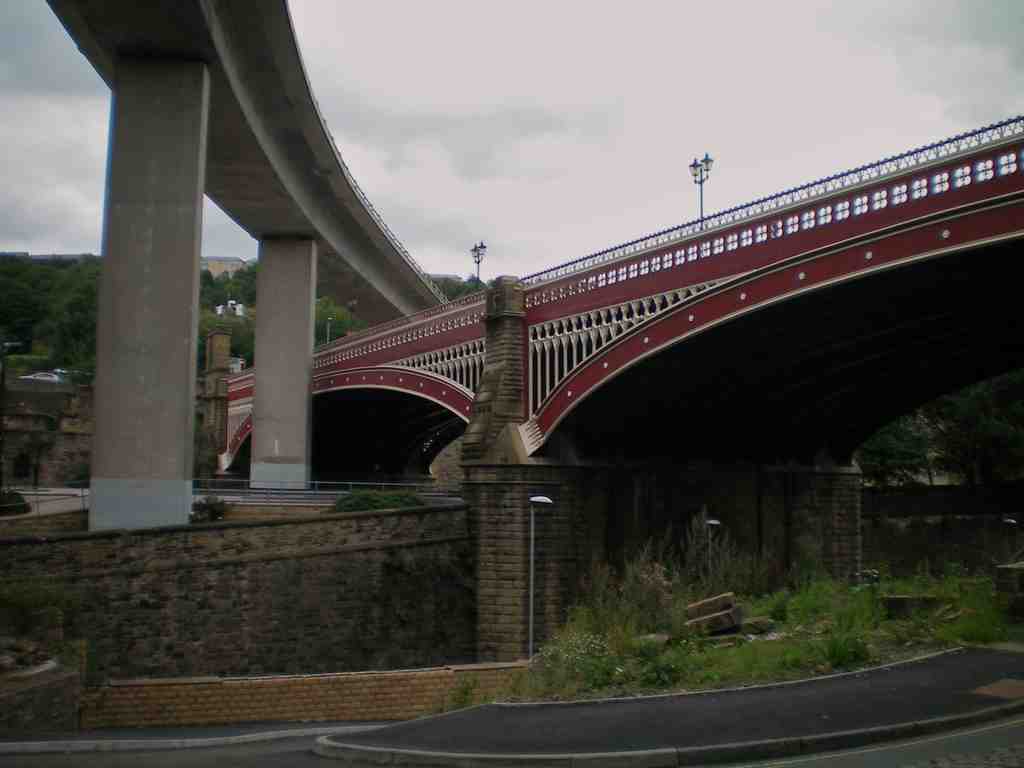
On your left is a broad iron-and-stone bridge with two sweeping arches, Gothic-style railings, and a little turret that holds a drinking fountain.
North Bridge is Halifax showing off. It strides across the Hebble valley in Victorian Gothic style, a nineteenth-century taste for church-like drama, with buttresses, pointed lancet openings, and parapets pierced with quatrefoils, those four-lobed shapes you see in medieval design, plus tiny Maltese crosses worked into the pattern. If you check the image on your screen, you can really catch those details in the bridge skin itself.
But this crossing has a long, rough family history. A wooden bridge stood here by the year twelve seventy-seven. Then a stone one took over, and in seventeen seventy, during Rogation Day, when people walked the parish boundary in a ceremony called beating the bounds, that bridge collapsed and injured many in the crowd. Halifax did not give up. Matthew Oates of Northowram started a replacement in seventeen seventy-two, using stone from Crib Lane quarries. His bridge stretched four hundred feet in six arches and carried the main toll road, complete with a toll booth. After a fatal incident there in eighteen nineteen, workers added iron palisades for safety. Even that bridge suffered, with flash flooding knocking part of it down in eighteen fifty-five.
Then came the version beside you. Brothers John and James Fraser of Leeds designed it, and John knew railway bridges inside out. They lifted this bridge eleven feet higher than the old one so the Halifax and Ovenden Joint Railway could run beneath the northern end, with North Bridge Station stretching under it. That is such a classic Victorian move... solve traffic, rail travel, and civic pride all at once.
The opening on the twenty-fifth of October, eighteen seventy-one turned gloriously chaotic. The town got a half-day holiday, crowds flooded the bridge before the mayor arrived, police tried to clear space, yeomanry rode in, twenty dragoons blocked the entrance, and after speeches from local grandees and visiting mayors, the ceremony ended with an artillery salute. Halifax did not do quiet ribbon-cuttings.
If you want the bigger picture, look at the app image showing North Bridge beside Burdock Way. That modern flyover took the heaviest traffic in nineteen seventy-three, letting this older bridge settle into local service. Before that, trams rattled across here too, and in nineteen oh-six one runaway double-decker overturned on the bridge, killing two people and injuring eleven.
This bridge is not just a crossing; it is Halifax engineering, ambition, and nerve in one grand span.
Take a final look at those Gothic details, and when you're ready, we can head on to Phoenix Radio.




