
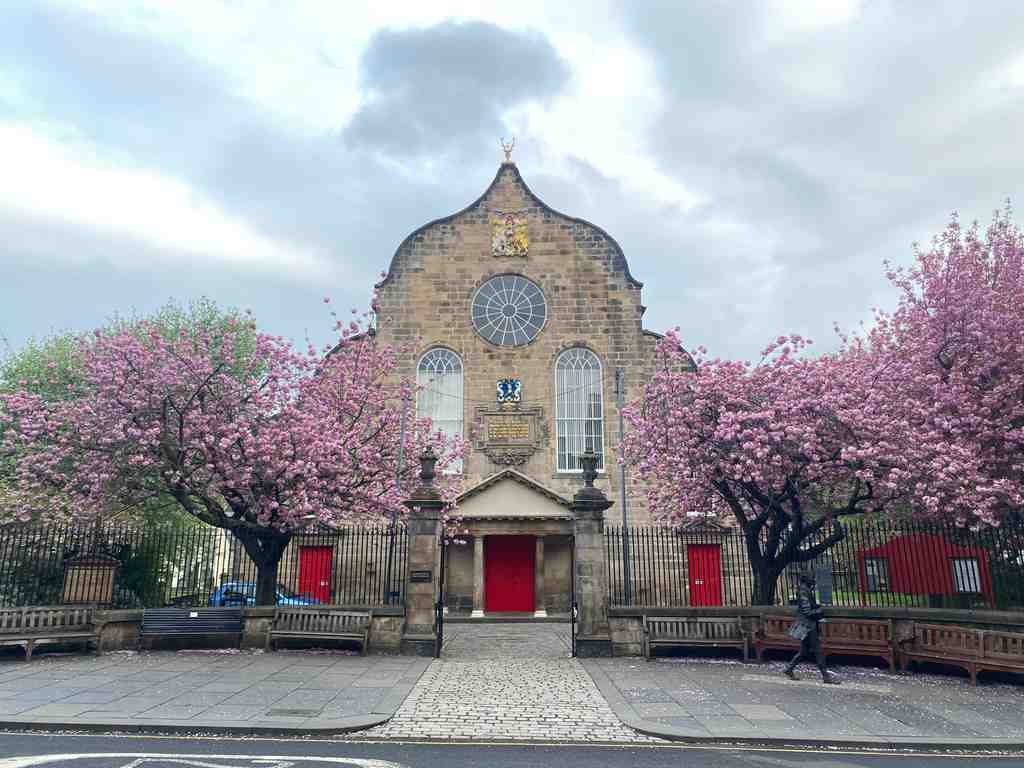
Take a look straight ahead and spot the Canongate Kirk by its big circular window, Dutch-style end gable, little portico held by columns, and a golden cross perched between antlers at the very top-flanked on both sides by blooming pink cherry trees.
Welcome, traveler, to the Canongate Kirk, a place where royalty, rebels, poets, and philosophers have crossed paths for centuries. Imagine it’s a blustery morning in the late 1600s-dust swirling as stone masons chip away, and hopeful parishioners watching from the street, dreaming of their new church.
The story begins with a bit of royal drama-back then, the congregation worshipped at nearby Holyrood Abbey, until the King decided he needed it for a Chapel Royal instead. So the locals were shuffled off and told to use Lady Yester’s Church temporarily, while a new grand kirk rose right here on the Canongate. To pay for the build, money was cleverly diverted from an old bequest-originally meant to fund bells or a minister’s house-but, after lots of petitions and polite arm-twisting of the council and king, Thomas Moodie’s fortune finally built this very kirk. If you look closely, you’ll see his coat of arms above the front door, a little stone thank-you from the past.
By 1691, when the doors first opened, the air was thick with excitement: a new home for worship, with beams still smelling of fresh-cut wood and sunlight streaming through big arched windows. A curious building from the start, with its Dutch gable and a golden cross tucked between antlers-echoing the old Canongate coat of arms, and, legend has it, topped off in 1949 with real antlers from a stag shot by King George VI!
As you’re standing here, try to picture the 18th century, when George Whitfield, the fiery preacher, was rattling the pews, and in 1745, the church echoed not just with hymns, but with the impatient shouts of Jacobite soldiers-yes, the army of "Bonnie Prince Charlie" camped right outside, and the Kirk itself held prisoners from the Battle of Prestonpans! Later on, overcrowding brought about new chapels, and the growing parish even got input from local tradesmen, who earned the rare privilege of picking the minister themselves.
By the 19th century, however, the Canongate began to fade in prestige as the city’s wealthy residents moved out and new roads bypassed the once-bustling thoroughfare. The kirk wasn’t immune-its royal connections weakened, and the congregation shrank. One minister described walking these streets as seeing “the unveiled and unmitigated vileness” of a city beset by poverty. It wasn’t all doom and gloom: a wave of religious revival swept through, swelling the pews once again. The 1860s saw a brand-new pipe organ, one of Scotland’s first, and for a time, the kirk was alive with music and hymn-singing where once there’d just been Psalms and silence.
Through two world wars, the Kirk stood strong-losing ninety parishioners in the First, forty in the Second, but never losing hope. In 1937, King George VI kindly sent over a Christmas tree from Balmoral-a tradition happily continued by the royal family to this day.
If these walls could talk, they’d tell you about Queen Elizabeth herself in the front row, about Zara Phillips’ royal wedding in 2011, and about funerals for national icons like the brilliant economist Adam Smith and the poet Robert Fergusson, whose statue gazes toward you from the gate. They’d recall the "Radio Padre," Dr. Ronald Selby Wright, who broadcast hope to the nation during war, and the everyday stories of families, students, and soldiers who sat on the benches you see around you.
Step a little closer and soak in the details: the noble royal and castle pews up front, reminders of the Kirk’s links to both palace and fortress; the gleaming Frobenius organ, its pipes singing out in concerts, weddings, and services every Sunday. The Kirk isn’t just a historic monument-it’s still a living, breathing community.
The Canongate Kirk has survived centuries of upheaval, kings both welcome and not, and more than a few brushes with disaster-yet it endures, a home of faith, music, and memory right in the heart of Edinburgh’s Old Town.
Next time you pass its cherry trees in bloom, think of the thousands of footsteps and the swirl of royal and everyday drama that have filled this courtyard across the ages. Now, onward to our next stop!
Yearning to grasp further insights on the building and kirkyard, current work or the ministry? Dive into the chat section below and ask away.




