
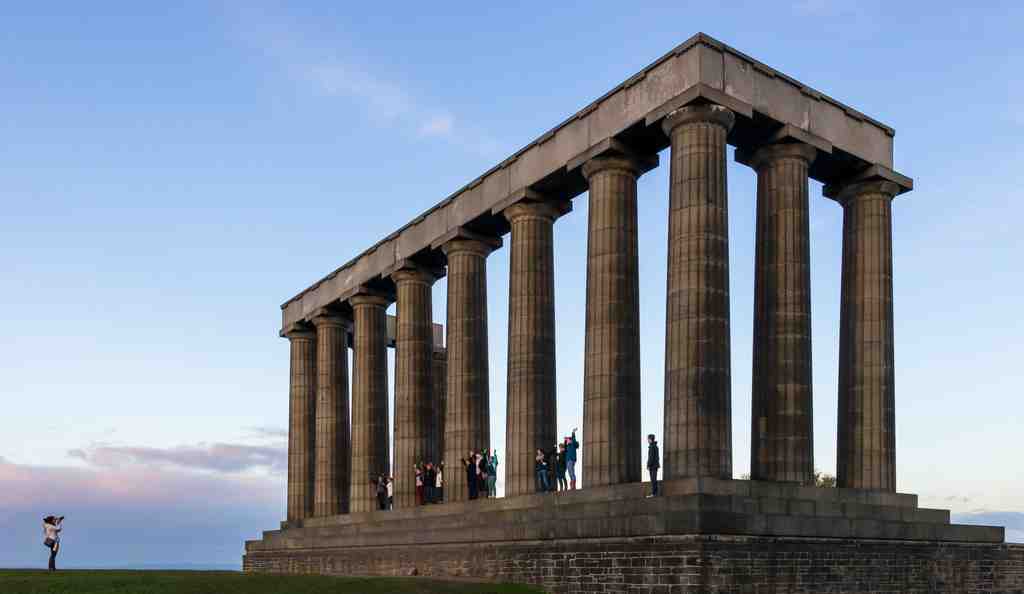
Right ahead of you, you’ll see a dramatic row of massive stone columns - just look up Calton Hill and you can’t miss it!
Now take in the scene: you’re standing before the National Monument of Scotland, a stone giant born from ambition and halted by misfortune, perched right on top of Calton Hill. The monument was meant to rival the glory of Athens, and - if you squint just right - you might imagine you’re standing amidst the ruins of the Parthenon itself, though a chilly Scottish breeze brings you right back home.
Let’s rewind the clock to the early 1800s. Picture the air shimmering with excitement and the sound of Edinburgh’s citizens bustling below. The Napoleonic Wars had left scars across Europe, and Scotland wanted to honor its bravest soldiers and sailors with something unforgettable. The original idea? A mighty “Scottish Valhalla,” where legends would rest in catacombs below a temple for the ages. But why here, you might ask, and not, say, the more convenient Mound? Well, Calton Hill was chosen for its majestic view over Edinburgh… and because every city deserves a spot for dramatic sunsets and equally dramatic monuments.
Support came from the great and the good - even Sir Walter Scott lent his fame to the cause. The chosen design, by Cockerell and Playfair, was boldly ambitious: recreate the Parthenon, but with a Scottish twist. And so, in August 1822, with King George IV himself in the city, a grand procession thundered up from Parliament Square. The Duke of Hamilton led a sea of dignitaries and masonic lodges, escorted by glittering horsemen. Listen closely - - as the foundation stone, heavier than six cars stacked together, was laid in a flurry of speeches, flags, and the echo of cannon fire from all corners of Edinburgh.
Now, if this was a fairy tale, our monument would rise swiftly, covered in dazzling sculptures and filled with heroic legends. But life - and Scottish weather - had other plans. Only sixteen months into fundraising, the dream needed £42,000, but less than half turned up. Parliament’s promise of a little more cash floated in, work sputtered to life in 1826, and yet, after just three years, the money and enthusiasm ran dry. All we got were these very columns, standing tall but unfinished, like a proud Scotsman in an untied kilt-majestic, but open to interpretation.
The people of Edinburgh love a bit of banter, so the monument quickly picked up some delightful nicknames. “Scotland’s Folly,” “Edinburgh’s Disgrace,” and my personal favorite, “the Pride and Poverty of Scotland.” Yet, there’s affection hidden in the teasing - after all, it still stands as a reminder of lofty dreams. Over the years, ideas to finish the monument swirled through the city like leaves in a Highland wind. Maybe it’d become a palace for Queen Victoria, or a temple to the Act of Union, or even a brand-new Scottish Parliament! But just like a haggis recipe in Paris, these plans never quite took hold.
Did you know they even planned for vast catacombs beneath you, a resting place for Scotland’s greatest? Or that in 2008, one of the giant stone lintels needed professional nudging back into place - costing over £100,000? This monument may not be finished, but it’s always cared for. Today, it’s a Category A listed building, protected as a piece of Scotland’s soul.
Now, as you stand here, wind perhaps tugging your coat and the sky stretching out over the city, let yourself imagine processions, plans, and laughter echoing off the stones. It might not be complete, but in Edinburgh, even our ruins come with grand stories and an extra helping of character. Go on, give one of those columns a gentle pat-just don’t expect Zeus to answer!


